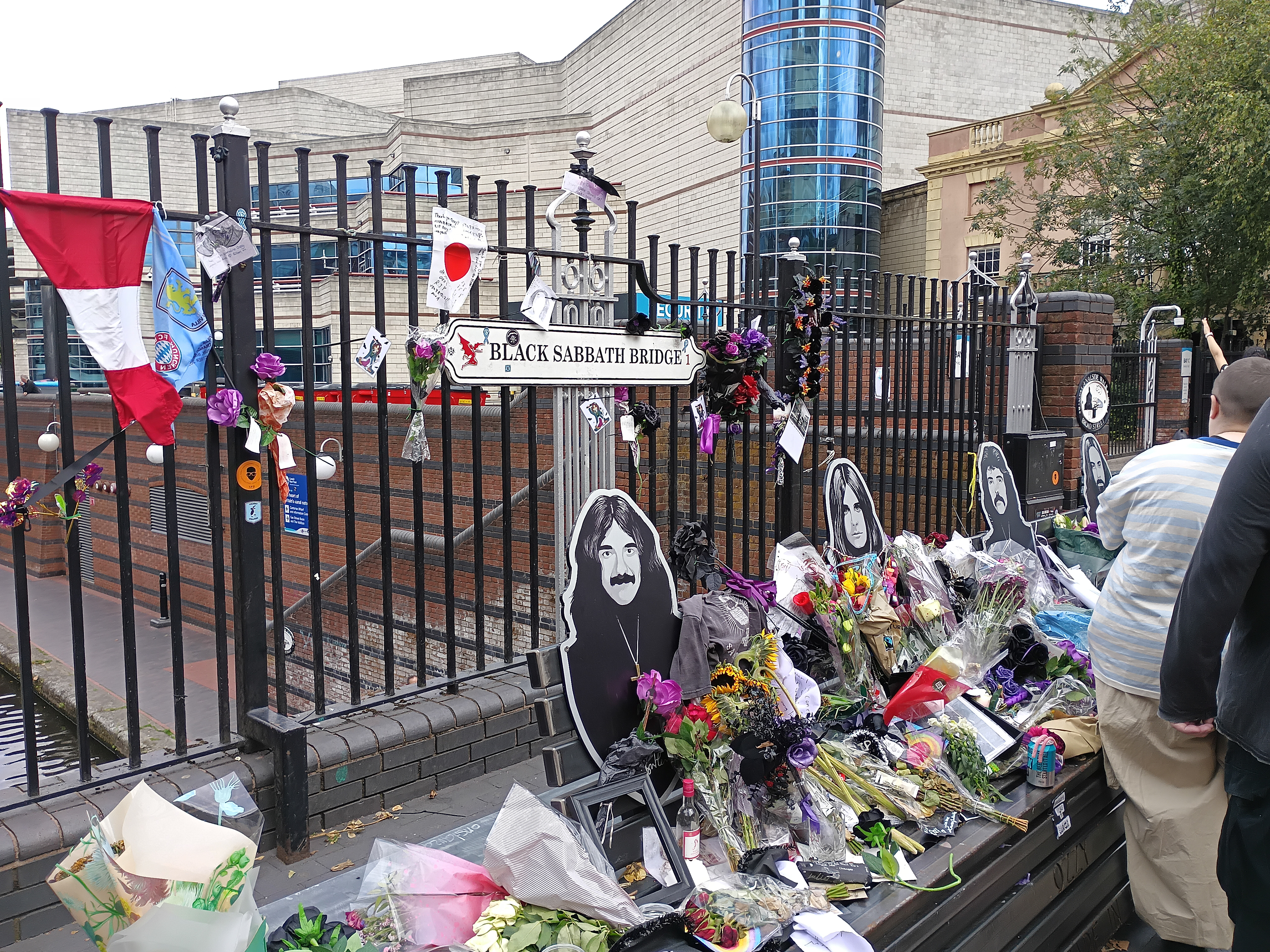
Foto: Fatih Renkligil — CC BY-SA 4.0, via Wikimedia Commons
Why Tony Iommi Turned Down Andrew Watt's Offer of a Final Black Sabbath Album
The producer who ran Ozzy Osbourne’s last two solo records asked for one more Black Sabbath album with the original four. Tony Iommi said no, and in a new Classic Rock interview he explained why.
The ask, and the answer
In a new interview with Classic Rock, picked up by Blabbermouth and Stereogum, Tony Iommi told a story most of us had never heard. A few years ago, when Ozzy Osbourne started working with Andrew Watt, Watt came to Iommi with a proposal: one last Black Sabbath album, the four original members, done properly.
Iommi turned it down.
His words, per Blabbermouth: “I’d met Andrew Watt when he was producing Ozzy. He was very keen and a bit too excited.”
On its own that sounds like a put-down. The rest of the interview shows it was something else, and it helps to start with who was doing the asking.
Watt was not a stranger knocking on the door
Andrew Watt produced Ordinary Man (2020) and Patient Number 9 (2022), the two records that closed Ozzy’s solo career, and he worked closely with the people around Ozzy. On Patient Number 9, released in September 2022 on Epic, Iommi himself plays on two tracks: “Degradation Rules”, which came out as the second single in July 2022, and “No Escape From Now” (Wikipedia, Rock Cellar).
That record went on to pick up four nominations at the 65th Grammys and won two: Best Rock Album and Best Metal Performance, the latter for “Degradation Rules” (BionicBuzz). Count it up and that is the third Grammy Ozzy and Iommi have won together. The other two came under the Black Sabbath name.
A producer in his thirties got Ozzy back in the studio after years of health problems, made two records people rate, and got the Black Sabbath guitarist in the room with the Black Sabbath singer for the first time since 13, on a song that won a Grammy. Then he asked the obvious next question. Why not the whole band?
If anyone had earned the right to ask, it was Watt, and he still got a no.
“Too excited” is really about Bill Ward
The second half of Iommi’s answer explains the first. Again from Blabbermouth: “He also didn’t know what it was like working with the original Sabbath, working with Bill.”
Bill Ward is the drummer on every Black Sabbath record that matters to the myth, and he is also the member whose relationship with the band has been the hardest to keep on the rails. The last studio album, 13 in 2013, was made without him. He sat it out over what he called an unsignable contract, and Brad Wilk of Rage Against the Machine played drums in the studio instead, with Rick Rubin producing (Stereogum).
Iommi is blunt about what it took to get Ward back on a stage for the farewell. Same interview, quoted by Stereogum: “We needed to rehearse with Bill, because it had been 20 years and he couldn’t remember how to play some of his stuff.”
Put those two quotes next to each other and Watt’s enthusiasm starts to look like the problem Iommi says it was. A producer used to modern sessions, working fast with a singer he had already figured out, walks into a room with a drummer who has not played these songs in two decades and a band whose internal weather has been unpredictable since the 1970s. “Too excited” is a polite way of saying: you have no idea how slow and heavy this would be, and I do.
Iommi has lived through every version of the original four trying to work together and knows what it costs, while Watt had only seen the Ozzy half of the equation.
13 was already the ending
Then there is the part of the answer that has nothing to do with Watt at all.
“Also, we’d done ‘13’, and I didn’t like the idea of: ‘Now here’s another album.’”
That sentence tells you how Iommi thinks about the discography. 13 was framed as the last word when it came out, and Iommi treated it that way. Coming back with another record a decade later would have turned “the final album” into a marketing phrase, one you can reuse whenever a good producer shows up with a good idea. He did not want the band’s last studio statement to be the second-to-last.
The timing changes the weight of the whole thing. Iommi says the conversation happened a few years ago, when Ozzy first started working with Watt, and Stereogum places it there too. That means the no came before Back to the Beginning, the July 5, 2025 show at Villa Park in Birmingham that turned out to be the last time the original four played together, and before Ozzy died on July 22, 2025, at 76 (Blabbermouth).
Iommi was declining a real album with a living, working Ozzy, at a moment when the two of them were clearly still capable of making something together, and not a tribute record. “Degradation Rules” is the proof. He said no anyway, because in his head the story already had its ending.
With Ozzy gone, that decision reads differently than it did when he made it. 13 stays the last Black Sabbath studio album, and Villa Park stays the last show. Nothing got tacked on. Whether that was the right call is a matter of taste. My take, for what it is worth: the guy who wrote most of those riffs gets to decide when the record collection is complete, and he decided.
The thread to pull
There is a strange symmetry in who got to make the late Ozzy records and who got to make the late Black Sabbath one. Rick Rubin, the producer with the reputation for stripping bands back to their first instincts, got 13. Andrew Watt, the producer with the reputation for energy and pace, got the two Ozzy solo albums and a pair of Sabbath guest spots. Each producer got one half of the Ozzy and Iommi partnership, and neither got both halves at once with all four members in the room.
Watt never got his Black Sabbath record. He did get Iommi and Ozzy on tape together on a Grammy-winning song, which is more than most producers alive can say. And as far as anyone can find, he has not commented on the refusal publicly.
What I keep turning over is Bill Ward’s place in both stories. He was the reason 13 happened without him, and he is half the reason a Watt-produced follow-up never happened at all. Twenty years away from the songs, by Iommi’s own count. That sends me back to the question of what Ward played on between 2005 and the Villa Park rehearsals, and whether any of it has been written up properly.
If you know, I want to hear it. Find us at @realrocklab on X or Threads.
Sources: Classic Rock (original interview), via Blabbermouth and Stereogum; Wikipedia, Patient Number 9; Rock Cellar; BionicBuzz; Blabbermouth, Patient Number 9 documentary.
In this web: Black Sabbath · Tony Iommi · Ozzy Osbourne · Andrew Watt · Bill Ward