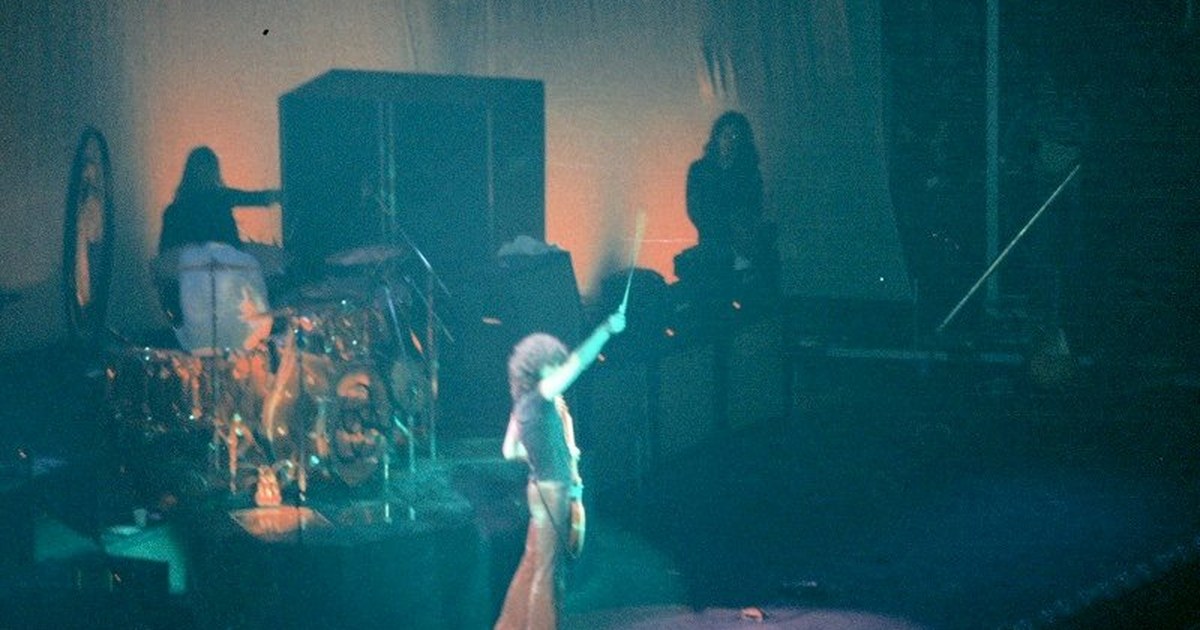
Jimmy Page raising the violin bow with Led Zeppelin, Chicago Stadium, 1975 — photo: Tony Morelli, CC BY-SA 2.0, via Wikimedia Commons (cropped, upscaled)
The Violin Bow on a Guitar: The 60-Year Lineage From Eddie Phillips to Metalcore
A cello bow dragged across guitar strings sounds like a ghost every time it resurfaces, and it keeps resurfacing. This is the chain of custody, from a 1966 mod-rock single to a metalcore stage in 2026.
There’s a clip going around right now: a guy pulls a violin bow across an electric guitar and the comments lose their minds like the technique was invented last Tuesday. (The clip is by Artem Komlev, an independent creator, and credit where it’s due, it’s a great 30 seconds.) The bowed guitar has a habit, though: every generation discovers it, thinks it’s new, and makes it sound like a completely different instrument.
That’s a lineage, and it can be mapped.
1966: Eddie Phillips gets there first, and almost nobody noticed
Ask most rock fans who first bowed a guitar and they’ll say Jimmy Page. Wrong, and Page himself has had to live with the correction. The first bowed guitar on record belongs to Eddie Phillips of The Creation, on “Making Time,” produced by Shel Talmy and released in June 1966, a fact Guitar World and Guitar Player have both dug into. Phillips has said he’d been doing it for years by the time he recorded it.
“Making Time” turns 60 this year. It’s a snarling mod-rock single with this alien scraping texture buried in it, and it should be a monument. Instead, The Creation became one of those bands other musicians namecheck, the connective tissue nobody outside the lab looks at.
1967: Jimmy Page, a session violinist, and a borrowed song
So where does Jimmy Page fit? He picked up the idea while doing session work. The suggestion reportedly came from David McCallum Sr., a session violinist he worked alongside (Guitar World traces this). Page brought the bow into the Yardbirds in 1966–67, and then it collided with a song.
On August 25, 1967, a folk singer named Jake Holmes opened for the Yardbirds at the Village Theater in New York and played a brooding thing called “Dazed and Confused.” The Yardbirds absorbed it, Page carried it into Led Zeppelin, and the credit today reads “Page, inspired by Jake Holmes,” settled after decades of dispute (Wikipedia has the whole saga). When Led Zeppelin I landed on January 12, 1969, “Dazed and Confused” featured the bow as its centerpiece, that shrieking, siren-like midsection, and Page used it on “How Many More Times” too (Wikipedia: Bowed guitar).
Notice what happened between 1966 and 1969: same tool, different job. Phillips used the bow as texture inside a pop single. Page used it as theater: a live ritual, wand-waving under stage lights, the bow as spectacle. The technique got reinterpreted on its way down.
1999: a gift for the wrong guy builds an entire band
Now jump three decades and one ocean north. The Sigur Rós origin story here is almost too good: bassist Georg Hólm, a Led Zeppelin fan, was given a cello bow by the band’s drummer, Ágúst Ævar Gunnarsson. He tried it on his bass, and it barely worked; a cello bow doesn’t get thick bass strings moving properly (Paste). So the bow migrated across the room to Jónsi, who put it on his guitar and effectively never took it off.
On Ágætis byrjun (1999), the bowed guitar is the primary voice of the band. That glacial, vocal, endless-sustain sound that made Sigur Rós sound like weather instead of a rock group comes from a cello bow, a guitar, and a wall of reverb. Third generation, third total reinvention: Phillips made texture, Page made theater, Jónsi made an entire sonic identity.
And the Zeppelin fandom in the origin story matters. The bow arrived in Iceland because the previous node in the chain had made it iconic. That’s how influence travels: a fan holds the artifact and asks “what else can this do?”
2026: the bow walks onto a metalcore stage
Which brings us to now. The viral short that kicked this piece off isn’t I Prevail; again, that’s Artem Komlev, a creator, and there’s no evidence I Prevail themselves use a bow. The lineage closes anyway, and it closes on their stage.
I Prevail just took Imminence across Australian arenas: the Violent Nature Tour played Australia in June 2026 (Blunt, with a Brisbane Riverstage review at No Barriers). And Imminence’s frontman Eddie Berg is both vocalist and violinist; he’s called the band’s sound “violincore” (Wall of Sound interview). Bowed strings, distorted guitars, breakdowns: the fourth generation stopped bowing the guitar and brought the actual violin into the pit.
The bow never really left heavy music in between, either. Tim McTague of Underoath, Claudio Sanchez of Coheed and Cambria, Jonny Greenwood, Mike McCready, all documented bowed-guitar users (Wikipedia: Bowed guitar). The technique kept a pulse for 60 years; it just kept changing what it meant.
The diagram
Eddie Phillips (The Creation, “Making Time,” 1966) → texture in a single → Jimmy Page (Yardbirds → Led Zeppelin, “Dazed and Confused,” 1967–69) → theater and ritual → Jónsi (Sigur Rós, Ágætis byrjun, 1999) → a whole band’s voice → Eddie Berg (Imminence, on tour with I Prevail, 2026) → the violin itself, weaponized for metalcore.
Four generations of the same physical gesture, horsehair on steel string, and four completely different sounds with four completely different meanings. That’s the thesis of this whole channel in one object: a technique is a question, and every era answers it differently.
The thread to pull next
What’s nagging me now is that the bow traveled from Phillips to Page via a session violinist, David McCallum Sr., a hired hand in a London studio who leaned over and said “try this.” How many other signature rock sounds started as a suggestion from an uncredited session player in the room? The half-time shuffle, the fuzz pedal, the twelve-string jangle: there’s a whole shadow history of studio lifers whispering ideas into the canon.
That’s the next dig. If you’ve got a candidate, a famous sound with a session-musician origin story, tell us at @realrocklab on X or Threads.
And if you’re near Edinburgh or Berlin between August 31 and September 21, Sigur Rós is closing out their world tour with 41-piece local orchestras (sigurros.com/tour). Go hear what a cello bow built.
In this web: The Creation · Led Zeppelin · Sigur Rós · I Prevail · Imminence · Eddie Phillips · Jimmy Page · Jónsi · Eddie Berg