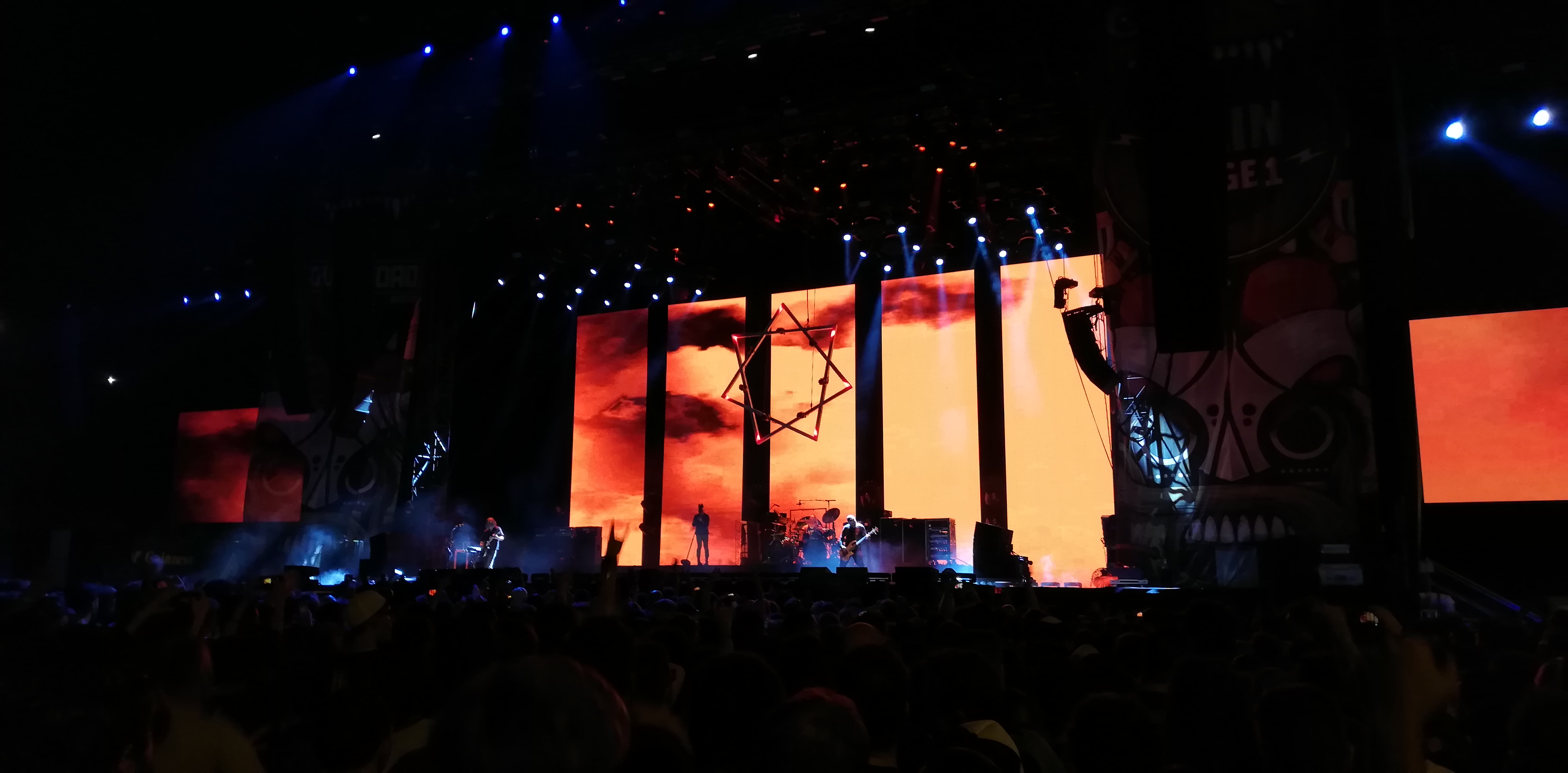
Foto: Aniol — CC BY-SA 4.0, via Wikimedia Commons
Use Your Illusion and Ænima: September 17, Five Years Apart, and What Rock Did in Between
On September 17, 1991, Guns N’ Roses released two albums at midnight and sold about 1.45 million copies in a week. On September 17, 1996, Tool released one album with a painting on the cover and a comedian at the center of the title track. It is the same date on the calendar, and the gap between them is the story of 1990s rock.
Midnight, September 17, 1991
Guns N’ Roses released two albums that Tuesday. Use Your Illusion I and Use Your Illusion II went on sale at midnight, on Geffen, and record shops stayed open to sell them. Thirty songs across the pair. Illusion I alone runs 16 tracks and 76 minutes and 9 seconds, which is roughly as much music as a CD could physically hold at the time.
The first week is still hard to believe. Illusion II entered the Billboard 200 at number one with 770,000 copies. Illusion I entered at number two with 685,000. No artist had ever held both top spots in the same week, and nobody had owned the top two at all since Jim Croce in 1974. Add the two numbers and you get about 1.45 million albums in seven days.
The songs were big too. “November Rain” runs 8 minutes and 57 seconds. “Coma” goes past ten. This was a band that had made its name on one lean debut, and now it wanted every song to be a monument. It worked. Both records went on to 7× Platinum in the US, and by 2010 Illusion I had passed 5.5 million copies on SoundScan.
This was arena rock at its absolute maximum: two discs, a midnight launch, and songs that ran longer than most bands’ entire singles careers. And the whole idea of what a rock band was for was about to get rewritten anyway.
What happened in between
The year Guns N’ Roses shipped the biggest release of their lives was also the year Nirvana turned MTV inside out, and nobody at Geffen had planned for that. Within a few seasons the big hair and the big-budget video went out of fashion faster than any label could have budgeted for. The arena ballad as an event, the thing “November Rain” did better than anyone, went from the center of rock to its embarrassing uncle.
Metal did something stranger. It went underground and got weird, and the bands that came out the other side cared less about the band photo and the single and more about the whole record, played as one piece in the dark. Five years is a short time for a genre to change its mind that completely, and one band is the cleanest example of where it landed.
September 17, 1996
Tool put out Ænima on September 17, 1996, through Zoo Entertainment and Volcano. (Sources disagree about which format came first; the CD and vinyl dates sit a couple of weeks apart, but September 17 is the date the record entered the world.) One album this time. 15 tracks, 77 minutes and 18 seconds.
Now hold that next to Use Your Illusion I and you get a strange symmetry: one Tool record is almost exactly as long as one Guns N’ Roses record, and Guns N’ Roses released two of them on the same day. Same running time, half the songs. Tool used the space differently. Nothing on Ænima is a radio ballad, and the record works as one piece heard front to back.
Compare the covers. Every Guns N’ Roses fan knows what Axl Rose looks like. Ænima has a painting on the front, “Smoke Box” by Cam de Leon, and on the North American pressings the case was lenticular, so the image shifted when you tilted it. There is no band on the cover, although the lenticular insert carries photographs of the members, so the band was in the packaging, just off the front.
First-week sales: 148,000 copies, good for number two on the Billboard 200. Against the 1.45 million of five years earlier that looks small, until you remember what it was buying: a number two debut for a band with no ballad on it and a title track built around a comedian’s routine. The record went on to 3× Platinum, certified in 2003.
The title track and Bill Hicks
“Ænema” takes its central image from a stand-up bit by Bill Hicks: the San Andreas fault gives way, California slides into the Pacific, and Arizona gets beachfront property. Tool turned that joke into the closing argument of the album, a song that wishes the whole of Los Angeles into the sea. Five years earlier the biggest rock band on Earth had come out of Los Angeles. Now the record of the moment ended by wishing the city underwater.
“Ænema” won the Grammy for Best Metal Performance in 1998. So the same industry that handed Guns N’ Roses the top two chart positions in 1991 gave its metal prize, seven years later, to a song about the apocalypse hitting the industry’s own hometown.
The producer in the room
Ænima was produced by Tool together with David Bottrill. Listen to the drums on this record. They sound close and dry, like the kit is in the room with you, and the bass sits right on top of it. Now play “November Rain” and listen to how much air there is around everything: the piano, the long fade, the space between the instruments. Two records, roughly the same length, and one of them sounds like a cathedral while the other sounds like a basement with the lights off. That difference is a production decision before it is anything else, and Bottrill’s name is the one on the sleeve.
Two anniversaries, one calendar day
In 2026 both dates come up round: 35 years for Use Your Illusion, 30 for Ænima. Guns N’ Roses marked the 30th of theirs with a 2022 box set, remasters plus live shows. Albumism ran a 30th-anniversary feature on Ænima this month, and the fact that a record with no faces on it still gets a birthday piece three decades on tells you which of the two bets aged better.
Neither record is wrong. Use Your Illusion is the last time a rock band could be that big and that excessive and have the numbers back it up. Ænima is the first time it was obvious that the numbers were no longer the point. The calendar just happened to line them up.
The thread to pull
A platinum metal album with a comedian’s routine as the spine of its title track is a rare object. Bill Hicks is a node here, sitting between stand-up and heavy music, and I do not know how many other records connect to him that directly.
Is there another rock or metal record where a stand-up comedian’s material is the core of a song, the actual argument of the track and more than a sample or a skit? I keep coming up empty. Tell me at @realrocklab on Threads or X.
Sources
In this web: Guns N Roses · Tool · Bill Hicks · David Bottrill