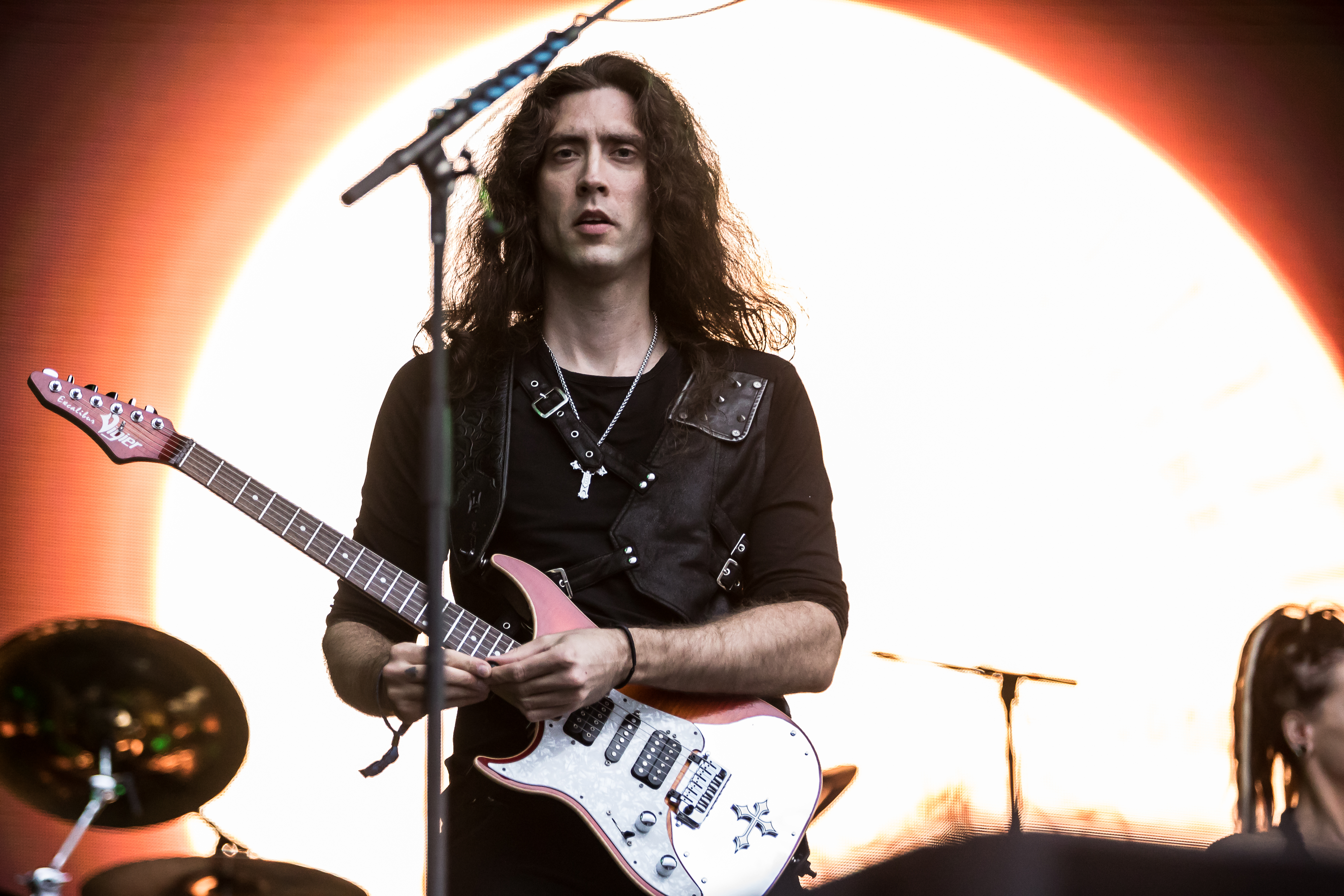
Foto: Πυρ Αεναον — CC BY-SA 4.0, via Wikimedia Commons
Two Blank Credit Lines: Why Bruce Dickinson Wrote Nothing on Somewhere in Time
Iron Maiden’s sixth album turned 40 on 29 September 2026. The singer’s name appears on none of its eight songs, and the reason has nothing to do with the reason his name was missing four years earlier.
The album with a hole where the singer should be
Open the sleeve of Somewhere in Time and count the writing credits. Steve Harris takes four: “Caught Somewhere in Time”, “Heaven Can Wait”, “The Loneliness of the Long Distance Runner” and “Alexander the Great”. Adrian Smith takes three, including the one everybody knows. Dave Murray and Harris share “Deja-Vu”. Bruce Dickinson takes none. That is the whole album: eight songs, and the man singing every word on it wrote none of them.
The record came out on 29 September 1986 through EMI in the UK and Capitol in the US, recorded between January and June that year at Compass Point in Nassau and Wisseloord in Hilversum, with Martin Birch producing. It went to number 3 in the UK, number 11 on the Billboard 200, number 1 in Finland, and eventually RIAA Platinum. By any commercial measure it worked.
What happened before the sessions
The World Slavery Tour finished in 1985 after 331 days on the road and close to 190 shows. Iron Maiden came off it wrecked, and Dickinson came off it with a plan.
He had written a batch of acoustic-based songs and he wanted the band to make a leap. His own framing, from Mick Wall’s Iron Maiden: Run to the Hills: “…we had to come up with our Physical Graffiti or Led Zeppelin IV… we had to get it onto another level or we’d stagnate.”
The band heard the same songs and heard something else. Harris, in the same book, said Dickinson “had lost the plot completely”. Then, in the same breath, he said Dickinson was “probably more burnt out than anyone”.
Both of those things were true at once. A band that had just spent the better part of a year in vans and arenas listened to material from the most exhausted person in the room and decided it was not the record. They rejected every song Dickinson brought. He then sang eight songs written by other people, on an album about time, distance and coming home worn out.
Now go back to 1982
The Number of the Beast also carries zero Bruce Dickinson writing credits, every song on it credited to somebody else. And Dickinson co-wrote three of them: “Children of the Damned”, “The Prisoner” and “Run to the Hills”.
The reason was legal. He had just come out of Samson, and his contractual situation made it impossible to put his name on the sleeve. He wrote, and the paperwork erased him.
Four years later the paperwork was gone, and there was nothing to sign. Two Iron Maiden albums, four years apart, same singer, same blank credit line: in 1982 he wrote and could not be named; in 1986 he could be named and had written nothing the band would use. That is the actual story of Somewhere in Time, and it is better than the one about synthesizers.
About those synthesizers
Since everybody brings it up: Somewhere in Time is the first Iron Maiden album to use guitar synthesizers, played by Murray and Smith, and bass synthesizer, played by Harris. No keyboard player walked into Compass Point, and nobody added a keyboard part. The sound people call futuristic came out of the same instruments the band always played, routed through different boxes.
Worth being precise about, because the record has spent 40 years being described as the one where Iron Maiden went keyboard.
Derek Riggs painted it for three months and it nearly finished him
The cover is a cyberpunk cityscape with Blade Runner all over it, and it is dense enough that people were still finding things in it decades later. Derek Riggs told Louder he was living in London, working on the painting for two months straight, and “it wore me out quite severely… I just had to stop, because I had had enough”. Three months in total, on a canvas of roughly 32 by 15 inches.
Some of what is buried in there, confirmed by Riggs himself:
- His own stylised signature, worn as a badge on Eddie’s chest.
- A street sign reading “Acacia”, pointing back to “22 Acacia Avenue”.
- A poster for the 1980 debut album, and Killers stickers in the windows.
- His wife’s name, Kim, hidden in the art. That one went unnoticed for decades.
- The cloud formation shaped like Eddie’s eyes, which Riggs says was an accident. He was just painting clouds.
- The biohazard symbol on Eddie’s crotch. Riggs’ explanation, to Wikimetal: “He’s got a nuclear-powered willy.”
So the most exhausted album in the catalogue also has the most exhausting cover in the catalogue, made by a man who had to walk away from it. Nobody planned that rhyme.
The part where this lands in São Paulo
Iron Maiden play Nubank Parque, the stadium everyone still calls Allianz Parque, on 25 and 27 October 2026, with Alter Bridge supporting. The first date sold out and the band added a second. That is roughly four weeks after this album turned 40.
The Run For Your Lives tour is the 50th-anniversary run, and its setlist comes entirely from the first nine albums, from the 1980 debut through Fear of the Dark in 1992. Somewhere in Time sits inside that window. Simon Dawson is on drums, after Nicko McBrain stopped touring in December 2024, and the 2026 leg, which opened in Athens in May, brought “Infinite Dreams” back for the first time since 1988.
Which means a São Paulo crowd will very likely hear it: “Wasted Years” has been the closing song on this tour from the Budapest opener in May 2025 through the North American dates in September. No set list is announced for 25 October. Dickinson, singing Adrian Smith’s song about coming home worn out, from the record where he wasn’t allowed to be the author. On a tour built as a career retrospective, the album where the frontman was a hired voice gets the same billing as the ones he shaped.
He has been singing those words for four decades now. Long enough that the question of who typed them first stopped mattering to anyone except the people who read sleeves.
The thread to pull next
The rejected songs did not evaporate. Dickinson had a stack of acoustic-based material that a band turned down in 1986, and a solo career that started properly with Tattooed Millionaire in 1990. What happened to those songs between those two dates is the next thing worth chasing, and the honest answer here is that we have not traced it yet.
There is a second thread, too. If you take Harris at his word that Dickinson was the most burnt out man in the room, then Somewhere in Time is the sound of a band covering for its singer. On the very next album, Seventh Son of a Seventh Son, Dickinson is back in the credits and the record is a concept piece. Something changed between 1986 and 1988, and it was not the gear.
Got a candidate for where those acoustic songs ended up? We are at @realrocklab on Threads and @realrocklab on X.
Sources: Mick Wall, Iron Maiden: Run to the Hills (2004), for the Dickinson and Harris quotes; Louder (Simon Young) on the Derek Riggs cover; Wikimetal interview with Derek Riggs; Wikipedia on the album’s credits, recording and chart placings, and on The Number of the Beast; Allianz Parque and Livepass for the São Paulo dates; Wikipedia on the Run For Your Lives tour.
In this web: Iron Maiden · Adrian Smith · Bruce Dickinson