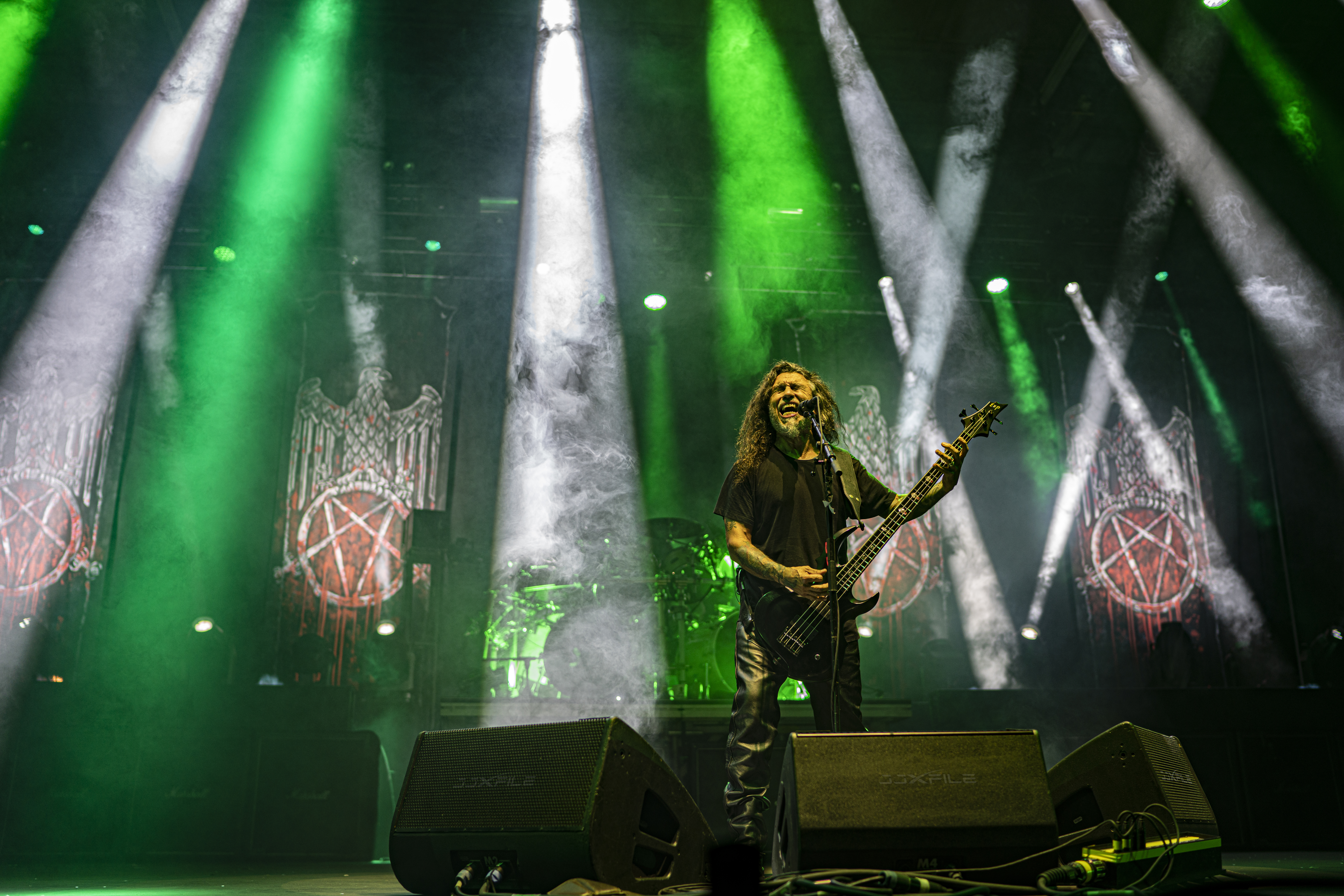
Foto: JJxFile — CC BY-SA 4.0, via Wikimedia Commons
The Slayer Drum Throne: What the Chair Demands of Whoever Sits In It
Dave Lombardo founded the sound. Paul Bostaph learned it note for note, played the last show, and is the one sitting there now. The chair outlasted the legend.
Pull up “Angel of Death” and listen to the kick drum.
That pattern is the entrance exam. In 1992, when Paul Bostaph auditioned for Slayer, he played nine songs and made exactly one mistake, and it happened in “Angel of Death” (Wikipedia). Thirty-four years later people still bring it up, because it is the job description.
This is the second piece in a line we started with the Arch Enemy vocalist lineage, same question, different instrument. What does a specific chair in a specific band demand of whoever sits in it, independent of who that person is? Arch Enemy’s answer lived in a voice. Slayer’s answer you can clock with a stopwatch, and the band left a paper trail.
Four people, thirty-eight years, one measuring stick
The Slayer drum throne had four occupants across the band’s life: two long-term holders and two interim players.
Dave Lombardo founded it in 1981 and drove Show No Mercy through Reign in Blood. He walked off the Reign in Blood tour in late 1986 over money. Tony Scaglione left Whiplash to cover the dates (Metal Injection; Whiplash’s official bio). Lombardo came back in 1987, then left for good in 1992 after friction with the band, Kerry King in particular (DRUM! Magazine).
Bostaph, then out of Forbidden, got the seat on a recommendation from King’s guitar tech. He recorded Divine Intervention (1994) and Undisputed Attitude (1996), stepped away briefly in 1996 to 1997 (Jon Dette filled in, and later turned up in Testament and Anthrax), then came back for Diabolus in Musica (1998) and God Hates Us All (2001). One of his last shows of that run, 7 December 2001, was filmed as War at the Warfield. The official reason was a chronic elbow injury; he later admitted the plainer version, that musically he wanted to do something else.
On 21 December 2001, Slayer announced Lombardo was rejoining, “at least temporarily,” per the announcement, to finish the God Hates Us All tour (Blabbermouth). The temporary arrangement lasted eleven years.
Christ Illusion: the only record that documents a return
Christ Illusion arrived in August 2006, 8 August in the US (AllMusic, Metal Archives). It had originally been penciled in for 6 June 2006, the 6/6/06 gag, and slipped for want of studio time.
It was Lombardo’s first Slayer studio album since Seasons in the Abyss in 1990. Sixteen years. It hit #5 on the Billboard 200, the highest chart position of the band’s career, and produced two Grammys: “Eyes of the Insane” in 2007 and “Final Six” in 2008. Josh Abraham produced; Rick Rubin took executive credit.
Here’s the part nobody points at. The cover was painted by Larry Carroll, the same artist behind Reign in Blood, South of Heaven and Seasons in the Abyss. Slayer brought back the drummer of the classic era and the painter of the classic era on the same record. Whether or not that was coordinated, the signal went out on two channels at once: the visual identity and the rhythm section both reverted to the years between 1986 and 1990.
The chair pays badly, and that’s part of its history
Both of Lombardo’s exits were about money, twenty-seven years apart.
1986: financial concerns, mid-tour. 2013: a contract dispute days before Slayer was due at Soundwave in Australia. Lombardo went public with numbers, an average of roughly US$745 per show in 2011, and a claim that of US$4.4 million in revenue, only about US$400,000 reached the band (Eddie Trunk). The band disputed his account of both the substance and the timeline (Blabbermouth).
What the audition actually asked for
Bostaph told RockSverige’s Niclas Müller-Hansen how he prepared in 1992: “I had ten days and over those ten days I walked around with headphones on”, a Sony Walkman, live tapes and studio tapes, on a loop (interview with RockSverige, English relay via Blabbermouth).
Ten days to internalize another drummer’s vocabulary well enough to reproduce it under audition pressure. That’s the specific thing this chair demands and the Arch Enemy microphone did not: the Slayer throne came with required repertoire, and the repertoire was one man’s invention.
Bostaph is clear-eyed about the arithmetic of that. “There’s only one Dave Lombardo and there’s only one of me and there’s only one of everyone else, which is a good thing,” he told the same interviewer. He also named the hardest one to get right, and it isn’t the one you’d guess: "‘Silent Scream’ was not an easy one."
That is the difference between the founder and the professional, stated without resentment by the professional. Lombardo wrote the vocabulary. Bostaph learned the book cover to cover.
Who was in the chair when it mattered
By albums, Lombardo wins, seven to five. By endings, Bostaph wins both.
Bostaph officially returned on 30 May 2013, recorded Repentless (2015), and played the 147-date farewell run that closed at The Forum in Inglewood on 30 November 2019 (Wikipedia). When Slayer came back in 2024 and 2025 for Riot Fest, Louder Than Life and Aftershock, the lineup was Araya, King, Bostaph and Gary Holt (Loudwire).
Bostaph played the last Slayer show and the first reunion show. Whatever the chair required, he had it, and for longer.
The chair is an intersection
Trace where these players came from and went and Slayer’s drum throne stops looking like one job and starts looking like an intersection.
Forbidden fed Bostaph into Slayer. Whiplash lent Scaglione and got him back. Dette left for Testament and Anthrax. And in 2024, Bostaph turned up on Kerry King’s solo debut From Hell I Rise, the same drummer, the same guitarist, a different letterhead. The chair is a node in a network of thrash chairs, and the same handful of people keep rotating through the whole grid.
Which raises the question we’ll pull next: does this hold outside thrash? Iron Maiden, Judas Priest and Deep Purple have all survived changes at instruments that seemed non-negotiable, and each one settled the founder-versus-professional argument differently. Slayer’s answer was unusually blunt, the replacement got the last word, twice.
Got a chair you think we should measure next? We’re at @realrocklab on X and Threads.
Sources: Wikipedia: Christ Illusion · AllMusic · Metal Archives · Wikipedia: Paul Bostaph · DRUM! Magazine · Metal Injection · Official Whiplash · Blabbermouth · Blabbermouth: RockSverige interview, English relay · Eddie Trunk · Blabbermouth: band response · Wikipedia: Slayer Farewell Tour · Loudwire
In this web: Slayer · Paul Bostaph · Dave Lombardo