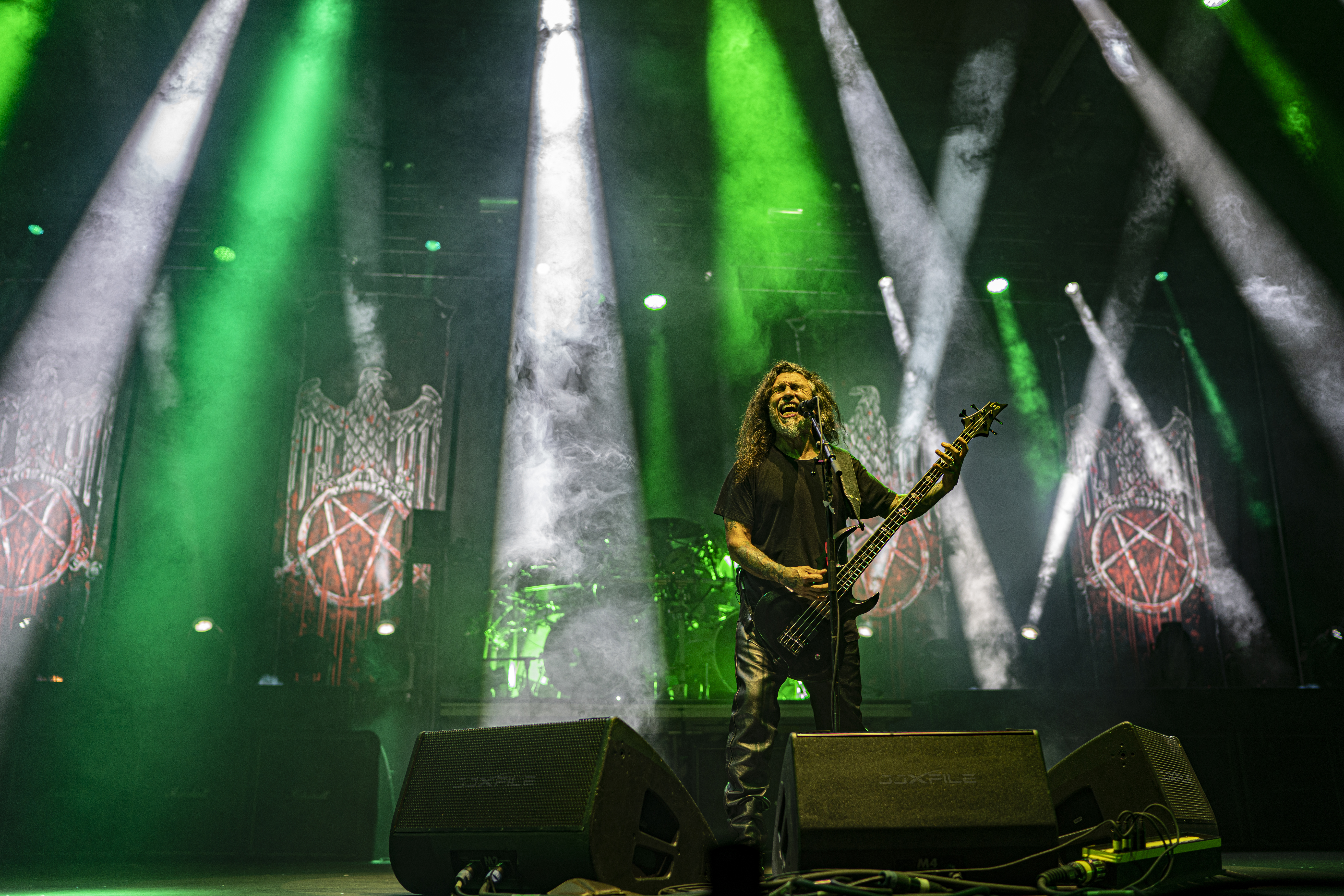
Foto: JJxFile — CC BY-SA 4.0, via Wikimedia Commons
The Rap Label That Released the Fastest Thrash Album Ever Made
Forty years ago on October 7, Slayer’s Reign in Blood came out on Def Jam, home of LL Cool J and the Beastie Boys, produced by a man who had never made a metal record. The distributor that finally put it in stores kept its own name off the sleeve.
A drummer made the call
In 1986 Slayer had two albums on Metal Blade, Show No Mercy and Hell Awaits, and a reputation as the fastest, filthiest band in Los Angeles. What they did not have was a major label, or any obvious reason to expect one.
Then Dave Lombardo heard that Rick Rubin wanted to work with them, and picked up the phone. That detail matters, because the story usually gets told backwards, with a suit and a checkbook discovering the band. The drummer heard a rumour and chased it.
Rubin came to a show with the photographer Glen E. Friedman and signed them off Metal Blade. On paper it was a strange pairing. Rubin had co-founded Def Jam with Russell Simmons. His credits were LL Cool J, Run-DMC, the Beastie Boys. His metal production credits were zero.
What the label sheet did not say is that Rubin had played in a hardcore band and knew exactly what he was walking into. The rap address described his business. It said nothing about what he listened to.
He didn’t know the right way, so he didn’t do it wrong
Every metal record in 1986 was drenched in reverb. That was the sound: big room, long tails, the drums arriving from somewhere down a hallway. Rubin took all of it off.
Reign in Blood is 28 minutes and 55 seconds of dry. Nothing is behind anything else. The guitars are in the front of the speaker, the snare is a flat crack with no room around it, and the whole record sits in your face for its entire running time.
Rubin’s own explanation of this, given to Channel 4 News and transcribed by Blabbermouth, is better than any theory anyone has attached to it since:
“No one had recorded it that way, because that’s just not the way you record things.”
And then, on where that instinct came from: “In each case, it comes from my lack of experience, lack of the ‘right way’ to do it.”
He also said the thing that kills the lazy version of this story, the one where the rap guy applies rap technique to metal. His actual argument was the opposite: “If you treat it like Black Sabbath, it won’t do what Slayer does.”
Kerry King described the result to Decibel, in its 2006 oral history of the record, as the moment the band could finally hear themselves: “Wow, you can hear everything, and those guys aren’t just playing fast; those notes are on time.”
Columbia read the lyrics and walked
Def Jam was distributed by Columbia. Columbia read “Angel of Death”, Jeff Hanneman’s lyric about Josef Mengele, written after he read books about Auschwitz while the band toured Europe, and refused to handle the record.
The song is a description, not an endorsement, and Hanneman spent the rest of his life saying so. To KNAC in 2004: “There’s nothing I put in the lyrics that says necessarily he was a bad man, because to me, well, isn’t that obvious?”
Tom Araya confirmed years later, to Loudwire in 2016, that the sticking point was the lyric, not the artwork.
Geffen picked up distribution and got the album into stores. Geffen also left its logo off the sleeve and left the title off its release schedule.
So the fastest, most extreme album the genre had produced reached the public through a rap label that couldn’t distribute it and a rock label that wouldn’t admit it had. It went to number 94 on the Billboard 200 and number 47 in the UK, and it was certified gold in the United States in November 1992, six years after release. Kerrang!’s Xavier Russell called it “the heaviest album of all time” in his October 1986 review, and the magazine has been repeating the line ever since — it formally crowned it Heaviest Album Ever Made in 2011. Rolling Stone put it sixth in its 2017 ranking of the 100 Greatest Metal Albums of All Time.
Two labels were embarrassed by it, and everyone who writes lists has been apologising ever since.
One building, two records, opposite ends of every list
While Slayer were cutting Reign in Blood, the Beastie Boys were cutting Licensed to Ill in the same studio, in the same stretch of late 1986, with Rubin producing both. Andy Wallace engineered the Slayer sessions. Rubin walked between rooms.
Which is how the guitarist on the fastest thrash album ever made ended up playing the solo on “No Sleep till Brooklyn”, the song that dropped a metal solo into the middle of the first rap album ever to hit number one on the Billboard 200.
King has told the story on the podcast Border City Rock Talk, quoted by American Songwriter and Guitar World: he took a flat fee, “a couple hundred bucks”, for a guest spot on a record that went on to sell in numbers Slayer would never touch. “I wish I took a quarter point or something, because now I would be a rich man.”
Forty years on, and the band is playing it whole
Slayer have been playing Reign in Blood in full through 2026: Shakopee, Minnesota in September, Sick New World in Fort Worth on 24 October, and two nights at the Kia Forum in Los Angeles on 13 and 14 November. The second Forum night was added because the first sold out the day it went up (Nuclear Blast, Loudwire).
No 40th-anniversary reissue of the album has been announced. Metal Blade put out a 40th-anniversary edition of Hell Awaits in May, but that is the older record, on the older label, and it is a different story.
The thread to pull
The man who took the reverb off Reign in Blood spent the next decade doing the same thing to the Red Hot Chili Peppers, to Johnny Cash, to Tom Petty: strip the production until the performance has nowhere to hide. The Slayer record is where that method got its first real test, and the test subject was the loudest possible material.
The open question for us is how far back it goes. Rubin says his method came from not knowing the right way. But Andy Wallace engineered these sessions and went on to mix Nevermind, which is a whole other argument about who actually put the sound in the room.
We’re chasing that one next. If you have a candidate for the record where Rubin’s dry-and-forward approach worked best, or the one where it stripped away something the songs needed, come argue about it with us at @realrocklab on Threads or X.
In this web: Slayer · Dave Lombardo · Rick Rubin · Kerry King · Jeff Hanneman