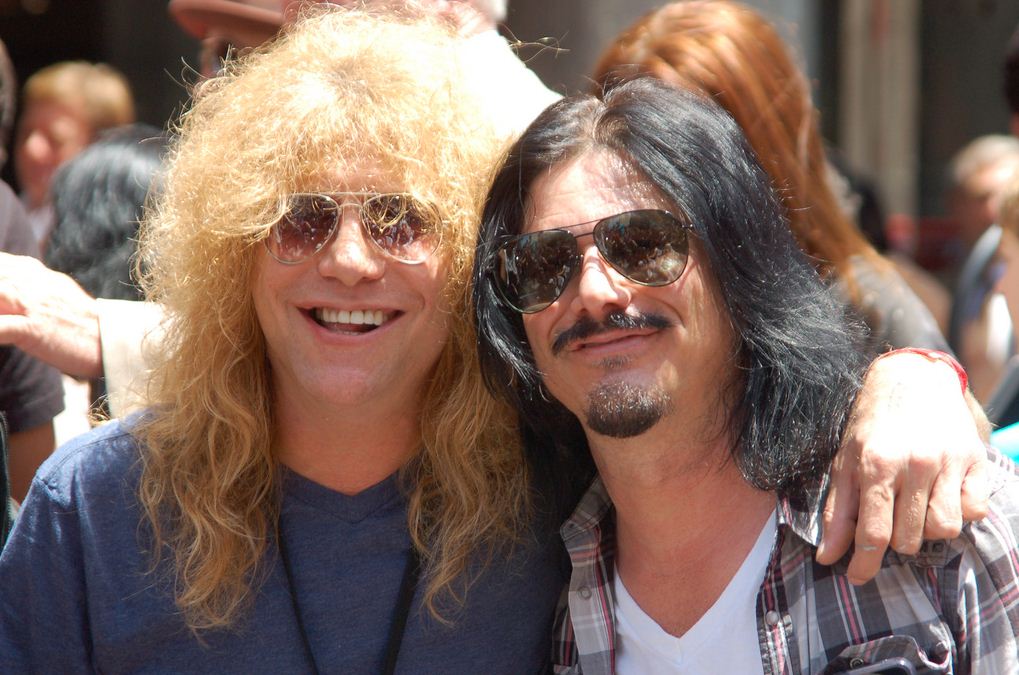
Foto: Angela George — CC BY-SA 3.0, via Wikimedia Commons
The Guns N' Roses drum chair: seven occupants, forty years, one honest autobiography
Frank Ferrer left in March 2025 after nineteen years behind Guns N’ Roses. Line up everyone who held that stool before him and you get a clearer account of what this band has been than any interview Axl Rose has ever given.
The first one left before there was anything to leave
In March 1985, a drummer named Rob Gardner joined a new Los Angeles band. He played a handful of shows, cut an unreleased demo, and quit in May. He was gone before Appetite for Destruction existed, before the songs on it existed, before there was a reason to stay. The guy who replaced him was a childhood friend of the guitarist.
That is where the chair starts, and the chair is the point. Guns N’ Roses has had seven drummers, and every changeover lines up exactly with the band turning into something else. Swing, then stadium, then a studio process with no exit, then a man paid to imitate another man, then nineteen years of keeping a touring machine on the road, and now a hire that came from inside the family. You can read the band’s whole biography off that list.
The last man to hold the job for real said as much himself. Frank Ferrer, describing his own gig to MusicRadar in August 2025: “When we play the Appetite stuff I try to have the push and pulls. Then with [Matt] Sorum it’s a little more tight and more reserved kind of playing. I’m in between there, I would imagine.” The drummer describes the band’s history as a question of feel. Nineteen years in the chair and that is the summary he reaches for.
Steven Adler: the feel was part of the song
Steven Adler played on Appetite for Destruction, G N’ R Lies, and one track of the Use Your Illusion records. What he did was loose, forward, slightly untidy, and the band found out the hard way that it was not decoration.
Late in 1987, Adler broke his hand in a fight in Michigan. Fred Coury of Cinderella filled in for a show in Houston. Coury was, by any reasonable measure, the tighter drummer. The songs came out wrong anyway. That is as close as rock gets to a controlled experiment: same songs, same room, better technician, worse result. What a player does is not separable from what the song is.
The end came in stages. The band had not played live since autumn 1989 when they took the stage at Farm Aid IV on 7 April 1990, reportedly without rehearsing. Slash described Adler attempting to jump onto the drum riser: “his depth perception and reflexes were clearly impaired, so he ended up landing about four feet short.” Slash also drew the line that actually decided it: “If his playing had been fine, I don’t think anyone would have cared what he was doing to himself.”
Adler tells it differently, and both versions belong here. In his memoir he wrote: “They weren’t cluing me in to new songs or even telling me what they were playing.” He believes he was set up to fail on national television.
Then “Civil War” — reportedly around thirty attempts before sessions were shelved for days. It is the only track on either Use Your Illusion album with Adler on it. He was fired on 11 July 1990 and sued over an agreement he had signed without his own attorney present; the case settled in September 1993 for $2.5 million, per UPI’s archive report. His last recorded act with the band is a song about a war.
Matt Sorum: the friend replaced by the professional
Slash found Matt Sorum playing with The Cult on the 1989 Sonic Temple tour. That transaction is the era in one sentence: a founding friend goes out, a hired professional comes in.
Sorum’s debut was Rock in Rio II at the Maracanã in Rio de Janeiro on 20 January 1991. He had never rehearsed with Axl Rose. His first night on the job was a stadium in Brazil.
What followed was the Use Your Illusion tour: 194 shows across nine legs for something like seven million people, run without a fixed setlist. Sorum’s line about how they managed it: “We figured out how to give each other eye signals.” Chaos scaled up to stadium size and held together by the one guy hired to be reliable. That is the job description of the whole era.
It ended in April 1997, after he objected to Paul Tobias joining. By his own account he told Rose “without Slash there is no Guns N’ Roses,” was asked whether he wanted to quit, said no, and was terminated anyway.
There is a coda. Sorum and Adler both showed up for the 2012 Rock and Roll Hall of Fame induction and played “Mr. Brownstone,” “Sweet Child O’ Mine” and “Paradise City” with Slash, Duff McKagan, Gilby Clarke, and Myles Kennedy singing. Axl Rose and Izzy Stradlin stayed home. Two fired drummers turned up; the singer did not.
Josh Freese: the band stops being a band
Josh Freese took the chair around 1997 and recorded a full album’s worth of drums over roughly eight months. Producer Roy Thomas Baker decided the parts were too industrial and persuaded Rose to re-record everything.
Freese left after roughly two years, and he left for A Perfect Circle. That is the detail that says what had happened: he went to a band that made records, because this one had stopped being one. It was now a studio process with no defined end.
Here is the part that makes this piece worth writing. Freese co-wrote the song “Chinese Democracy” — he came up with the main riff, which he has cheerfully called “really dumb, simple, dirty.” He does not play drums on it. Frank Ferrer does. A song written by one drummer, released nine years after he quit, with a man on it who joined eight years after it was written.
A footnote from last year, because it rhymes: the Foo Fighters let Freese go in May 2025. “In my 40 years of drumming professionally, I’ve never been let go from a band,” he told Variety. He went back to Nine Inch Nails.
Brain: paid to be somebody else
Bryan “Brain” Mantia took over in 2000, and his era is the strangest documented thing in this band’s history. Rose liked Brain’s feel but wanted Freese’s parts. So a Sony staffer was handed two CDs and transcribed roughly thirty songs’ worth of drums into notation, and Brain learned them and played them back note for note.
That work reportedly cost over $300,000 across seven months, to redo drums that already existed on tape. Freese, who had every right to be sour about it, was generous: “He’s playing exactly what I just recorded, which is totally fine, and I don’t mind at all.”
Zoom out and the numbers get worse. Chinese Democracy was recorded between 1998 and 2007 across fifteen studios. A 2005 New York Times estimate put the cost at $13 million, peaking around $250,000 a month. People called it the most expensive album never made, and they were right for another three years.
Brain left in July 2006 when his wife was due to give birth. He never took the chair back.
Frank Ferrer: nineteen years of keeping it running
Ferrer got the call at his seven-year-old daughter’s talent show. It was Tommy Stinson: “Hey, man, there’s this thing happening. Why don’t you learn a bunch of Guns songs?” It was supposed to be a two-week cover for Brain.
He was already family, which is the connection worth sitting with. Ferrer had played with Richard Fortus in Richard Butler’s Love Spit Love through the nineties, and in The Psychedelic Furs’ touring lineup in the 2000s. The Psychedelic Furs’ rhythm players walked into Guns N’ Roses and one of them stayed nineteen years.
First show: 24 June 2006, Dessel, Belgium. Made official that October. He is on five Chinese Democracy tracks including the title cut, plus the singles that trickled out between 2021 and 2023. Nineteen years is longer than Adler and Sorum put together.
He also drummed the entire Not in This Lifetime reunion from 2016 to 2019: $584 million gross, 5.4 million tickets, one of the biggest tours anyone has ever run. Slash came back. Duff McKagan came back. The drum chair did not. On 6 July 2016 in Cincinnati, Steven Adler walked out and guested on “Out ta Get Me” and “My Michelle,” played the songs he built, and handed the sticks back to Ferrer.
On what the gig actually demands: “During the live show I play on all of the [guitar and keyboard] solos so I don’t get off my riser once.” And, more honestly: “Sometimes you get to the double time in ‘Paradise’ and think, ‘Man, I’ve got to play this now!?’”
He was out on 19 March 2025. The band thanked him for his “friendship, creativity, and sturdy presence.” Ferrer, to Blabbermouth: “Everything comes to an end. Everything just comes to an end.” And, flatly: “We didn’t get into a fight or anything like that. No.”
Isaac Carpenter: the first one who came in through the front door
Isaac Carpenter was announced on 20 March 2025, one day after Ferrer’s exit, and debuted on 1 May 2025 in Incheon, South Korea. He co-founded Loudermilk in high school, signed to Rick Rubin’s American label, then spent four albums in Duff McKagan’s Loaded and about a decade with Awolnation.
McKagan has known him since the Loudermilk days and calls him “the best drummer I know.”
Look at the pattern that breaks here. Gardner quit. Adler was fired over an addiction. Sorum was fired over a disagreement. Freese walked out of a process with no end. Brain went home to his family. Ferrer’s nineteen years ended in a statement nobody has explained. Every single change in this chair was a rupture. This one was a recommendation from inside the band.
What to watch in April
Guns N’ Roses’ 2026 world tour hits nine Brazilian cities in April, starting in Porto Alegre on the 1st, São Paulo on the 4th for Monsters of Rock, Rio on the 10th, then Salvador, Fortaleza, Belém and more. That is Carpenter’s first full cycle in the job. Two new songs, “Nothin’” and “Atlas,” arrived on 4 December 2025 through Geffen; Slash has suggested they are close to the last of the polished-up Chinese Democracy leftovers, with attention now on genuinely new material.
So a Brazilian crowd is about to watch the newest man in this chair play songs written before he was hired, some of them written by drummers he has never shared a stage with. And January 2026 was thirty-five years since Sorum’s own first night in Brazil, at the Maracanã, having never rehearsed with the singer.
Which leaves the question this whole lineage keeps circling. Every Guns N’ Roses record since 1991 is a composite: parts tracked by one player, replaced by another, released with a third listed. So what does an album cut with one drummer from first take to last actually sound like from this band? It has been a very long time since anyone found out, and Carpenter is the first person in decades who has arrived without a mess to clean up first.
If you have a take on which drummer is Guns N’ Roses for you, we’re at @realrocklab on Threads and X.
In this web: Guns N Roses · Steven Adler · Slash · Matt Sorum · Duff Mckagan · Josh Freese