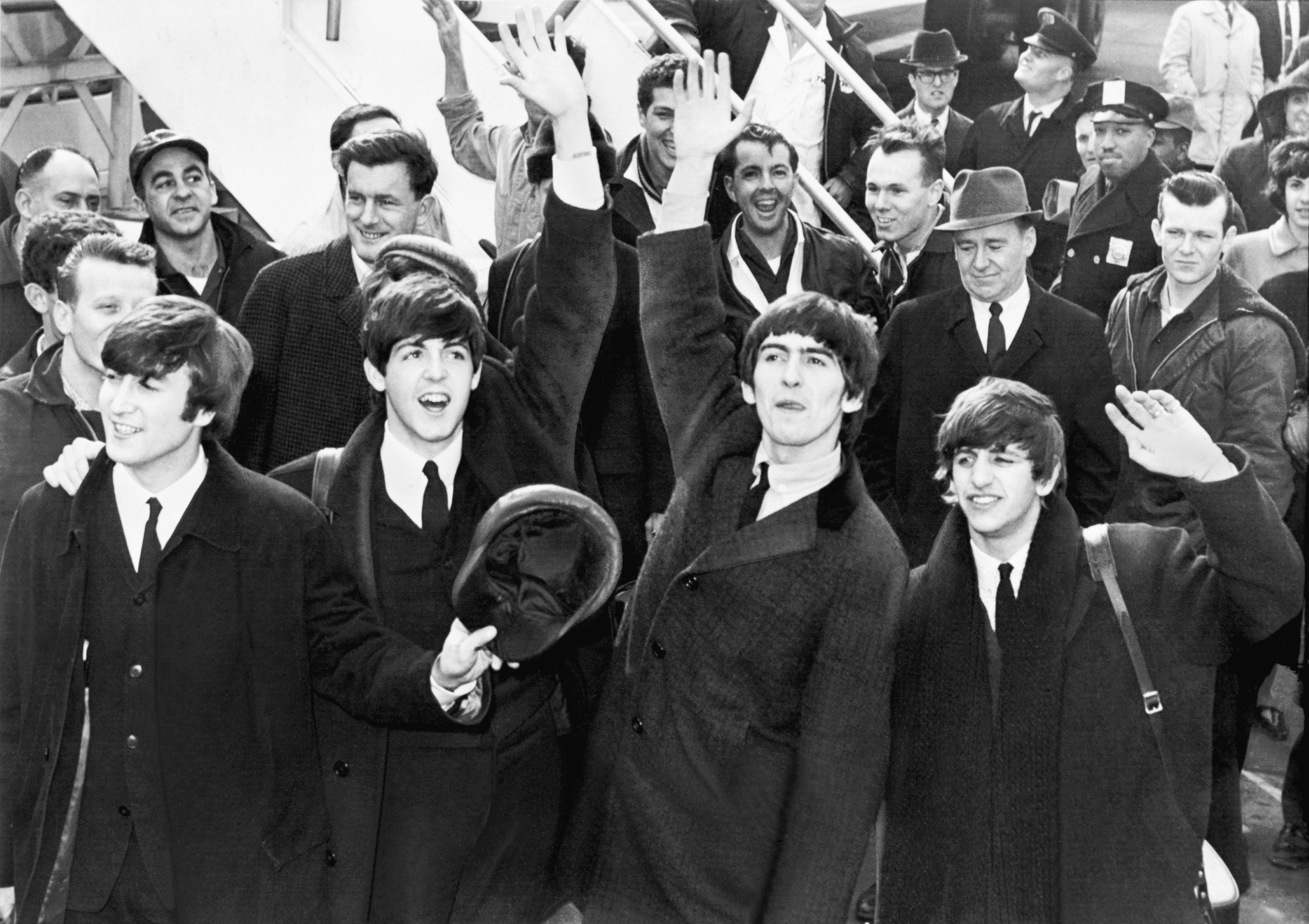
Foto: United Press International, photographer unknown — Public domain, via Wikimedia Commons
The Beatles handed the Rolling Stones a hit and accidentally built Jagger–Richards
In September 1963, John Lennon and Paul McCartney finished a song in the corner of a Soho basement while the Rolling Stones watched. The Stones got their first UK top 20, and the idea that they should be writing their own songs.
Two Rolling Stones spent 2026 saying nice things about The Beatles in public, which the music press of 1964 would have found unprintable.
Keith Richards, talking to Zane Lowe on Apple Music around the release of Foreign Tongues, said Paul McCartney “really misses being in a band. And his joy of just being in that context is great.” He added: “He’s a lovely player and I’d like to do more with him.” The clip resurfaced and travelled again at the end of August 2026, with a longer chunk attached in which Richards leaves the door open: if there are more songs to do, he’ll let Paul know.
Mick Jagger, on SiriusXM’s Classic Vinyl with Meg Griffin, went further: “They were the most prolific songwriters of that time.” Then the part that matters here: the Beatles were handing finished songs to other acts, he said, “like Cilla Black and this one and that one, all had huge hits with songs which the Beatles wrote, including us.”
Including us. Jagger was reading out a receipt.
The rivalry was a press invention, and both bands knew it
The standard story (long-haired scruffy Stones versus suited moptop Beatles, pick a side) was staging. Andrew Loog Oldham built the Stones’ image partly in opposition to a band his clients were friendly with, and the two camps coordinated behind it.
They coordinated literally. McCartney, in The Beatles Anthology (2000):
“There must have been a bit of competition because that’s only natural, but it was always friendly. We used to say, ‘Have you got one coming out?’ and if they had we’d say, ‘Well, hold it for a couple of weeks, because we’ve got one.’ It made sense, really, to avoid each other’s releases.”
Two songwriters on the phone, moving single dates around each other, with no record company in the room. Jagger’s own read on the feud: “I think there was an element of truth in it… I think there was an element of PR in it, too.”
The first meeting was fan-shaped. On 14 April 1963 the Beatles had a free night after taping Thank Your Lucky Stars and went to Richmond to watch the Rolling Stones, then the house band at the Crawdaddy Club. The bigger band went to see the smaller one.
10 September 1963: the twenty minutes
Five months later, the Stones were rehearsing at Studio 51, the Ken Colyer Club, a basement off Great Newport Street in Soho. They needed a second single and didn’t have one.
What happened next has two tellings, and they disagree on who spotted whom. Oldham’s version: he left the rehearsal hunting for material, saw Lennon and McCartney getting out of a taxi on Charing Cross Road on their way back from a Variety Club lunch, and pulled them in. McCartney’s version, told to BBC Radio 2, is that the Stones flagged them down: “We go, ‘Hey!’ So we told them to pull over. We jumped in. There’s me and John, Mick and Keith in this taxi.” Wikipedia shrugs and calls it “various accounts.”
The part nobody disputes is the basement. Inside half an hour, two Beatles were in a Soho cellar playing a song they hadn’t finished. Ringo Starr had already cut it for the Beatles’ own album; it wasn’t going out as a single. The middle section didn’t exist yet.
So Lennon and McCartney went to the corner of the room and wrote it. Roughly twenty minutes, in front of an audience of four.
Richards, in Life (2010):
“They played it through with us. Brian [Jones] put on some nice slide guitar; we turned it into an unmistakably Stones rather than Beatles song. It was clear that we had a hit almost before they’d left the studio.”
Bill Wyman remembered the smaller details, which is why we can date the day at all:
“Paul, being left-handed, amazed me by playing my bass backward. The Beatles were number one on the chart with She Loves You, and we went off that night to play the Ricky Tick Club in Windsor, for £67!”
What “I Wanna Be Your Man” did to each band
The Stones recorded it on 7 October 1963 at De Lane Lea in Soho and released it on 1 November as their second single. It reached UK number 12, their first top 20.
The Beatles put their own version on With the Beatles three weeks later, on 22 November, with Ringo singing. An album track, a leftover. Lennon later admitted they gave it away precisely because they didn’t rate it.
A Beatles offcut became the record that put the Rolling Stones on the national chart. That’s a good story on its own. The important one is what Jagger and Richards took away from watching. They had no songwriter. They were a covers band with a great singer and a great guitarist, playing Chicago blues to art-school kids in Richmond. That afternoon they watched two people their own age treat songwriting as a thing you simply do, in a corner, in twenty minutes, between engagements. Oldham locked them in a kitchen not long after and told them not to come out without a song.
The biggest thing Lennon and McCartney made that day was Jagger–Richards.
The orbit kept spinning, in public
Once you see the two bands as one system, the credits list stops looking like trivia:
- 1 June 1966: Brian Jones does backing vocals and the clinking-glasses noises on “Yellow Submarine.”
- 25 June 1967: Jagger, Richards and Marianne Faithfull sit on the floor of Abbey Road’s Studio One singing in the chorus of “All You Need Is Love,” broadcast live to roughly 400 million people in 25 countries on Our World. Eric Clapton, Keith Moon and Graham Nash are in the same huddle.
- 19 July 1967: Lennon and McCartney sing uncredited backing vocals on “We Love You” at Olympic Studios. The single, out 18 August, hit UK number 8. It’s a thank-you note to fans for standing by Jagger and Richards through their February 1967 drug bust, sung, in part, by two Beatles.
- 11 December 1968: Richards plays bass in the Dirty Mac, alongside Lennon, Clapton and Mitch Mitchell, on “Yer Blues” at the Rolling Stones Rock and Roll Circus.
- 20 January 1988: Jagger inducts the Beatles into the Rock and Roll Hall of Fame at the Waldorf Astoria, then plays “I Saw Her Standing There.”
Then the direction of traffic flips. In 2023, McCartney played bass on “Bite My Head Off” from Hackney Diamonds, his first appearance on a Rolling Stones track since 1967. In the same sessions, working with producer Andrew Watt, he cut a second one.
2026: Paul McCartney, session bassist
Foreign Tongues came out on 10 July 2026 on Polydor/Capitol, produced by Andrew Watt: the Rolling Stones’ 25th British studio album, their first new material since Hackney Diamonds. It went to number one in the UK and number seven on the Billboard 200. Charlie Watts plays on two tracks, recorded before his death; Steve Winwood, Robert Smith and Chad Smith turn up elsewhere.
Track eleven is “Covered in You.” The bass is Paul McCartney.
Jagger told NME he wanted the bass to sound punk and ugly, and had to check with Watt whether McCartney would even go there. He would. It took him about ten minutes.
McCartney’s own account of those sessions, to NME in May 2026, is the line that closes the circle:
“It was really nice to just show up at a studio with your bass and just say, ‘Right, where do you want me?’”
And: “I’m playing with the Stones! And I’m well chuffed! … I went home that day, and I’m saying to everyone, ‘I just played with The Stones!’”
Twenty minutes in a Soho basement in 1963, ten minutes in a Los Angeles studio sixty years later, the same two organisations with the traffic running the other way.
Which is what makes Richards’ remark land harder than it reads. Paul “really misses being in a band,” said by the man in the band that Paul’s band accidentally taught to write. The Beatles gave the Rolling Stones a song, then a profession, then a rivalry to sell papers with. Six decades on, the Stones are the ones who still have the thing McCartney misses, and they keep inviting him in to borrow it for an afternoon.
The thread to pull next
The 1963 handoff was routine for them that year. Lennon and McCartney were writing to order for half of British pop: Billy J. Kramer, Cilla Black, Peter and Gordon, the Fourmost. Jagger named that machine directly on SiriusXM.
The question worth chasing is how many other bands got their first hit out of a Lennon–McCartney cast-off, and how many of them, like the Stones, decided afterwards that they’d rather write their own. The Stones are the famous case. They’re almost certainly not the only one.
Got a candidate? We’re taking arguments at @realrocklab on X and Threads.
Sources: Keith Richards to Zane Lowe, Apple Music, via MusicRadar (9 July 2026) and Guitar World (August 2026 recirculation) · Mick Jagger to Meg Griffin, SiriusXM Classic Vinyl, via Rolling Stone and American Songwriter · uDiscover Music · Ultimate Classic Rock · The Paul McCartney Project · Time Is On Our Side, 1963 chronology · Beatles Bible, 14 April 1963 and 20 January 1988 · Wikipedia: Foreign Tongues, “I Wanna Be Your Man”, “We Love You”, “All You Need Is Love” · NME and NME, 30 May 2026 · Keith Richards, Life (2010) · The Beatles Anthology (2000)
In this web: The Beatles · Keith Richards · Paul Mccartney · Mick Jagger