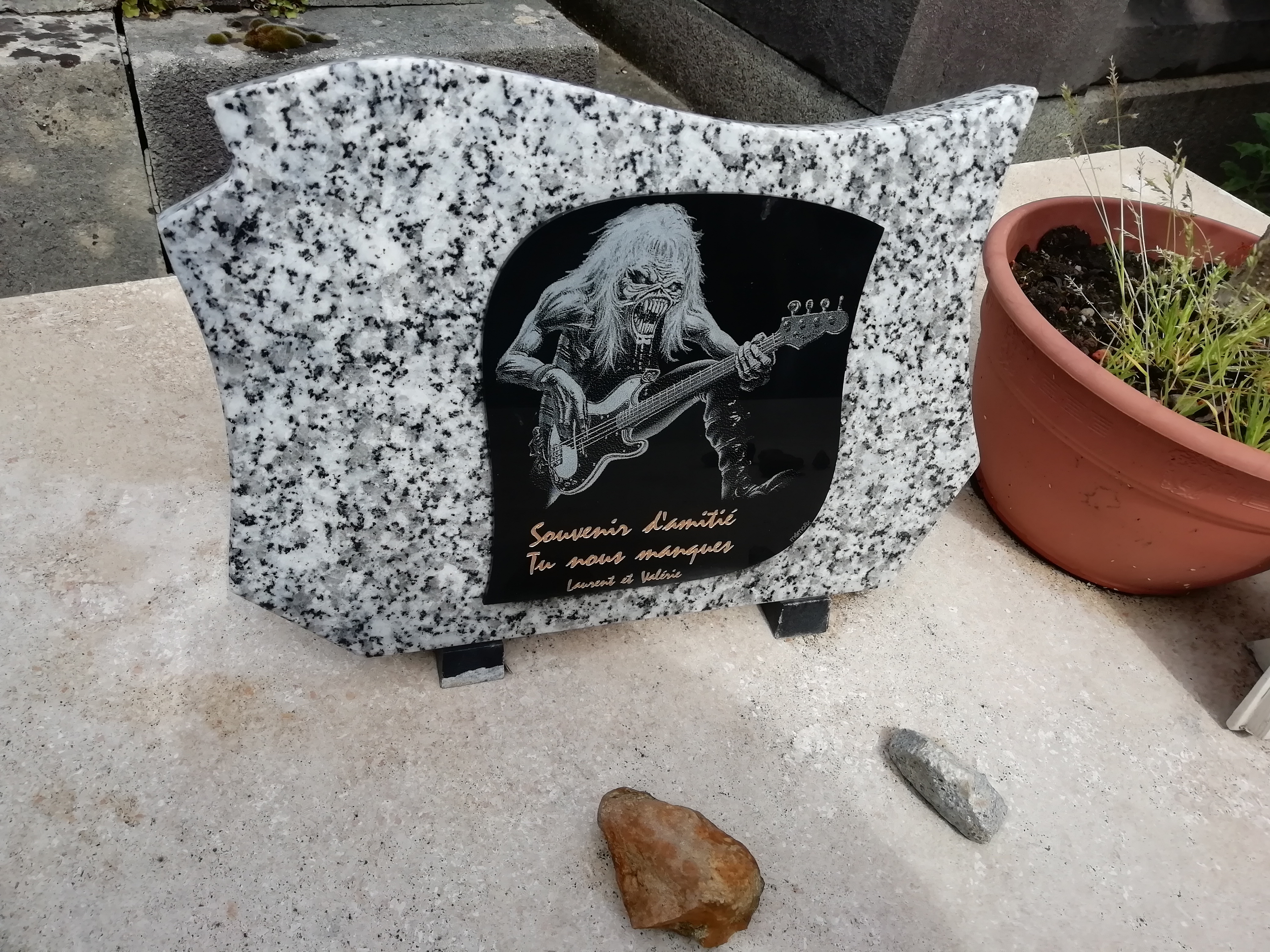
Foto: ManoSolo13241324 — CC BY-SA 4.0, via Wikimedia Commons
Steve Harris built a stage at Knebworth for the Iron Maiden history his own 50th-anniversary tour leaves out
On 10 July, Iron Maiden’s founder stood sidestage watching Blaze Bayley sing songs the two of them wrote together — songs the band’s 50-year setlist has no slot for. He booked the show himself.
Here’s the version of this story that went around in July: Steve Harris turned up to watch his old singer. Nice gesture. Classy guy. Moving on.
That’s not the story. The story is what Harris put on that stage, and what it says about the band’s own 50-year accounting of itself.
The Friday stage was his
Iron Maiden’s EddFest ran across 10 and 11 July 2026 at Knebworth House, with the band headlining Saturday. Friday was a different animal: the Maidenville stage, personally curated by Steve Harris. He filled it with two acts that don’t fit anywhere else in the 50th-anniversary machine.
One was Gypsy’s Kiss — the band Harris formed in 1974 with singer-guitarist David Smith, a year before he started Iron Maiden. The other was Blaze Bayley, Iron Maiden’s singer from 1994 to 1999, headlining Friday night.
Put those two bookings next to each other and you get something the coverage mostly missed. Harris used the one stage he controlled directly to program the beginning that predates the band and the middle chapter the band mostly doesn’t play. The prologue and the deleted scene, on the same bill, chosen by the man who wrote the official version.
What Bayley actually played, and who wrote it
The setlist was nine songs, eight of them Iron Maiden: “Lord of the Flies,” “Justice of the Peace,” “Judgement of Heaven,” “Sign of the Cross,” his own “Born as a Stranger,” then “The Clansman,” “Man on the Edge,” “Futureal” and “The Angel and the Gambler.”
Now the credits, because this is where the gesture stops being sentimental and starts being specific. Across The X Factor (1995) and Virtual XI (1998), Harris and Bayley share a writing credit on exactly six songs: “Look for the Truth,” “The Aftermath,” “The Edge of Darkness” and “2 A.M.” on the first record, “Futureal” and “When Two Worlds Collide” on the second.
The obvious one isn’t on that list. “Man on the Edge” — the single, the video, the one song from that era that survived into the band’s live rotation for years — is credited to Bayley and Janick Gers. No Harris.
So when Harris stood sidestage for the whole set and had a brief chat with Bayley afterwards — captured on video by Maiden author Stjepan Juras — he wasn’t watching a former employee do covers. He was watching a co-writer sing their material to a Knebworth crowd. That’s a different relationship entirely, and it’s one the singer-shuffle narrative never accounts for.
Harris had already said the quiet part in March, when the booking was announced: “He has been a big part of Iron Maiden’s career.” Twelve words, in a press release, from a man who does not do press releases about feelings.
The hole in the 50-year setlist
Iron Maiden’s Run for Your Lives tour is a 50th-anniversary show with a hard rule: the setlist draws entirely from the first nine albums, 1980’s debut through 1992’s Fear of the Dark. Seventeen songs, opening on “Murders in the Rue Morgue,” encore of “Aces High,” “Fear of the Dark” and “Wasted Years.” At Knebworth the reviewer noted it was the same set as the UK run a year earlier, with “Infinite Dreams” swapped in for “The Clairvoyant.”
Nothing from 1993 onward. Which means nothing from the Bayley records — but also nothing from Brave New World, A Matter of Life and Death, The Book of Souls or Senjutsu. This isn’t a grudge against one singer; it’s a frame that cuts the band’s history in half at 1992 and plays only the first part.
And it’s worth being accurate about the rest, because the lazy version of this piece writes itself and it’s wrong. With Bruce Dickinson back on vocals, Iron Maiden played “Sign of the Cross,” “The Clansman,” “Lord of the Flies,” “Man on the Edge” and “Futureal” live — some of them for years, some of them on official live releases. The Bayley-era songs were never banned. They were absorbed.
What’s absent is the era as an era: those songs sung by the man who sang them, in a set built around them. That existed on exactly one stage in 2026, and Harris is the one who booked it.
The room nobody from the band will be in
Three months before Knebworth, on 17 April, Iron Maiden’s camp confirmed they won’t attend their own Rock and Roll Hall of Fame induction on 14 November at the Peacock Theater in Los Angeles. Manager Rod Smallwood’s reason was logistics: the band is on tour in Australia, with shows on 13 and 15 November. “The fans always come first,” and the shows go on.
That’s not a snub, and it shouldn’t be sold as one. Two Australian dates bookending the ceremony makes Los Angeles physically impossible, and 14 November being an off-day between them is what a routed tour looks like, not a statement.
The detail that matters is buried in the band’s own thank-you: the induction covers Iron Maiden “and former members who were all part of our story.” So the Hall’s list includes people who left. Bayley among them, along with every other singer, drummer and guitarist the band has cycled through in fifty years.
Which produces the shape of the whole thing. In November, an institution will formally recognise Iron Maiden’s full membership in a Los Angeles theatre, and not one current member will be standing there to hear it. In July, in a field in Hertfordshire, a chunk of that membership was recognised by the one person whose opinion actually governs the band — who curated the stage, booked the acts, and then stood at the side of it for an hour watching.
One of those is an award. The other is a decision.
The thread to pull
Two things are still open, and both come due on 14 November.
The first: if nobody from the current lineup is in the building, who accepts? The Hall has handled absent inductees before, usually with a presenter and a taped message. Whether any former member walks up to that podium — and whether Bayley, Paul Di’Anno’s estate, or the drummers get an invitation of their own — is unanswered as of this writing, and it’s the most interesting unanswered thing about this induction.
The second is the one Harris keeps declining to answer directly. He curated a stage that ran from 1974 to 1998 and skipped everything the official tour plays. Read it as a fiftieth-birthday indulgence and it’s charming. Read it as a setlist and it’s an argument.
Got a theory about which one it is? We’re at @realrocklab on X and Threads — bring the credits.
In this web: Iron Maiden · Gypsys Kiss · Blaze Bayley · Janick Gers · Bruce Dickinson · Paul Dianno