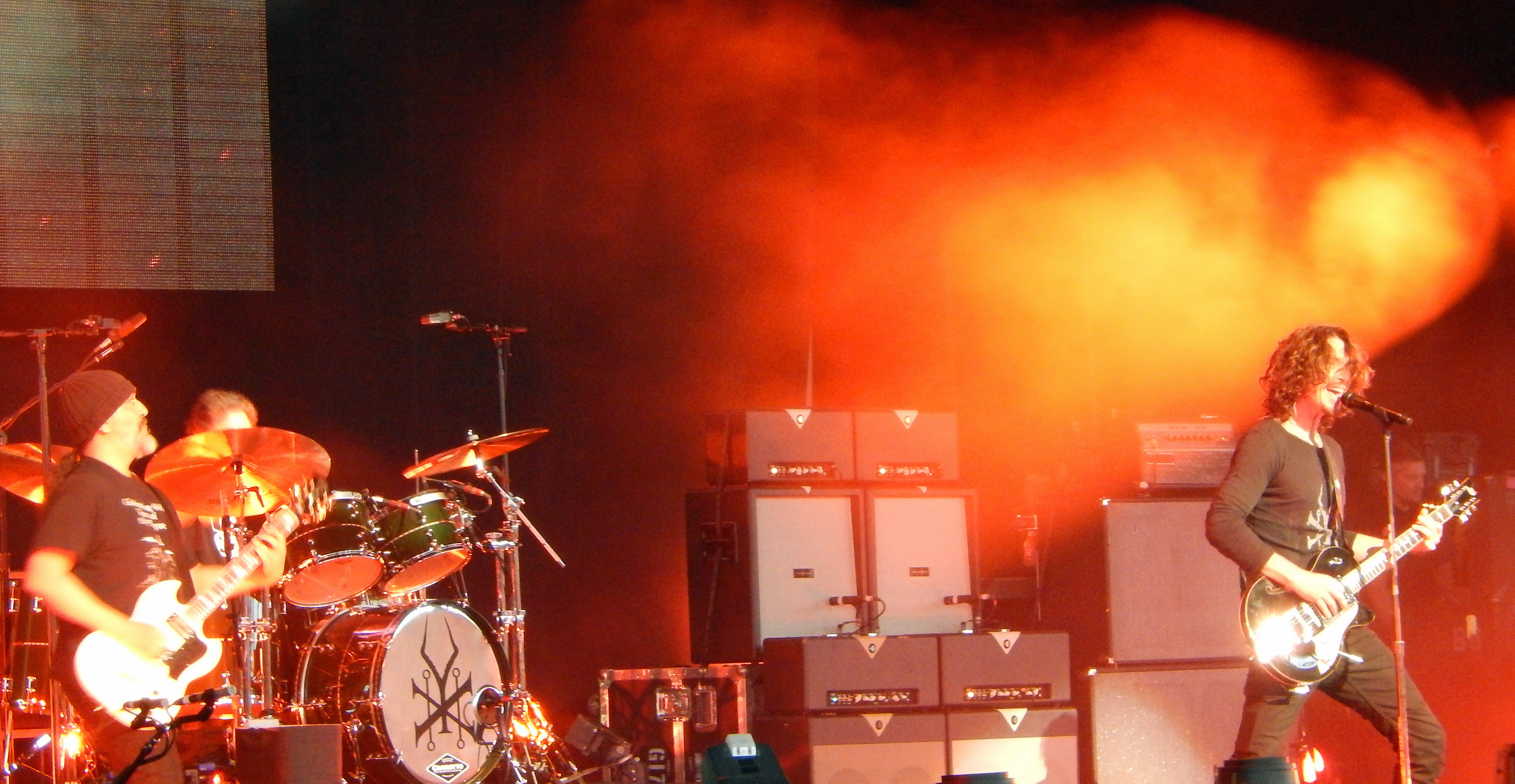
Foto: swimfinfan — CC BY-SA 2.0, via Wikimedia Commons
Soundgarden's Final Album: Terry Date Is Building Eight Songs Around Chris Cornell's Last Vocals
Soundgarden are mixing a record built on vocals Chris Cornell recorded before May 2017, and the producer in the room made Louder Than Love and Badmotorfinger*. The interesting part is who is doing the building, and around what.*
The record that was already being made
Soundgarden were in the middle of an album in 2017. That fact changes how the rest of this release reads. According to Matt Cameron, the eight songs now being finished were already in progress before Chris Cornell died in May of that year (Metal Addicts). These are the songs the band was working on when it stopped. The singer’s parts were already on tape.
Kim Thayil confirmed to Ultimate Guitar in July that the album comes out in 2027, with no date inside the year (WRIF, 16 July 2026). Recording is finished and the record is in mixing (WRIF, 27 May 2026). There is no title yet and no single.
Eight tracks with Cornell’s voice on all of them, and everything else still open.
Why it sat for six years
The material did not move for a long time. A legal dispute between the band and Vicky Cornell, Chris’s widow, kept the recordings locked up, and the settlement only came in spring 2023 (Consequence, November 2025).
After that the statements arrive in a line. Cameron says the album is over halfway done in September 2025 (Consequence). Thayil says “pretty close” in November (Consequence). By May 2026 tracking is done and the record is being mixed. By July it has a year attached.
Roughly three years passed between the settlement and the mix. Nobody was rushing, and given what the job actually is, I think that is the right read.
What the band cannot change
In an ordinary session the singer is the most flexible person in the room. The producer hears a line that could sit better, the singer tries it again, the guitar player adjusts a part to leave space for the new phrasing. The whole thing bends around the voice, because the voice can respond.
On this record it cannot. Cornell’s takes are fixed. Every guitar, every bass line, every drum decision has to be built to match a performance that will never be sung a second time. The band is arranging around an archive.
The sources do not agree on what those takes are, and the difference changes the picture. Consequence describes the material as “vocal demos.” The rock radio reports from July 2026 call them Cornell’s “last recorded vocals” (WRIF, 31 July 2026, 102.9 The Buzz). Those are different things. A demo vocal is a sketch sung over a rough track, sometimes recorded at home, with the song still moving. A final vocal is sung to an arrangement that has settled, in a room built for it. Nobody in the band has said which one Date is working with, and it matters: instruments built around a demo are guessing at a song that was not finished yet, and the guesses are being made by everyone except the person who sang it.
Terry Date is the constant
Date is the part of this story that reaches back to the first records.
Terry Date produced Louder Than Love in 1989 and Badmotorfinger in 1991 (NME). Most coverage mentions the second one, because that is the record with “Rusty Cage” and “Outshined” on it. It is two records, though, and the first one matters just as much here. Date was in the room the first two times Soundgarden recorded that voice at full volume on a major label budget. He heard Cornell push a take, redo it, argue about it, nail it. He knows what that singer sounded like when the take could still be redone.
Now he is the one deciding what sits underneath takes that cannot. Think about who else could do that job. A producer who never worked with Cornell would be reading the vocals cold, treating them as a finished object and decorating around them. Date has a reference nobody else in the building has: the memory of what the band did with a Cornell vocal when Cornell was standing there. That memory is information, and it is the reason the choice of producer is the most revealing decision the band has made public.
The second name in the chain is Joe Barresi, who is mixing (WRIF, 16 July 2026). Barresi has mixed Tool, Queens of the Stone Age and the Melvins. So the last pass on the record goes through someone who spent years with heavy, slow, room-sized guitar bands. Date builds it, Barresi balances it. Two producers, one of them from 1989, one of them from the generation of bands that came after Soundgarden and learned from them.
What the band says it is doing
Thayil has been direct about the stakes. Finishing the record, he said, is “incredibly important” and about wanting “to properly honor Cornell and the music they created together” (102.9 The Buzz).
Read that next to the timeline. Three years of work after the settlement, the original producer brought back, a mixer chosen from outside the band’s own era. That is a group treating the vocals as the one thing on the record that cannot be improved, and putting everything else on trial.
The thread to pull next
Two things I want to know before 2027, and neither has an answer in print yet.
First: demo or finished take? Every description of this record depends on that word, and the sources cannot agree on it. If it is a demo, Date is finishing a song. If it is a final vocal, he is finishing an arrangement, and those are different jobs.
Second: does the record sound like 1991 or like 2017? Date made Badmotorfinger thirty-five years ago. The band that was working in 2017 had been through Superunknown, a breakup, a reunion and King Animal. The producer has a reference from one era; the songs come from another. Which one wins in the mix is the thing I will be listening for first.
If you were in a studio with Terry Date or Soundgarden and know which kind of vocal these are, I am at @realrocklab on Threads and X. And if you know another record where the band’s original producer came back years later to finish one built on archived vocals, that is the next piece.
In this web: Soundgarden · Matt Cameron · Chris Cornell · Kim Thayil · Terry Date