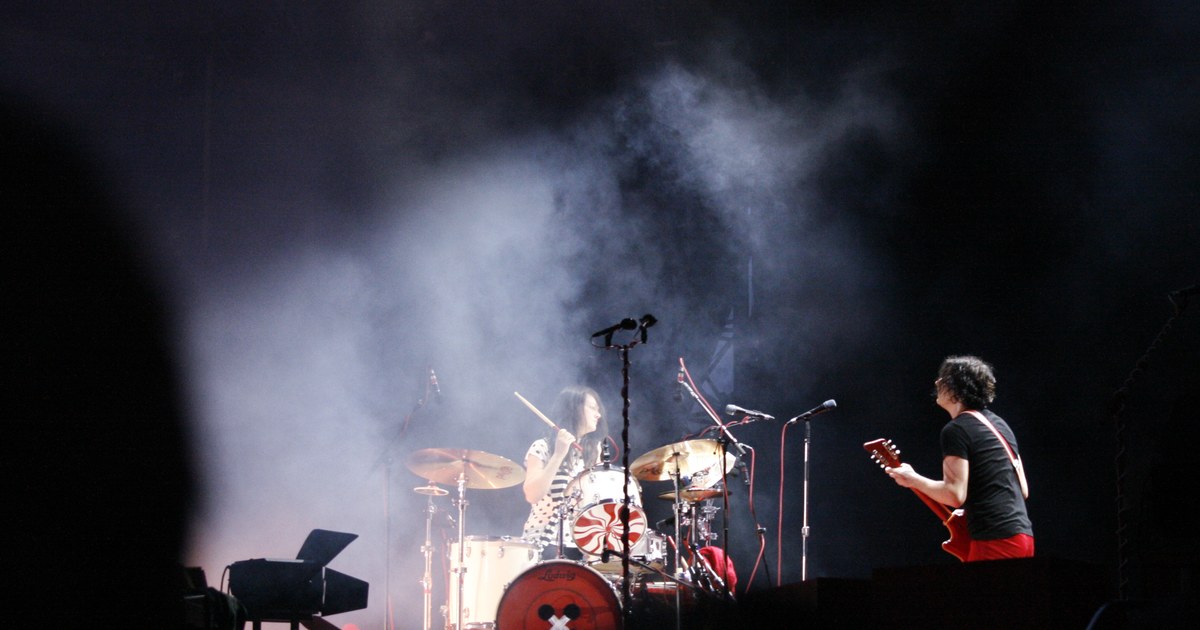
The White Stripes at O2 Wireless Festival, London, 2007 — photo: Fabio Venni, CC BY-SA 2.0, via Wikimedia Commons (cropped)
How "Seven Nation Army" Became Soccer's Global Anthem — From a Milan Bar to the World Cup Final
On Sunday, 82,500 people at MetLife Stadium will sing a riff written in a Detroit two-piece’s practice space. Here’s the verified chain of how seven notes with no words conquered the terraces, and why Queen engineered the blueprint thirty years earlier.
The final has no rock band on the marquee. Listen anyway.
This Sunday, July 19, Argentina and Spain meet at MetLife Stadium in the 2026 World Cup final, the first final in World Cup history with a halftime show. The bill, per Global Citizen, is Madonna, Shakira and BTS co-headlining, with Burna Boy, Justin Bieber, Gustavo Dudamel, and the PS22 Chorus featuring Coldplay, all curated by Chris Martin. The closest thing to a rock band on that stage is a Coldplay cameo backing a school choir.
So rock lost, right? Biggest football broadcast on the planet, and the genre doesn’t even get a slot.
Wrong ledger. The sound those 82,500 people will make together, the one thing no one on that stage can script, is seven notes from a White Stripes song. And the stomp-stomp-clap that’ll ripple through the upper deck between goals? That’s Queen, built in a studio in 1977, on purpose.
Rock lost the stage and won the crowd, and the crowd is the bigger venue.
The chain: a bar in Milan, October 2003
The “Seven Nation Army” terrace story usually gets told as vibes. It has a documented chain of custody, traced by Slate and NPR, and it starts in a bar.
October 22, 2003. Club Brugge fans are in Milan ahead of a Champions League match against AC Milan. The song comes on in a bar, the traveling fans start singing the riff (po, po po po po, poo, pooo) and they carry it with them into San Siro. Brugge win 1-0, an away upset against one of Europe’s giants, and the chant gets welded to the memory. From that night on, it’s a Brugge song.
Note what didn’t happen: no stadium DJ pushed it, no marketing campaign, no White Stripes concert lit the fuse. A few hundred Belgians in a bar decided a garage-rock riff was singable, and they were right.
February 15, 2006. Brugge host AS Roma in the UEFA Cup. Roma win 2-1 and lose the intellectual property battle of the century, because the Roma fans hear the chant, love it, and take it home to the Stadio Olimpico. Francesco Totti later admitted, per Slate: “I can’t get the ‘po po po po po poo pooo’ out of my head.”
June-July 2006. Italy goes to the World Cup in Germany, and Roma’s chant scales up into the unofficial anthem of the entire Azzurri campaign. Italy lift the trophy on July 9, 2006, and after that “Seven Nation Army” belongs to everyone with a scarf.
Jack White’s reaction, when Slate asked him about watching his riff get absorbed into football culture: “Nothing is more beautiful in music than when people embrace a melody and allow it to enter the pantheon of folk music.” That is a technical description, and an accurate one. A melody passed from person to person without sheet music or words, mutating slightly with each crowd, is folk music. This one happens to be twenty-three years old instead of two hundred.
Why these seven notes, though?
The riff works on the terraces for reasons you can name:
- No words. A Belgian, an Italian, an Argentine and a Spaniard can all sing it on day one. Lyrics are a localization problem; a melody is not.
- One breath. The full phrase fits comfortably in a single exhale, with a built-in pause to inhale before it loops. Try that with most choruses.
- It sounds like a bass, so crowds become the bass. White famously played it on guitar pitched down an octave to fake a bass tone. The melody lives in the low register where 80,000 untrained voices naturally sit when they’re shouting.
- It’s a taunt-shaped contour. It rises, peaks, and falls like something you’d chant at someone. The song was already aggressive before football borrowed it.
Nobody designed that for stadiums, which makes the next part funnier: somebody else absolutely did.
Queen already ran this experiment: deliberately
Rewind to May 1977, Bingley Hall in Stafford, England. Queen come offstage stunned because the crowd wouldn’t stop singing back at them. Brian May, recounting it to MusicRadar, says he turned to Freddie Mercury and said: “Maybe we should be harnessing this kind of energy.”
So he went and wrote “We Will Rock You” as an engineering answer to a specific question: what can a massive crowd actually do together? May spelled it out on NPR’s Fresh Air in 2010: “They can stamp, and they can clap, and they can sing some kind of chant.” Stomp-stomp-clap. There is no drum kit on the track; the band overdubbed their own stomps and claps over and over, with delays, to simulate a crowd that didn’t exist yet. They recorded the audience before the audience showed up. It landed on News of the World, released October 28, 1977, and has been the default sound of stadium anticipation ever since.
Queen reverse-engineered the crowd, top-down, in a studio. The White Stripes got adopted bottom-up, by accident, in a bar. Both methods end at the same place: music whose real instrument is 80,000 people.
Sunday’s real headliner
Back to MetLife. Argentina arrive chasing back-to-back titles after their comeback semi-final win over England (2-1, two late goals in Atlanta); Spain arrive chasing their first title since 2010 after shutting out France 2-0 in Dallas. Two of the loudest terrace cultures on Earth, and both of them sing the riff.
The halftime stage belongs to pop. Fine. Halftime is fifteen minutes. The crowd is the whole match, and its setlist was written by a duo from Detroit and four guys from London. When the camera pans the stands Sunday and you hear that low, wordless swell start to build, that’s rock’s chart position in 2026, off the marquee and in the larynx of everyone in the building.
The thread to pull next
What’s still bugging us in the lab: “Seven Nation Army” made the jump from record to folk music in three years flat, through one bar and one away fixture. Queen needed a studio and a plan. So what’s the next riff sitting in the catalog right now with the right shape (low, wordless, one breath, taunt-contoured) waiting for its Milan-bar moment? We have a shortlist brewing. Tell us yours: we’re @realrocklab on X and Threads, and we read everything.
In this web: The White Stripes · Queen · Jack White · Brian May · Freddie Mercury