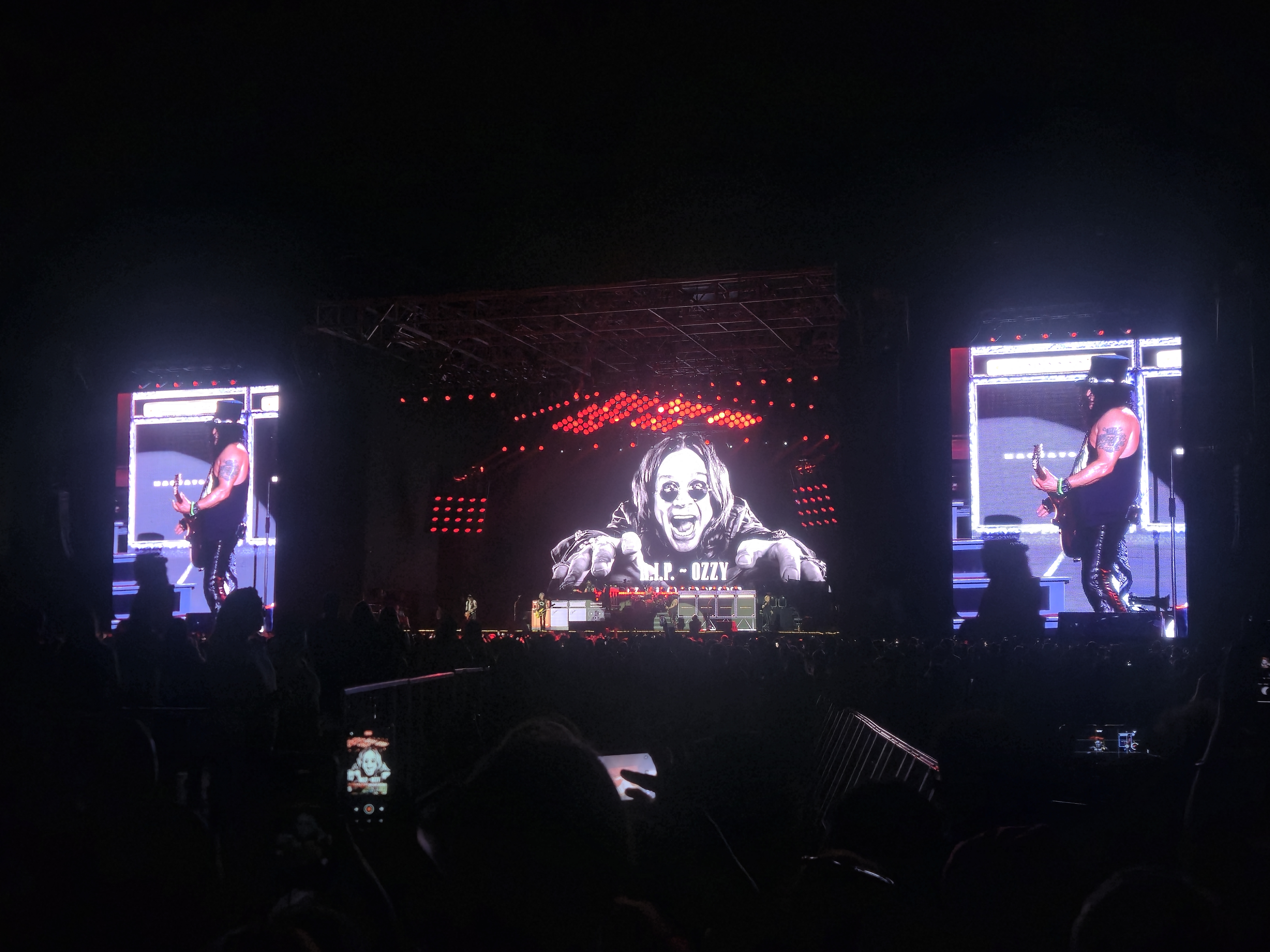
Foto: Lenny Maidana — CC BY-SA 4.0, via Wikimedia Commons
September 1991: Guns N' Roses Sold 1.45 Million Records in a Week, Then Nirvana Released Nevermind
Thirty-five years ago this week, the biggest band on the Geffen roster put out two albums on the same Tuesday. Seven days later, the same label shipped 46,251 copies of a record from Aberdeen, Washington.
Tuesday, September 17, 1991: two records, one day
Guns N’ Roses did something on September 17, 1991 that nobody had really tried at that scale. They released Use Your Illusion I and Use Your Illusion II on the same day, on Geffen Records, as two separate full-price albums. Thirty songs across the pair. A nine-minute “November Rain”, a nine-minute “Coma”, an Alice Cooper cameo, a Bob Dylan cover, a Paul McCartney cover, a Charles Manson credit, and a piano ballad written from the point of view of a man mourning his own wedding. Excess was the plan, and the plan worked.
The first-week numbers in the US: Use Your Illusion II sold 770,000 copies and opened at number one. Use Your Illusion I sold 685,000 and opened at number two. That is 1,455,000 records in seven days, and the same band holding the top two slots on the Billboard 200 at once. Use Your Illusion I went on to be certified seven times platinum by the RIAA.
If you were a rock fan in September 1991, this was the story. Two discs from one band sat on top of the whole chart, and the only thing anyone was arguing about was which of the two was better.
Tuesday, September 24, 1991: 46,251 copies
Seven days later, Nirvana released Nevermind on DGC Records, with Sub Pop still attached from the band’s earlier deal. The initial pressing for US stores was 46,251 copies. The UK got 35,000. The album debuted at number 144 on the Billboard 200.
Put those two Tuesdays next to each other. One band sold nearly a million and a half records in the time it took the other band’s label to ship enough copies to stock a few hundred shops. Nobody at the time treated the second Tuesday as news, because number 144 is where records go to disappear.
Then “Smells Like Teen Spirit” did what it did. By November 1991, Nevermind was certified gold and platinum. On January 11, 1992, it reached number one on the Billboard 200, selling around 300,000 copies a week at that point. One detail worth getting right, because the internet gets it wrong constantly: the album Nevermind knocked off the top spot was Michael Jackson’s Dangerous, not either Use Your Illusion. The Guns N’ Roses records had already had their run at the top by then. “Smells Like Teen Spirit” peaked at number six on the Hot 100. Nevermind was certified Diamond in March 1999, and has passed 30 million copies worldwide.
Less than four months from number 144 to number one is the number underneath every “grunge changed everything” story you have ever read.
Same building, different floors
The “grunge killed hair metal” version usually leaves out that both records came from the same house.
Geffen Records put out Use Your Illusion I and II. DGC Records, which put out Nevermind, was Geffen’s own imprint. So the label that had the top two albums in America on September 17 was, one week later, releasing the record that would define the next five years of rock radio. The same company pushed both through the same distribution pipeline in the same quarter. One act got the marketing budget of a band that could sell a million and a half in a week; the other got 46,251 copies and a video on MTV.
This is not a story about an old guard being ambushed by outsiders. Geffen was, in effect, competing with itself, and did not know it. The “revolution” arrived through the front door of the incumbent’s own building, on a Tuesday, with a small print run.
Axl wanted them on the tour
The other thing the clichéd version misses: Axl Rose was a Nirvana fan before most of America had heard the band. According to Rolling Stone’s history of the feud, Axl wore a Nirvana cap in public and pushed to have Nirvana open for Guns N’ Roses on the Use Your Illusion tour.
Kurt Cobain turned him down, and did not do it quietly. In an interview he described his band as “not your typical Guns N’ Roses type of band that has absolutely nothing to say.” That is a 15-word quote that tells you the whole shape of what came next. The bigger band extended a hand. The smaller band slapped it away, on the record, and the rock press had its storyline.
Set that against the calendar. Axl was in the middle of the most commercially dominant month of his life, and the person he most wanted to share a stage with was the singer of a record that had debuted at 144. He saw it coming; he just assumed it would be a supporting act.
September 9, 1992: the pavement
The feud reached its low point a year after both releases, backstage at the MTV Video Music Awards on September 9, 1992. As reported by Louder and Best Classic Bands from people who were there, Courtney Love spotted Axl and asked, mocking, whether he wanted to be godfather to her and Cobain’s daughter, Frances Bean.
Axl turned to Cobain and said: “You shut your bitch up, or I’m taking you down to the pavement.” Cobain answered with sarcasm rather than fists. Later that night, from the stage, Axl referred to Cobain as a “junkie with a junkie wife.”
Twelve months earlier, one of these men had sold 1,455,000 records in a week and asked the other to open his tour. Now they were a few feet apart in a corridor and one of them was threatening the other with concrete, and both of them took it personally.
What the calendar actually says
The lazy version of this story is a coup: grunge arrives, hair metal dies, the end. The dates say something less tidy and more interesting.
Guns N’ Roses did not lose in September 1991. They won harder than almost anyone ever had. The Use Your Illusion records kept selling for years, the tour ran through 1993, and Use Your Illusion I alone moved seven million units in the US. Meanwhile the record that supposedly replaced them started at 144 and took until January to reach the top, displacing Michael Jackson, not Axl.
The week of September 17 to 24, 1991 shows two ideas of what a rock record could be, released a week apart by the same label, and both of them working. One idea was maximal: two discs, orchestras, nine-minute epics, a band that sounded like it wanted every song to be the biggest thing you had ever heard. The other was a 42-minute album that sounded like it had been recorded in a garage with the door open, with a singer who kept insisting he had nothing to sell you.
Thirty-five years later both are still in print and still being argued about. Geffen went back to the Use Your Illusion well in 2022 with a 30th-anniversary box of 97 tracks, including full live shows. Nevermind got its own anniversary reissues. The excess and the noise both survived, and they still split rock fans into camps roughly along the line Cobain drew in that interview.
The thread to pull
September 17, 2026 marks 35 years of Use Your Illusion. September 24, 2026 marks 35 years of Nevermind. That seven-day gap has a lot more to give. The next layer down is the man who signed both bands’ checks and the A&R staff who moved between them, because the Geffen roster in 1991 is a map of the whole decade if you know where to look.
Two questions for you, and we mean them. Which of the two Use Your Illusion discs do you actually put on in 2026, and did Axl have it right when he thought Nirvana belonged on his stage in 1991? Tell us at @realrocklab on X or Threads.
Sources
- Use Your Illusion I, Wikipedia
- Use Your Illusion II, Wikipedia
- Nevermind, Wikipedia
- Guns N’ Roses vs. Nirvana: A Beef History, Rolling Stone
- The story of Axl Rose and Kurt Cobain’s MTV bust-up, by those who were there, Louder
- Nirvana, the 1992 VMAs and the Guns N’ Roses feud, Best Classic Bands
- Guns N’ Roses Use Your Illusion box set, Ultimate Classic Rock
In this web: Guns N Roses · Nirvana · Axl Rose · Kurt Cobain