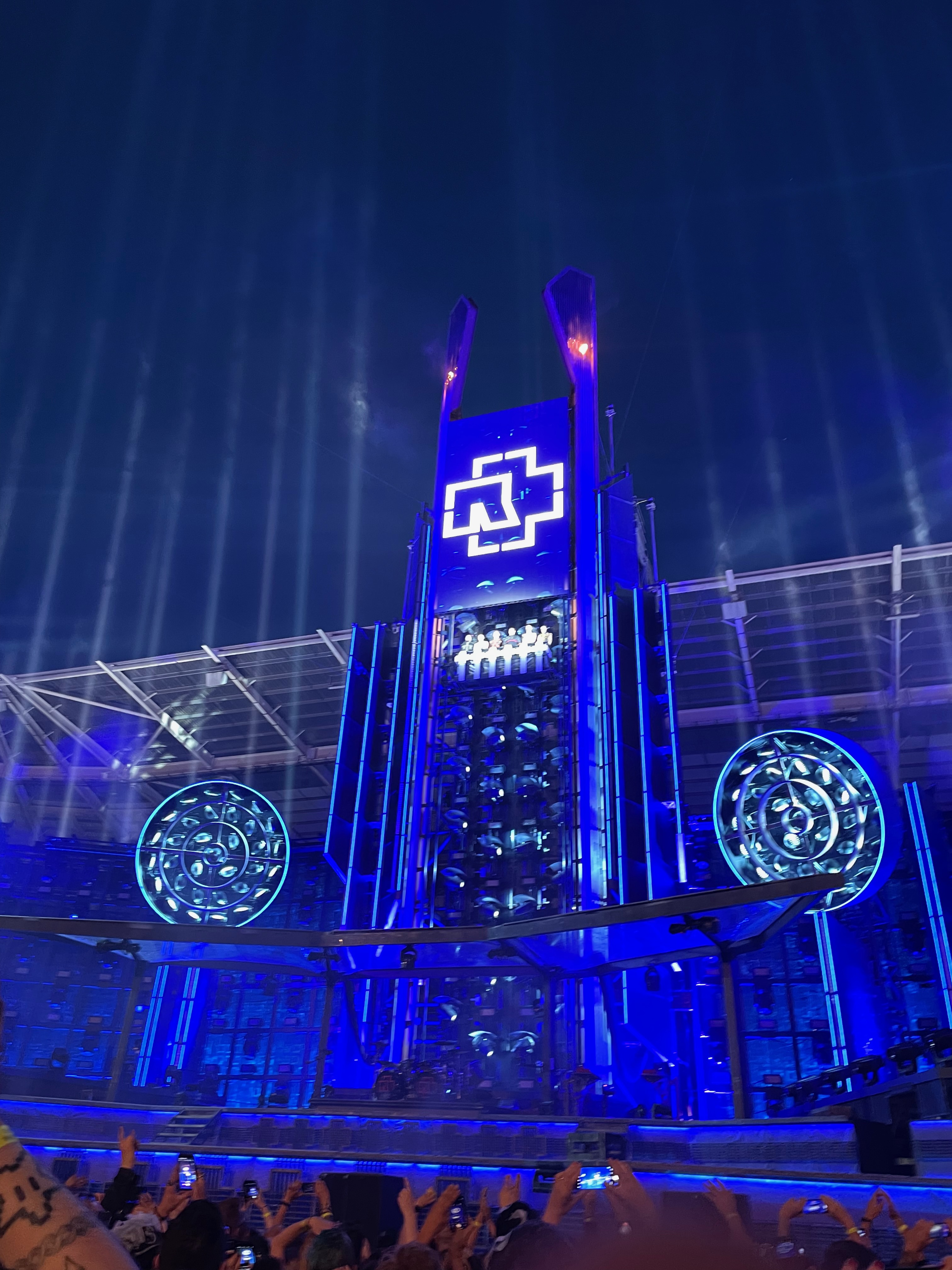
photo: Andy Harbach, CC BY 2.0, Wikimedia Commons
Rammstein's Stage Show Is Half Metal, Half East German Theater — The Gert Hof Connection
Everyone assumes the lineage runs KISS → Rammstein. It half does. The other half runs through a Leipzig theater, a Brecht research center, and a lighting director who did prison time in the GDR as a teenager.
At the end of our Till Lindemann piece we left a question hanging: how much of Rammstein’s staging is metal inheritance, and how much comes from somewhere metal fans don’t usually look? We went looking. The answer has a name, a birthplace, and a criminal record issued by the East German state.
The man in the lighting booth didn’t come from rock
In 1995, one year after Rammstein formed, a man in his mid-forties joined the crew with a CV built on theater: Leipzig stages, the Volksbühne orbit. The closest he’d come to a band was directing East German rock acts inside theater productions.
Gert Hof (1951 to 2012) came out of East German state theater. In 1967, still a teenager, he was convicted by a Leipzig district court of “incitement against the state” and sentenced to 18 months in prison; he was only legally rehabilitated after the Wall fell. He worked at Leipzig’s municipal theater, where his path crossed Frank Castorf’s, the future director of Berlin’s Volksbühne. Then he became a researcher at the Brecht Center in Berlin, publishing on Bertolt Brecht’s work. And by 1983 he was already fusing the two worlds: he staged Brecht’s Threepenny Opera with the rock band Silly in Karl-Marx-Stadt, twelve years before Rammstein called.
From 1995 to 2010, Hof was Rammstein’s architect of light, pyro and stage design. He signed the visuals on Live aus Berlin (1999), Lichtspielhaus (2003) and Völkerball (2006), wrote the band’s official book, Rammstein – Das Buch (2001), and shot photographs for Till’s poetry book Messer (2002).
When Rammstein’s stage show became architecture, light as structure and fire as punctuation, the man holding the pencil had been formed by GDR state theater and Brecht scholarship, not by watching KISS.
The whole band is East German, and that’s where the grammar comes from
Paul Landers and Flake Lorenz came out of Feeling B, a punk band founded in East Berlin in 1983. Flake joined at sixteen, playing basslines on an organ because that’s what was available. Till drummed in First Arsch. Punk in the GDR came with surveillance, bans, improvised stages.
Six musicians learned, inside a censorship state, that a stage is the place where you say what can’t be said, and their lighting director carried a political prisoner’s file. Everything else grew out of that.
The ancestor who answered the plagiarism question
Rammstein’s scariest trick is totalitarian imagery deployed with no stated position, the ambiguity that makes people nervous. Ask where it comes from and the trail leads to Laibach, the Slovenian collective that invented exactly that move to provoke post-Tito Yugoslavia.
Asked whether Rammstein stole from them, Laibach answered in a statement that has circulated in fandom for years, its original interview now offline: “Rammstein seem to be a kind of Laibach for adolescents, and Laibach are Rammstein for grown-ups.”
The bridge is a serious academic subject: Jan-Peter Herbst’s paper on the politics of Rammstein’s sound connects both bands back to Wagner’s Gesamtkunstwerk, the total artwork, music and image and stage fused into one object. So the line runs Wagner → Laibach → Rammstein, with Brecht cutting across it via Gert Hof.
What metal actually contributed
The metal inheritance is real, and it has names. Richard Kruspe came up on KISS. The fan motto, “Other bands play, Rammstein burns!”, is a rewrite of a line from Manowar’s “Kings of Metal”: “other bands play, Manowar kill”. Alice Cooper’s guillotine and Gene Simmons’s spat blood established, decades earlier, that a rock stage could stage theater at all.
Each tradition supplied something different. Metal gave Rammstein permission: the precedent that spectacle belongs on a rock stage. East Germany gave them the grammar: what the spectacle is for.
The fire started as stage fright
The “born showman” myth falls apart at the origin: Till started using simple pyro because he was insecure on stage and wanted something to occupy himself with. In a 1998 interview he described the early days playing to twenty or thirty people in a four-hundred-cap club.
Then it got real: on 27 September 1996 in Berlin, part of a burning set piece collapsed into the crowd; RammWiki’s log of the show records four people lightly hurt and a 24-year-old hospitalized for several days. After that the band professionalized everything, and Till earned a pyrotechnician’s license. The frontman is legally certified to burn you, and there’s paperwork to prove it.
Reading the show through Brecht
Watch any Rammstein show and notice what’s missing: no “hello, Berlin!”, no smiling, no invitation to sing along. Till stands nearly motionless while flames go up around him. That deadpan is Brecht’s Verfremdungseffekt, the distancing effect: staging designed to stop you from dissolving into the spectacle and force you to look at it. Normally that reading would be critic’s overreach. Here, the man who designed the stage worked at the Brecht Center and published on Brecht, so the theory walked in through the crew entrance.
And Flake is the Brechtian device in human form: the thin man in the wrong suit whom the show keeps contradicting, boiled in a cauldron during “Mein Teil”, walked on a leash, sent over the crowd in a rubber dinghy. He’s the ironic commentary running inside the opera. The 5 June 1999 Worcester show proved how far that device goes: after “Bück dich”, Till and Flake were arrested for onstage obscenity. That meant a night in jail, a fine reported variously as $25 and $200, and Live aus Berlin ultimately shipping in multiple versions because of that one scene. Thirteen years later they came back to Worcester, with the song still in the set.
So: the most load-bearing stage prop in rock history
We asked for candidates last time. Ranked, with our reasoning:
3. The “Mein Teil” cauldron. A butcher-dressed Till flame-throwing his own keyboardist, staging an actual criminal case (the Meiwes cannibalism trial) as opera. It’s the prop that became the band’s portrait.
2. Till’s flamethrower. The argument for it: without the flamethrower there’s no motto, no pyro license and no Rammstein-as-concept. It’s the prop the entire brand rests on.
1. The “Bück dich” apparatus. The only prop in rock history with its own criminal record: it jailed two musicians and split a DVD release into multiple cuts. “Load-bearing” in the legal sense. If the prop that carries the most weight is the one with an arrest on file, then theater beat fire, which is the whole thesis.
The thread to pull next
Gert Hof died in 2012. Rammstein’s stadium shows since then, the stadium towers and the pram-burning of the current era, are still unmistakably built on his grammar. So who inherited the pencil? Whoever is directing the current staging is either Hof’s student or his revision, and we haven’t found an interview where any band member says Brecht’s name out loud. If one exists, it’s the missing arch-stone of this whole argument. Seen one? Bring it to @realrocklab on X or Threads. The lab wants the primary source.
In this web: Rammstein · Laibach · Gert Hof · Flake Lorenz · Till Lindemann