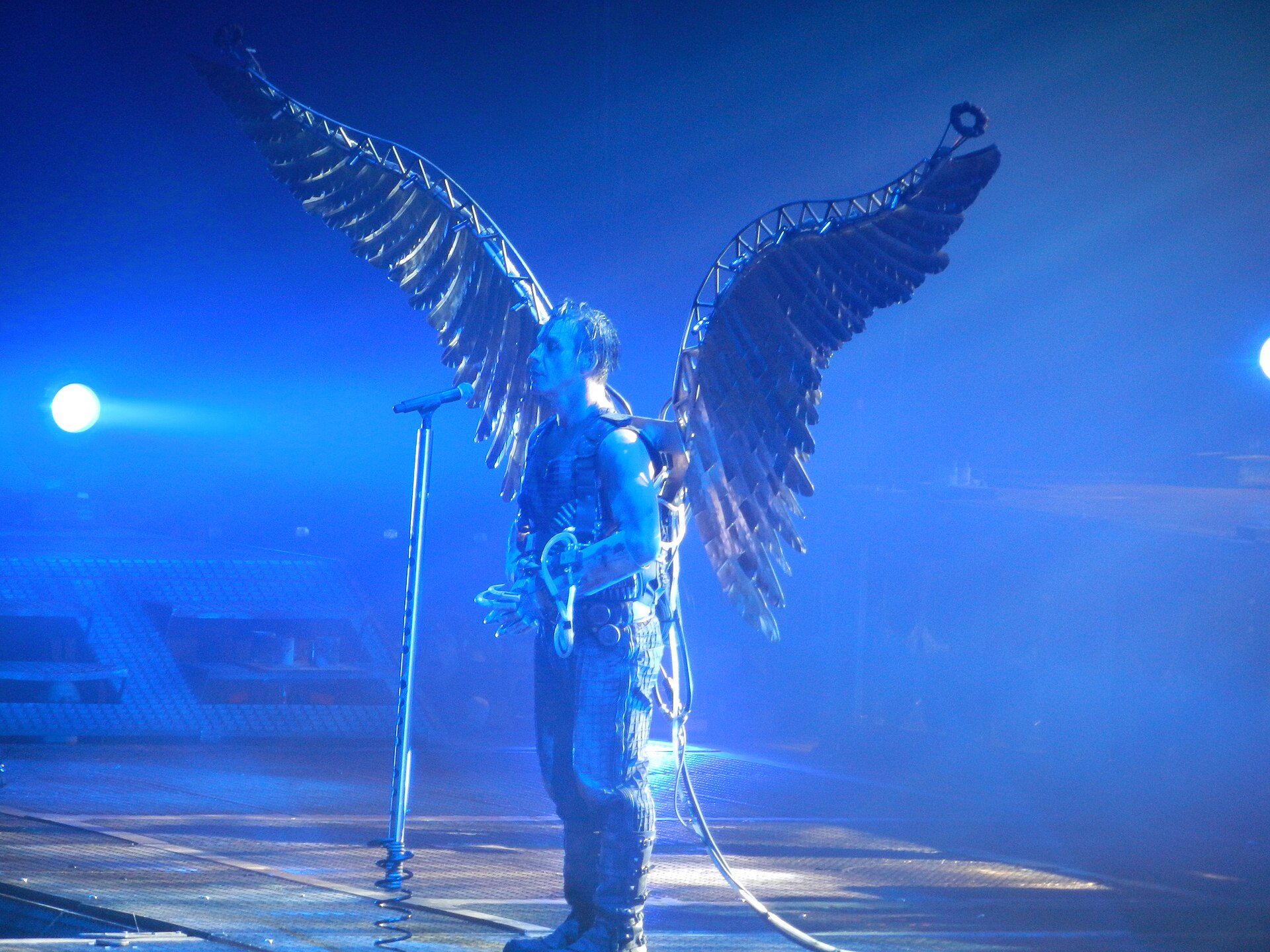
Photo: swimfinfan — Wikimedia Commons, CC BY-SA 2.0 (Rammstein, Allstate Arena 2012)
Rammstein's Mouth Light: The "Rammlied" Opener That Came Back 14 Years Later
A LED in Till Lindemann’s mouth, a slow elevator, and one song built to announce the band playing it: why the LIFAD-era opening was strong enough for Rammstein to reuse it in 2023.
The moment, in case you haven’t seen it
The house goes dark. Then one point of light appears above the stage, and it’s coming from inside Till Lindemann’s mouth. He’s riding an elevator down, slowly, singing the opening lines of “Rammlied” with his face lit from within like a jack-o’-lantern that decided to front a band. While he descends, the rest of Rammstein (everyone except drummer Christoph Schneider) rises through a hatch in the center of the stage, per the staging breakdown on RammWiki.
The version you want is the official one: “Rammstein – Rammlied (Live from Madison Square Garden)” on the band’s own channel, pulled from the Rammstein in Amerika film. That’s the December 11, 2010 show at Madison Square Garden, released as a concert film in 2015 (Wikipedia). Watch the first ninety seconds; the whole argument of this piece is in that one shot.
One song, one job
“Rammlied” is the opening track of Liebe ist für alle da (2009), and it opened the shows of the LIFAD Tour. According to the setlist archive at Rammstein World, it was played at 117 of the tour’s 118 shows between October 2009 and May 2011. That’s a song with a fixed position, welded to a specific piece of staging.
And the song earns the slot, because “Rammlied” barely pretends to be about anything except the band performing it. The chorus is the band’s own name, chanted like a summoning. The lab reading: it’s self-citation in plain sight. Herzeleid (1995) already had a track called “Rammstein”, and “Rammlied” opens the 2009 album with the same name turned into a chant. A band quoting its own founding myth, fourteen years later, in front of an arena.
So you have a song whose lyric function is announcement, paired with a stage entrance whose visual function is announcement. The light in the mouth says the same thing the chorus does: once in German, once in LED.
Pyro as grammar, not garnish
The flamethrowers, the foam cannon, the burning coat: the easy read on Rammstein’s production is “shock band, big budget, more fire every year.” But look at how the mouth light works and it reads more like grammar than spectacle.
The first thing the audience sees at a LIFAD show is the smallest light source an arena can hold, a glow the size of a mouth, doing the job that other productions assign to sixty moving heads, and it arrives before a single flame. Everything about the entrance is inverted: the singer descends while the band ascends, the biggest show in metal opens with its dimmest cue. That’s a choice about scale, and it only pays off because the next two hours escalate from it. You can’t feel the flamethrowers hit at full weight unless the show opened at one candle.
That’s the difference between pyrotechnics as language and pyrotechnics as gimmick. A gimmick is interchangeable: swap the mouth light for lasers and a gimmick show loses nothing. Rammstein’s opening is not interchangeable. The light is in the mouth because the voice is the instrument being introduced; the man is lowered like equipment because Rammstein has always played with the imagery of industry and machinery. Remove the specific image and the sentence stops meaning anything.
The 2023 return is the receipt
If you needed proof the band thinks of it that way, they provided it. On the 2023 European stadium tour, “Rammlied” came back as the show opener, replacing “Armee der Tristen”, with the same staging: mouth light, slow elevator, band rising through the hatch (RammWiki). This is a band with effectively unlimited production resources and a crew that can build anything they can draw. They could have opened 2023 with any new image money can buy. Instead they went back to a fourteen-year-old idea, unchanged.
Bands don’t do that with gimmicks. Gimmicks have expiration dates; that’s practically the definition. Bands do that with vocabulary. The mouth-light entrance had become part of how Rammstein says “the show is starting,” the same way a riff becomes part of how a band says anything. A stage image that survives fourteen years and gets deliberately restaged is repertoire.
Worth noting for anyone hoping to see it live: as of this writing (August 2026), there’s no tour to catch. Rammstein wrapped their 2019 to 2024 stadium run and have been quiet since summer 2024. The “Rammstein 2026 World Tour” dates floating around search results come from resale and clickbait sites; the band has announced nothing. The MSG film is the canonical way in.
Pull this thread next
Once you start reading stage production as language, the family tree gets interesting fast. Rammstein didn’t invent the idea that a prop can become vocabulary: Alice Cooper’s guillotine and KISS’s blood-spitting were doing repertoire-level stagecraft in the mid-’70s, and Iron Maiden turned a backdrop monster into arguably the most durable visual asset in metal. What’s distinct about Rammstein is the direction of scale: most theatrical bands escalate by adding, and Rammstein’s most iconic entrance works by subtracting down to a single mouth-sized light.
Which raises the question we want to chase in a future piece: what’s the actual lineage between the German industrial theater tradition and Rammstein’s staging? How much of this is metal inheritance, and how much comes from somewhere metal fans don’t usually look? If you’ve got a candidate for the most load-bearing stage prop in rock history, bring it to @realrocklab on X. We’re collecting nominees.
In this web: Rammstein · Till Lindemann