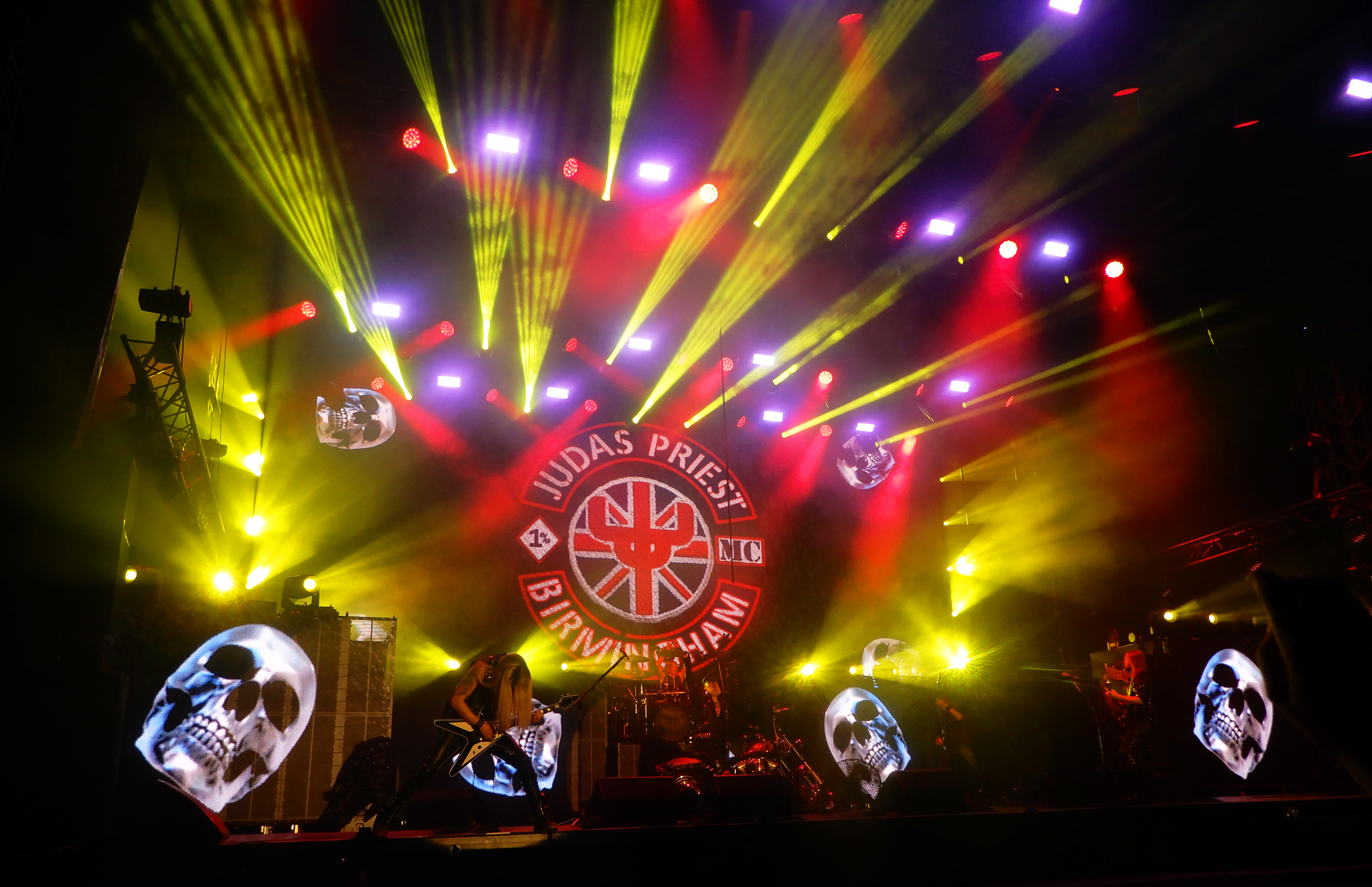
Foto: Antoine TILLY — CC BY-SA 4.0, via Wikimedia Commons
Queen has never made an album with Adam Lambert — and that's why he's still there
Roger Taylor says a return to the stage is “more down to Brian.” Fifteen years in, the thing that keeps Adam Lambert safe is the record Queen never finished.
Asked in June 2026 whether Queen would play live again, Roger Taylor did not say the band was tired. He said something stranger, and more useful:
“Well, it is a big machine to gear up, if you know what I mean.”
Then he handed the ignition key to someone else: “I think it’s more down to Brian [May] than me. I love playing live. I enjoy it, always have. It’s really how he feels about it.” (BBC Radio 2, The Rock Show With Shaun Keaveny, June 2026 — via brianmay.com; Blabbermouth picked it up in July.)
Machine is the right word. A legacy band at this scale is equipment — crew, freight, insurance, a stage that takes days to build. It has a start-up cost, and someone has to decide to pay it. In Queen’s case, that someone is one man with a documented medical history.
The paper trail behind “it’s more down to Brian”
Brian May had a stent fitted after a heart episode around 2020. In September 2024 he had a minor stroke and temporarily lost control of his left arm — the one that fingers the fretboard (Deadline, Variety).
Since then the signals have all pointed the same way. May, to Rolling Stone in September 2025: “I’ve had 50 years of touring and there’s a part of me that thinks it’s enough. […] I still want to play shows. I still want to innovate.” His wife Anita Dobson, to the U.K. Mirror in December 2025: “They will do little bits and bobs, but they won’t do those big tours. We are all getting old” (via Blabbermouth). And in January 2026, May ruled out the United States entirely — “America is a dangerous place at the moment” — telling the Daily Mail that the country “grew up” with Queen but “it’s not what it was” (via Rolling Stone).
There was an obvious escape hatch: the Sphere in Las Vegas. One room, no freight, no continent to cross. May was openly keen in September 2025 — “It’s got my mind working. The stuff that we could bring to this would be stupendous” — after watching the Eagles play there. A year on, there’s still no announcement: no dates, and Queen isn’t on Sphere’s published 2026 calendar. Whether that’s dead or just slow, nobody has said.
Last Queen show of any kind: Japan, February 2024. Before that, 23 North American dates in 2023. Nothing since.
The singer who was never a replacement
Taylor, in the same interview: “We have been working for a while with [singer] Adam Lambert, who has the most incredible voice.”
A while is doing a lot of work there. May and Taylor first sang with Lambert on American Idol in 2009; the occasional appearances started in 2011, and the first full show was Kyiv, 30 June 2012, on a bill shared with Elton John. Anchor it at 2011 and you get fifteen years.
The touring numbers are not small. The Rhapsody Tour ran 109 shows between July 2019 and February 2024, grossed $133,807,954, and sold 1,076,089 tickets out of 1,080,773 available — 99.6% capacity. Ten nights at London’s O2 Arena sold out to the last seat: 174,485 of 174,485 (Wikipedia, compiled from Billboard Boxscore).
It did not start warm. Far Out ran a piece under the headline “Is Adam Lambert the worst replacement singer in rock history?” — and spent the article knocking the label down. Lambert himself, to People in 2018, on that first show: “Man, I was really nervous beforehand. […] it was also the perception of the fans. I definitely had some concerns.”
It faded. And the interesting question is what he did in the fourteen years since that the other guys didn’t.
The three albums that ate three singers
Hold Lambert against everyone else who walked into a legacy band’s microphone.
Tim “Ripper” Owens joined Judas Priest in 1996 and made two studio albums, Jugulator (1997) and Demolition (2001). Both sold poorly. Owens was out in 2003 when Rob Halford returned, and Judas Priest has not played a song from either album since.
“Judas Priest decided — their decision, no one else’s — to erase the records. […] It was great when I was in the band; now I’m just erased. But they can’t erase the fun I had.”
— Tim “Ripper” Owens, video interview with Whiplash, June 2026 (via Ultimate Classic Rock)
Blaze Bayley joined Iron Maiden in 1994 and made two: The X Factor (1995) hit #8 in the UK, Virtual XI (1998) hit #16 — the band’s two worst-charting studio albums since Killers in 1981. US dates were cancelled when his voice gave out. He was gone by 1999. “They hated me just because I was new,” he later said (via Louder).
Gary Cherone joined Van Halen in 1996 and made one: Van Halen III, March 1998 — the first Van Halen album that failed to sell a million copies, and the only one with no RIAA platinum certification. A second record was recorded and never released.
Three singers, five albums, three exits. The pattern isn’t the voice. It’s the record. A new album is the moment a band asks its audience to accept the new singer as the singer — the point where comparison stops being conversation and becomes a sales figure.
Queen has never asked.
Queen tried, and threw it away
This is the part almost nobody connects to the Lambert question. They did go into a studio.
Roger Taylor: “We did record a song which we haven’t actually finished. I can’t remember what it’s called.”
Brian May: “It was a song that we’d tried to adapt that had come from a friend. It had the makings of being a great song, but we couldn’t crack it.”
— both to Classic Rock magazine (via Ultimate Classic Rock, February 2021)
May again, to Rolling Stone in September 2025: “Not many people know, but Adam and we have been in the studio trying things. […] Nothing really materialised so far. Some things are meant to be and some things are not.”
Fifteen years, no album. And the billing has always said what the arrangement is: not Queen, but Queen + Adam Lambert. That plus sign does every piece of legal and emotional work in the sentence.
Lambert has never pretended otherwise. To Music News at the O2 Silver Clef Awards in June 2023: “There’s no replacing Freddie Mercury. It’s impossible. […] I look at it always as a celebration and a tribute to him” (reported by Louder/Classic Rock). And to Smooth Radio in June 2026, on whether Queen tours again: “It’s sort of up to them. They’re the boss. I’m the guest.”
So the honest claim isn’t “most successful replacement.” It’s narrower and sharper: Lambert is the most successful case of a legacy band playing its catalogue without pretending it replaced the dead man.
Because two replacements did far better commercially, and pretending otherwise would be dishonest. Brian Johnson walked into AC/DC in 1980 and made Back in Black — the best-selling hard rock album ever made, 50 million-plus. Sammy Hagar walked into Van Halen in 1985 and put four consecutive albums at #1 in the US: 5150, OU812, For Unlawful Carnal Knowledge, Balance. Both of them replaced. Both committed to the new record. Both won.
That’s the fork. Commit to the album and you either become the band, like Johnson, or you get erased, like Owens. Never make the album and you stay a guest — which is a smaller job, and a permanent one.
Two bands, same problem, opposite answers — four weeks apart
In July 2026, a month after Taylor said the machine was down to Brian, Blaze Bayley headlined the Friday night of Eddfest at Knebworth Park — Iron Maiden’s own two-day 50th-anniversary event — the night before Iron Maiden played. He played material from The X Factor and Virtual XI. “I am so proud of my two albums with the band,” he said (Iron Maiden official; setlist.fm).
Judas Priest erased its era. Iron Maiden invited its era back onto the main stage. Same problem, opposite answers, one month apart — and Queen sits outside the choice entirely, because it’s the only one of the three with no era to erase or reclaim. There are no Lambert albums to argue about. There’s a live catalogue, a plus sign, and the whole of Fire Fight Australia sitting on Queen’s official YouTube channel from February 2020, where they played the Live Aid set start to finish for the first time.
Which leaves the machine question unanswered, and it isn’t Lambert’s to answer. He’s the part that starts every time.
The thread to pull next
If the album is what kills replacement singers, then the safest job in rock is the one with no studio time attached — and the most dangerous is the one that comes with a record deal. That reframes a lot of hires: Ripper Owens got a Grammy nomination in 1999 for “Bullet Train,” off an album his own band now behaves as though it never made.
Here’s what I want to test next: the singers who survived the album. Johnson and Hagar did. Who else? Steve Perry walked into Journey and rebuilt it. Ronnie James Dio walked into Black Sabbath and made Heaven and Hell, which is arguably a better record than the one before it. Is there a common shape to those, or did they just get lucky with the material?
Got a candidate — or think the plus sign is a cop-out? Come argue at @realrocklab on Threads or X.
In this web: Queen · Judas Priest · Iron Maiden · Van Halen · AC/DC · Black Sabbath · Brian May · Adam Lambert · Elton John