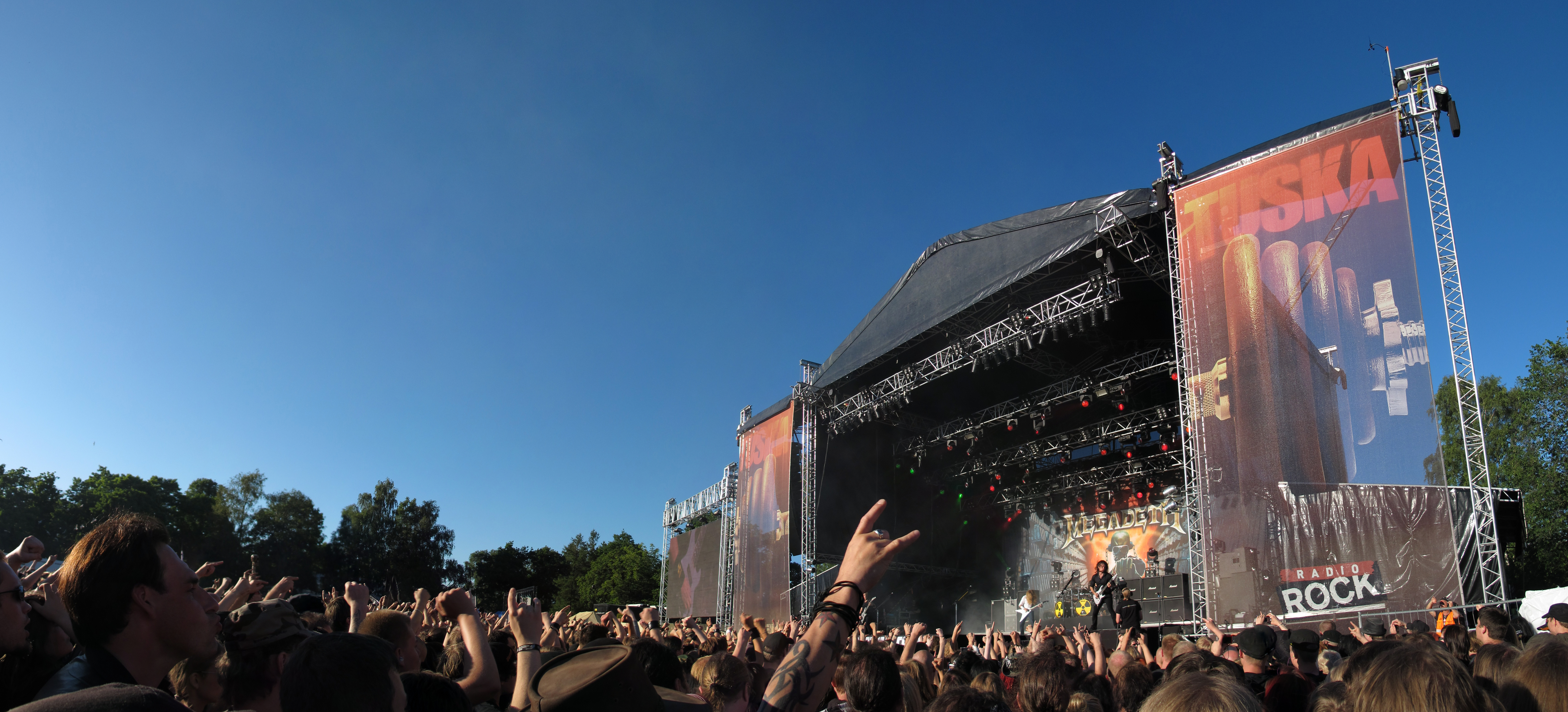
Foto: Fileri — CC BY-SA 3.0, via Wikimedia Commons
Peace Sells... But Who's Buying? at 40: Megadeth's Farewell, Mustaine's Memoir, and the Family Tree Behind His "New Big Four"
Four clocks struck in the same ten days of September 2026. Put them side by side and the story of Bay Area thrash turns out to be one family, still arguing at the same table.
The week the calendar lined up
Start with the dates, because nobody planned them and they still fit.
On September 8, Dave Mustaine published In My Darkest Hour: A Memoir, written with Joe Layden and centred on his 2019 throat cancer diagnosis and the making of The Sick, The Dying… and the Dead! (megadeth.com, Rolling Stone).
On September 13, Blabbermouth ran an interview Mustaine gave to Czech channel Óčko, in which he named the bands he would put in a new Big Four of thrash (Blabbermouth).
On September 19, Peace Sells… but Who’s Buying? turns 40.
And the whole time, Megadeth is on the road on what the press has been calling its farewell tour, opening for Iron Maiden on the North American leg of the Run For Your Lives 50th-anniversary run. That leg started August 29 in Toronto and ends September 29 in San Antonio, with Megadeth on every date and Anthrax on four of them (Rolling Stone, Consequence, megadeth.com). Australia and New Zealand follow in November, Auckland first (ironmaiden.com).
So the anniversary lands mid-tour. The band will be somewhere between two arenas when the record hits 40, which feels right for this record.
Clock one: the record
Peace Sells… but Who’s Buying? came out on Capitol in September 1986. Wikipedia gives September 25 (Wikipedia); uDiscover Music and most anniversary coverage give September 19 for the US release (uDiscover). I’m going with the 19th. Mustaine produced it with Randy Burns. David Ellefson played bass.
It peaked at number 76 on the Billboard 200, which sounds modest until you remember what 1986 radio was playing. It went platinum eventually. Rolling Stone put it at number 8 on its 2017 list of the 100 greatest metal albums, above a lot of records that sold ten times more.
The part the DJ in me loves: the bass line that opens the title track became the bumper for MTV News. If you watched MTV in the late eighties or nineties, you heard Ellefson’s bass hundreds of times without knowing whose it was. Mustaine has said the band never got royalties for it, because the piece was pulled shortly before MTV would have owed them money (Wikipedia). Forty years on, that bass line is probably the most-heard thing Megadeth ever recorded, and it was heard by people who never bought a Megadeth record. There is a joke about the album title in there. I will leave it alone.
Clock two: the road
Opening for Iron Maiden on a farewell run is a strange, generous way to go out. Iron Maiden is celebrating 50 years. Megadeth is closing a book that opened in 1983. This pairing has a particular weight: the headliner is doing a victory lap and the opener is saying goodbye, on the same stage, in the same night.
Whether “farewell” is the band’s official wording or the press’s shorthand, I cannot tell you. Loudwire hedged it as “what’s been billed as their farewell tour” (Loudwire), and I will hedge it the same way. The itinerary needs no hedging: Toronto to San Antonio, then across the Pacific in November. If you want to see “Peace Sells” played by the man who wrote it, you have a few weeks and a few countries.
Clock three: the book
In My Darkest Hour is Mustaine’s second memoir, and the subject this time is narrower and harder: the throat cancer, the treatment, and making a record while not knowing whether the voice would come back. I have not read it yet. I mention it here because of what it means for the timing. A man who nearly lost his voice in 2019 is, seven years later, publishing the account of that year during the same month his band’s farewell run crosses the US and he watches his most-loved album turn 40. He picked this September.
Clock four: the “new Big Four”, and why it is the old one
Asked which bands would form a new Big Four of thrash, Mustaine said: “I think that TESTAMENT, I think OVERKILL, I think EXODUS, and maybe TRIVIUM; I don’t know. TRIVIUM’s not really a thrash metal band, so I’d have to think about that.” (Blabbermouth)
Most outlets ran this as a list, and as a list it is a nice tip of the hat from an elder to the next tier. Read it as a map and something else shows up: the “new” Big Four is already wired into the old one, and Mustaine himself is one of the wires.
Take Exodus. The band was formed in 1979 by guitarists Kirk Hammett and Tim Agnello, with drummer and vocalist Tom Hunting and singer Keith Stewart (Wikipedia). In April 1983, Hammett left Exodus to replace Dave Mustaine in Metallica, on the recommendation of producer and then-manager Mark Whitaker. Mustaine had been officially ejected on April 11, 1983, after the band had already driven to New York to record their debut, Kill ‘Em All (Wikipedia). He still has co-writing credits on four songs from that record. He went home and started Megadeth.
So the founder of the band Mustaine just nominated is the man who took his chair.
Then there is the other guitar chair in Exodus. When Tim Agnello left in 1981, a 17-year-old Gary Holt took it, and Holt is the only person on every Exodus album since (Wikipedia). In February 2011, Holt was announced as the temporary fill-in for Jeff Hanneman in Slayer. After Hanneman’s death in May 2013 the job became permanent, and Holt stayed until Slayer’s split at the end of their 2018 to 2019 farewell tour, then came back when the band resumed touring in 2024.
One Exodus guitarist became Metallica’s. The next Exodus guitarist became Slayer’s. That is two of the original Big Four staffed out of one Bay Area club band, and the one who got displaced by the first move is the man who built the third.
Testament and Overkill have their own threads into that same scene, and I would rather do those properly than in one line here. The point is already made with Exodus alone: Mustaine did not name successors. He named cousins. The genealogy runs through the same handful of rooms in the Bay Area in 1981 to 1983, and it runs straight through him.
The thread to pull next
Forty years after Peace Sells, the man who wrote it is on a farewell stage, has a memoir on the shelf about nearly losing his voice, and is publicly passing a torch to a band whose founder replaced him. Hammett and Mustaine have both talked about April 1983 many times over the decades; whether the memoir says anything new about it, I do not know yet.
What I want to hear from you is narrower. Who is the Exodus of the next tier? Which band, right now, is staffing everyone else’s lineups the way that one Bay Area group did in 1983? I have a candidate and I am not sure about it. Bring yours to @realrocklab on Threads or X.
In this web: Megadeth · Iron Maiden · Exodus · Metallica · Slayer · Dave Mustaine · David Ellefson · Kirk Hammett · Gary Holt