The Ozzy guitarist pipeline — brand art, Real Rock Lab
Ozzy Osbourne's Guitarists: How Rock's Greatest A&R Career Happened by Accident
Part 2 of 4 in our series climbing to July 22. Ozzy Osbourne never scouted a guitarist in his life. He collided with them. Seven collisions, four decades, and a family tree half of rock still lives in.
The frontman who kept tripping over the future
Last week we traced how heavy metal itself started with an industrial accident in a Birmingham factory. With Ozzy Osbourne, the accidents never stopped. They just changed shape.
When Ozzy left Black Sabbath in 1979, he needed a guitarist. Over the next four decades, the solo band became the single most productive guitar pipeline in hard rock, and almost none of it was on purpose. Ozzy didn’t audition players so much as walk into them, half by luck, half drunk, occasionally literally asleep. And every collision seeded a scene somewhere else.
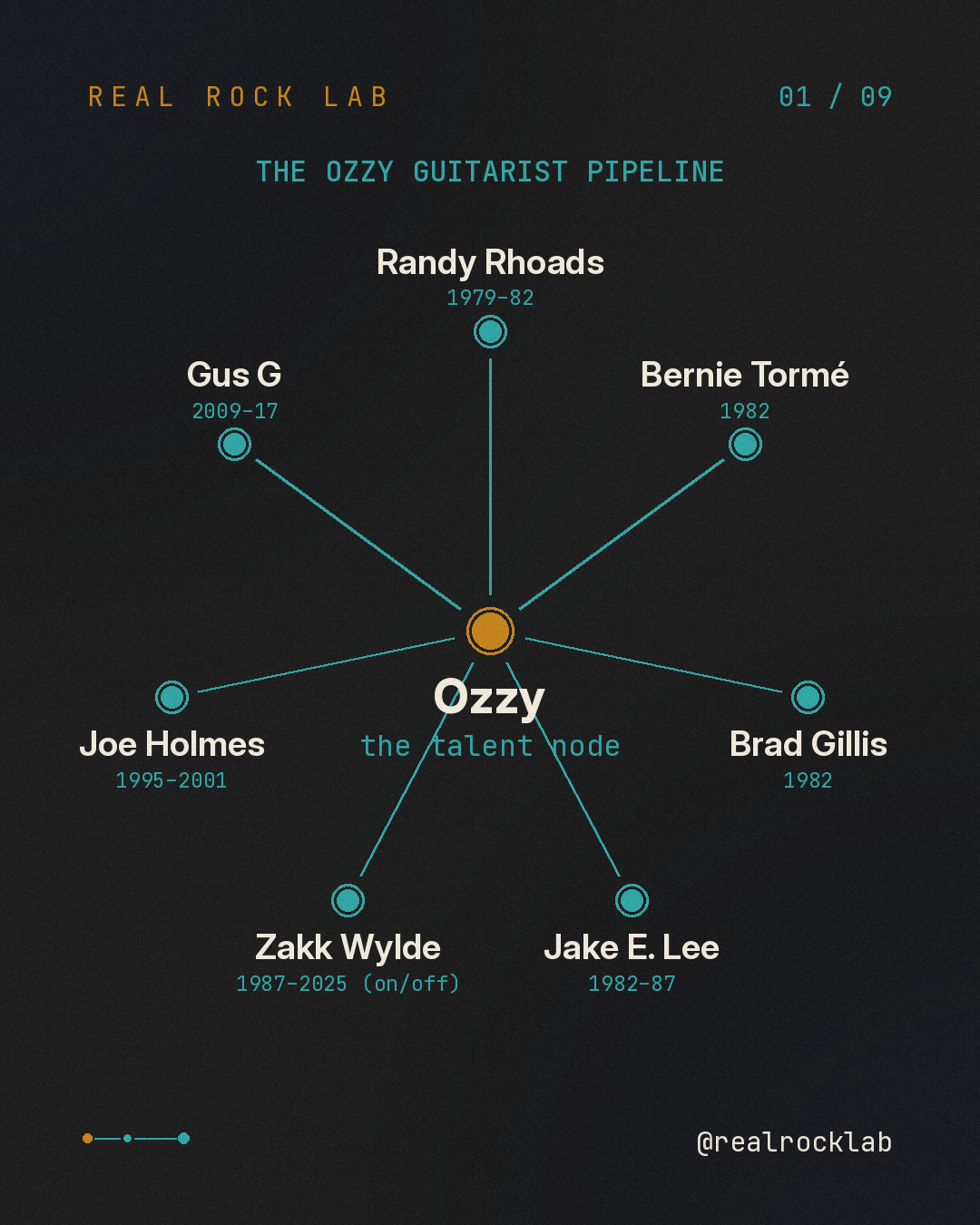
Ozzy was a talent node more than a talent scout. Things connected through him whether he was paying attention or not. Pull up the map, with Ozzy in the center and seven guitarists orbiting, and watch how each one arrives by accident and leaves carrying a whole new branch of the tree.
The succession, in one breath
The full chain runs: Randy Rhoads (1979-82), Bernie Tormé (a roughly seven-show stopgap in 1982, live only), Brad Gillis (1982), Jake E. Lee (1982-87), Zakk Wylde (on and off from 1987 through the 2025 farewell), Joe Holmes (touring, 1995-2001), and Gus G (2009-17).
Each of those hires has its own story.
Randy Rhoads: hired while warming up
The origin collision happened in late 1979, when bassist Dana Strum dragged Rhoads, then Quiet Riot’s guitarist, to an LA audition. Rhoads plugged into a practice amp and started warming up. Ozzy hired him on the spot. Per Ultimate Classic Rock and Guitar World, Ozzy’s verdict came mid-warmup (you’ve got the gig), and Rhoads essentially replied: you didn’t even hear me yet. Ozzy has admitted he was too drunk to properly judge the audition anyway.
Too drunk to judge, and he still made the single best guitar hire of the 1980s. Blizzard of Ozz (1980) and Diary of a Madman (1981) rewired what metal guitar could be. Rhoads died in a plane crash on March 19, 1982, at 25, and the Rock and Roll Hall of Fame gave him its Musical Excellence Award in 2021. Two albums make up the whole studio catalog, and they were enough.
1982: the year of emergency guitarists
Rhoads’s death left a tour mid-flight. Bernie Tormé stepped in as the stopgap (around seven shows, nothing recorded), and then Brad Gillis arrived at genuinely absurd speed: auditioned April 5, 1982, played his first show April 12. Seven days from tryout to stage. He’s the guitarist on the live Speak of the Devil (1982).
That’s the first payoff of the node effect: Gillis went straight back to Night Ranger, who put “Sister Christian” on the radio in 1984. A guitarist passes through Ozzy’s orbit for months and comes out the other side into one of the defining power ballads of the decade. Ozzy’s band accelerated players more often than it kept them.
Jake E. Lee: “He’s got it. You don’t. You’re fired.”
The Jake E. Lee hire is the closest Ozzy ever came to an actual A&R decision, and it still reads like a bar fight. The audition came down to Lee versus George Lynch, and per GuitarPlayer, Ozzy settled it with one of the great brutal sentences in rock hiring: “He’s got it. You don’t. You’re fired.”
Lee delivered Bark at the Moon (1983) and The Ultimate Sin (1986), then left in 1987, and this is where the map loops back on itself. Lee founded Badlands with singer Ray Gillen, who had himself just come out of Black Sabbath. Ex-Ozzy guitarist plus ex-Sabbath singer: the family tree grafting onto its own roots. Lee later resurfaced with Red Dragon Cartel, still carrying the branch forward.
Zakk Wylde: hired off a Polaroid
If Rhoads was hired without being heard, Zakk Wylde was nearly hired without being seen. In 1987, a demo tape and a Polaroid, taken by Zakk’s sister, reached Ozzy through rock photographer Mark Weiss. According to Loudwire and GuitarPlayer, what Ozzy remembered was the photo, not the tape: this kid must really love Randy Rhoads. Then Ozzy got drunk with Andre the Giant and missed the first audition entirely.
That Polaroid bought rock nearly four decades of Zakk: No Rest for the Wicked (1988) through Patient Number 9 (2022), across stints in 1987-92, ‘95, ‘98, 2001-09 and 2017-25. And the seeding here is the biggest of all: Black Label Society (founded 1998), Zakk Sabbath, and the touring guitar chair in the reunited Pantera. One missed audition, three active branches.
Joe Holmes: the secret student
This is the node’s strangest connection. In 1995, drummer Deen Castronovo tipped Ozzy off about Joe Holmes. Holmes toured with Ozzy from 1995 to 2001 (his only studio appearance is “Walk on Water,” 1996), and the whole time he was sitting on a secret: back in 1979, Holmes had been Randy Rhoads’s actual guitar student.
He never told Ozzy. And Ozzy, unaware, told Guitar World that Holmes’s playing reminded him of Randy.
Ozzy couldn’t have scouted that connection because he didn’t know it existed. The system routed Rhoads’s teaching back into Ozzy’s own band, sixteen years later, through a player who kept it quiet. Neither luck nor A&R explains it. A talent node works like this: the connections form on their own, and the node feels them without seeing them. Holmes’s solo album, fittingly, has Robert Trujillo and Mike Bordin on it, both ex-Ozzy rhythm section, per Blabbermouth.
Gus G: the demo handed at Ozzfest
The last hire is the most modern-shaped collision. In 2005, a Greek guitarist handed his band Firewind’s CD to Ozzy’s people at Ozzfest. Four years of silence. Then, per Blabbermouth: a 2009 email invite, four songs learned, hired on the spot, public debut at BlizzCon in August 2009. Gus G played on Scream (2010), stayed through 2017, and went back to Firewind, with a new band, Steel Burner, landing in 2026. Even the pipeline’s quietest chapter still seeded something.
The node, one year on
Ozzy died last July, and the orbits are still moving, which is the point. Zakk Wylde told WRIF in June he’s open to yearly Ozzy gatherings, alongside the Berzerkus 2026 festival. Jake E. Lee told Loudwire and GuitarPlayer he’d felt forgotten in Ozzy’s legacy until the final show, and that he received Ozzy’s last text. Gus G skipped the farewell entirely, telling TheMetalList in April, “I probably wasn’t needed there.”
Three guitarists, three different relationships to the same center. A scout builds a roster; a node builds a field, and the field outlives the node.
The thread to pull next
One thing kept snagging me while mapping this, and Joe Holmes’s solo record points at it: Trujillo and Bordin. The rhythm sections passing through Ozzy’s band have a family tree at least as tangled as the guitarists’, and one of them ended up in the biggest metal band on Earth. That’s part 3.
Got a favorite Ozzy-guitarist era, or a connection we missed on the map? Bring it to @realrocklab on X, which is where this conversation lives.
In this web: Black Sabbath · Night Ranger · Badlands · Black Label Society · Firewind · Ozzy Osbourne · Randy Rhoads · Zakk Wylde · Jake E. Lee · Joe Holmes · Gus G · Brad Gillis · Bernie Tormé