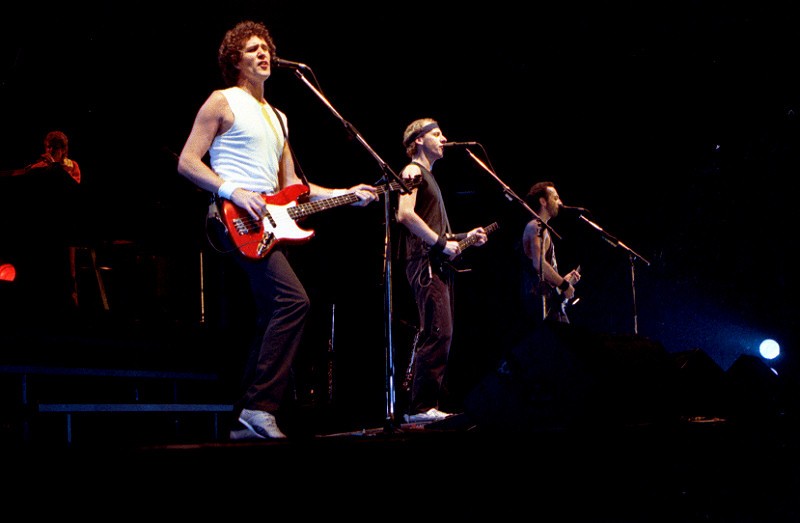
Dire Straits on the Brothers in Arms tour, October 1985 — photo by Helge Øverås (CC BY-SA 4.0, via Wikimedia Commons)
'Money for Nothing' Wasn't the First CGI Music Video — But It's the One That Changed Everything
Everyone remembers the blockhead movers from 1985. Almost nobody remembers the two animators behind them, or that their next act was the first all-CGI TV series in history.
First, let’s kill the myth
Ask anyone to name the first computer-animated music video and you’ll get the same answer: Dire Straits, “Money for Nothing,” 1985. The blocky delivery guys. The floating dog. “I want my MTV.”
Wrong, and the real story is better.
The first CGI music video, as far as anyone can pin down, is Will Powers’ “Adventures in Success” from 1983, a strange, half-forgotten art project by rock photographer Lynn Goldsmith, two full years before Mark Knopfler ever put on that headband (The Vinyl Factory has the whole affirmative-disco saga). Even Mick Jagger got there first: his 1985 solo clip “Hard Woman” was rendered on a Cray X-MP supercomputer (IMDb), the same family of machines governments used for nuclear simulations.
So what did “Money for Nothing” do? It took CGI mainstream. It’s the difference between the first garage band to use distortion and the record that made every kid want a fuzz pedal (Vice makes the case well). Being first is trivia. Being the one everybody copies is history.
What was actually on screen in 1985
The single dropped June 28, 1985, and the video, directed by Steve Barron, who was already the guy for ambitious clips, followed that summer. The animation was built by two artists, Ian Pearson and Gavin Blair, on a Bosch FGS-4000 animation system with a Quantel Paintbox handling the paint work (Wikipedia).
This was one of the first music videos to attempt computer-animated human characters. Crude, blocky, hilarious people, but people, at a time when most CGI on screen was wireframes and flying logos. The machines of 1985 could barely handle it, and the animators leaned into the limitation instead of fighting it. The blockheads look the way they look because that’s what the hardware could do, and the style became iconic because of the constraint. There’s a lesson in there for every producer who ever made a classic out of a broken amp.
The band-performance shots got their own treatment: live footage rotoscoped and colorized frame by frame into glowing neon on the Quantel Paintbox, by Barron’s own account, so the whole clip reads as one continuous experiment, a lab piece from start to finish.
The Sting connection hiding in the writing credit
Pull up the credits and you’ll find Sting listed as co-writer. He wasn’t in the room for the riff; the credit comes down to four words. That falsetto “I want my MTV” hook is sung to the melody of The Police’s “Don’t Stand So Close to Me,” and the publishing lawyers noticed before anyone else did (Songfacts, Wikipedia).
So the song about MTV borrows its MTV slogan from another band’s melody, and MTV then wrapped itself around the song completely: at the 1986 VMAs it pulled eleven nominations and won Video of the Year and Best Group Video, plus a 1986 Grammy for Best Rock Performance by a Duo or Group with Vocal (Songfacts).
Then MTV did something almost too on-the-nose. When MTV Europe launched on August 1, 1987, the first video ever aired on the channel was “Money for Nothing,” deliberately, for the “I want my MTV” of it all (uDiscoverMusic, Far Out). A network launching itself with a song that satirizes the network. Nobody’s ever fully decided who was in on the joke.
Where the animators went next: this is the good part
Ian Pearson and Gavin Blair, the two guys rendering blockheads on a Bosch FGS-4000, didn’t stop at music video. They went on to found Mainframe Entertainment, the studio that made ReBoot in 1994, the first all-CGI television series ever produced.
A Dire Straits video was the proving ground for the people who put full CGI on television a year before Toy Story hit cinemas. Every all-CGI show your kids watch traces part of its DNA back to a song complaining about guys who get their money for nothing on MTV. The video that mocked television ended up rewiring it.
Fifteen years later: ‘Californication’ flips the whole idea
Now jump to June 5, 2000. Red Hot Chili Peppers release the video for “Californication,” directed by Jonathan Dayton and Valerie Faris, the duo who’d later get Oscar-nominated for Little Miss Sunshine (IMVDb, IMDb).
By 2000, CGI wasn’t novel anymore. You couldn’t impress anyone by simply having computer graphics. So Dayton and Faris made the CGI pretend to be something else. The whole video is a fake third-person video game, one playable storyline per band member, complete with game-camera swoops, level geometry, and PS1-era jank that was at least partly a choice.
“Money for Nothing” said: look what computers can do now. “Californication” said: computers are so everywhere that we can do bits about them. That’s the full arc of a technology in two clips, from spectacle to vocabulary.
And then reality caught up with the joke. In 2022, Spanish developer Miquel Camps Orteza built the Californication game for real, seven levels recreated from the video in Unity, free to play on itch.io (PC Gamer, Guitar.com). A video pretending to be a game became a game pretending to be a video, twenty-two years later.
The channel died; the videos didn’t
On December 31, 2025, MTV’s last remaining 24-hour music channels went dark worldwide, and the final video they played was “Video Killed the Radio Star,” the same clip that opened MTV US on August 1, 1981 (Rolling Stone, Collider).
This August 1, MTV would have turned 45. The network that “Money for Nothing” mocked and crowned at the same time is gone as a music channel, but the video outlived it, and so did everything the video set in motion: the animators, the studio, the entire idea that a music clip could be a technology demo with a sense of humor. The song asked for its MTV. It got something stranger: it outlasted its MTV.
The thread to pull next
Steve Barron is the quiet node in all of this. Before the blockheads, he directed a-ha’s “Take On Me,” the pencil-sketch rotoscoping clip that was the other most famous animation experiment in music video, released the same year. One director, one year, two completely different animation revolutions. That’s a body of work, and it’s where we’re going next.
Got a candidate for the most underrated CGI clip of the ’80s or ’90s? Bring it to @realrocklab on X. The lab is open.
In this web: Dire Straits · The Police · Red Hot Chili Peppers · Sting