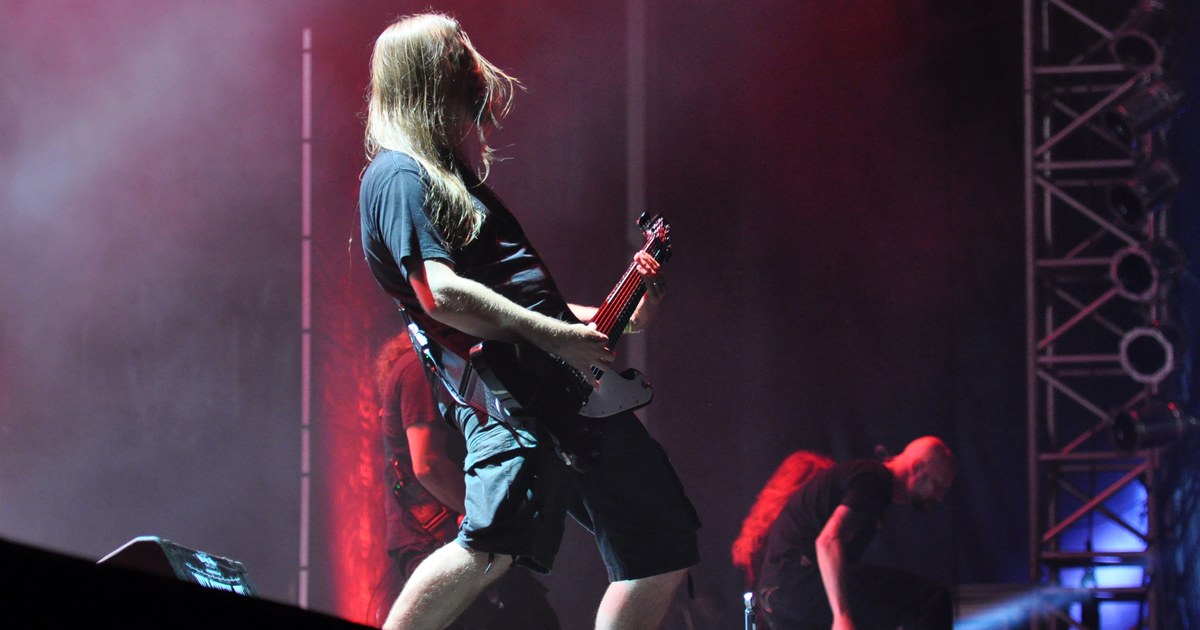
Meshuggah at Wacken Open Air, 2013 — photo: Jonas Rogowski, CC BY-SA 3.0, via Wikimedia Commons (cropped)
Meshuggah to Spiritbox: The Djent Lineage Hiding Inside Mike Stringer's Guitar
Three straight Grammy nominations, a Grammy-stage performance, and an arena tour on deck: Spiritbox is metal’s new blood. Trace the signal chain in their guitars and you find a twenty-year lineage that starts with one slurred syllable in Sweden.
In February 2026, Spiritbox played “Soft Spine” on the Grammy stage, in their third consecutive year nominated for Best Metal Performance (Revolver has the clip). Turnstile took the trophy home. Fine. Awards are a lagging indicator anyway.
The leading indicator is bolted into Mike Stringer’s guitar.
The pickups are a family tree
Stringer plays signature Aristides STX guitars in 6, 7 and 8-string versions, with the 7 tuned down to drop F# (Premier Guitar’s Rig Rundown, February 2026). The pickups in them are his signature Bare Knuckle Halcyon set, launched in early 2025 and built specifically to stay articulate at tunings that low (Guitar World).
The credit line on the Halcyon is the detail that gets skipped. Bare Knuckle credits the design to Stringer, company founder Tim Mills, and Adam “Nolly” Getgood of Periphery (it’s right on the product page).
Periphery is the band Misha Mansoor built in the mid-2000s out of a bedroom, a laptop, and an obsessive Meshuggah forum habit. The scene that spent years chasing Meshuggah’s palm-muted tone on internet message boards eventually produced the guy who helped voice the pickups in the biggest new metal band of 2026. Meshuggah’s DNA got into Spiritbox through the scene itself, one pair of hands at a time, and ended up in the hardware. That is a deeper route than the “influence” a band names in interviews.
The rest of this piece is the wiring diagram.
A drunk word becomes a genre
Meshuggah, Swedish and polyrhythmic and frankly terrifying, had a guitar tone so distinctive it needed its own onomatopoeia. The story, as retold in Guitar World’s history of djent, is that guitarist Fredrik Thordendal, post-show and several drinks deep, tried to vocalize the sound of his own palm-muted chug to a fan: djent. The drunken-slur framing is lore more than record, but the word’s Meshuggah origin isn’t in dispute.
Whatever the exact delivery, the syllable escaped. Through the mid-2000s it became the organizing word of a forum scene: kids on Meshuggah message boards trading amp sims and eight-string tab, trying to reverse-engineer that tone without owning a real amp. Mansoor turned it into Periphery. Acle Kahney turned it into TesseracT. A genre got named by accident and built in bedrooms.
One of the people downstream of all that was a guitarist in Victoria, British Columbia, playing in a screamo-adjacent band he’d never quite felt at home in.
Two “replacement people” quit and start over
The Courtney LaPlante origin story deserves its own episode. In 2012, iwrestledabearonce’s vocalist Krysta Cameron left mid-Warped Tour. A tour rep suggested LaPlante, then about 23, who flew from Canada to Dallas and performed the next day, having never met the band (per Alternative Press, via her Wikipedia entry). Stringer joined the same band during the Hail Mary sessions in 2015.
And then, with two weeks left on a tour that same year, they both quit. LaPlante later said they’d never shaken the feeling of being “replacement people” in someone else’s band (Loudwire, 2019). They married in 2016 and asked wedding guests to skip the gifts and fund their music instead (Rock Sound). Two weeks after the wedding, on October 9, 2017, Spiritbox was announced out of Victoria, BC.
LaPlante’s own framing of the band’s design principle: “My main goal with this band is fluidity” (Rock Sound). Coming from two people who knew exactly what a rigid band feels like from the inside, that reads as a mission statement.
The rise, in five data points
- July 2020: “Holy Roller” goes pandemic-viral, hitting #25 on Billboard’s Hot Hard Rock chart.
- September 2021: Eternal Blue debuts at #13 on the Billboard 200.
- 2024 to 2026: three consecutive Best Metal Performance Grammy nominations: “Jaded,” “Cellar Door,” “Soft Spine.”
- March 2025: Tsunami Sea lands at #26 on the Billboard 200 and #1 on Top Hard Rock Albums (Lambgoat).
- Right now: they’re out on Evanescence’s 2026 world tour with Nova Twins (Live Nation), with their own biggest-ever EU/UK arena run alongside Jinjer coming in September (Knotfest).
That’s eight years from wedding-gift funding to arenas, and the forum kids’ scene grew a headliner.
How a new metal fan gets made in 2026
Spiritbox matters beyond their own numbers because they’re an on-ramp, and the on-ramp runs in both directions.
LaPlante names Meshuggah, alongside TesseracT and Deftones, as her standard-bearer for heaviness, but her clean singing pulls from Kate Bush, Amy Lee, and modern R&B: Doja Cat, SZA, The Weeknd (her cited influences). Those influences are built into the structure of the songs. A pop listener arrives through the choruses of “Cellar Door” and leaves, six months later, streaming obZen. Megan Thee Stallion fans find them through the “Cobra” rock remix, Poppy fans through “End of You”, their 2025 collaboration.
Brazilian readers may have already caught them in the flesh: Spiritbox opened for Korn at Allianz Parque in São Paulo this past May (Wikimetal). It was a one-off show for forty thousand people, and a decent bet that some of them walked in for the headliner and walked out googling the opener.
Assembled, the machine looks like this: Meshuggah makes the sound. A forum scene names it, takes it apart, and learns to build it. The scene’s alumni design the tools. A married couple who refused to stay replacement people picks up those tools and welds pop architecture onto them. And a new fan, 2026 model, walks in through a Grammy broadcast, an Evanescence tour, or a São Paulo one-off, with no idea they just joined a lineage that started with a drunk Swede imitating his own amplifier.
The thread to pull next
There’s one node in this web we deliberately skipped: TesseracT. Acle Kahney came out of the same Meshuggah forums as Mansoor, but where Periphery’s branch of djent got sharper and more aggressive, TesseracT’s got spacious, and LaPlante cites them right next to Meshuggah in her canon. Same forum, two bands, and opposite answers to the same question. That fork is its own story, and we’re taking it apart soon.
Got a first-Spiritbox-song story? Which door did you come in through? Tell us @realrocklab on X.
In this web: Spiritbox · Periphery · Meshuggah · Korn · Mike Stringer · Courtney Laplante