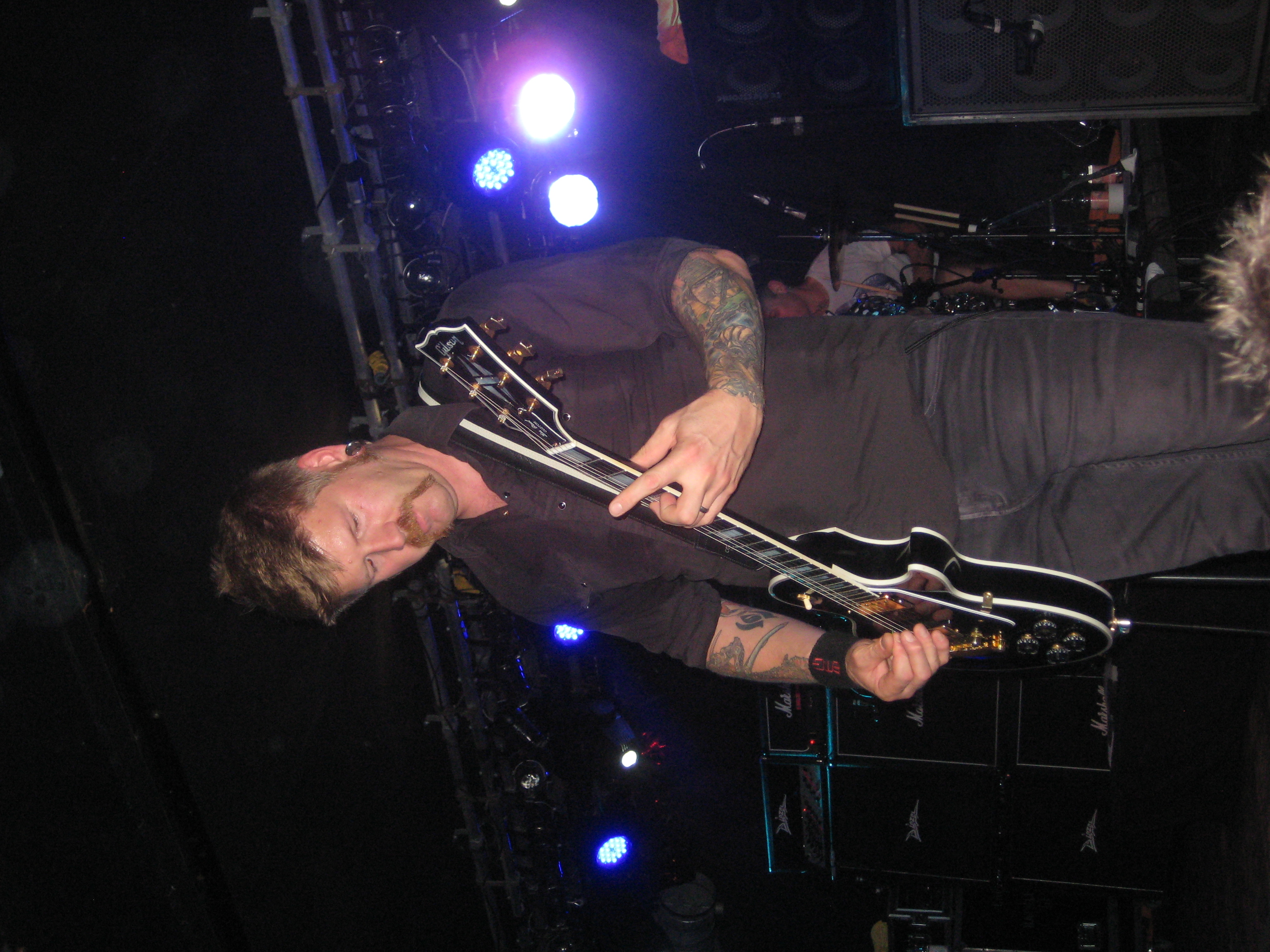
Foto: © JD (de.wikipedia.org) — CC BY-SA 4.0, via Wikimedia Commons
Mastodon's *Marrow Deep*: one voice out, two members in
Brent Hinds was gone before a single note of this record was tracked. What Mastodon did next was fill the space with two new members instead of a replacement.
The aggregator headline writes itself: first Mastodon album without Brent Hinds. It is true, and it is the least interesting sentence you can write about Marrow Deep.
Here is the more useful way in. Mastodon went into the studio down a guitarist and came out a five-piece. Nick Johnston took the guitar chair, and keyboard player João Nogueira became an official member. Nine albums in, this is the first one made by five people. Something got added here.
The timeline, in order, because everyone is compressing it
Brent Hinds left Mastodon in March 2025, after 25 years, in a split neither side dressed up. Five months later, on 20 August 2025, he was killed in a motorcycle accident in Atlanta. He was 51.
The band tracked Marrow Deep the month after that, in September 2025, at their own West End Sound in the same city. So the record does not document a band losing a member mid-session. He was already gone.
The loss ledger around it is real, and it belongs to more than one person. Troy Sanders lost his home to Hurricane Helene in September 2024. Brann Dailor’s mother died in February 2025, after being resuscitated four times. Hinds left in March and was dead by August. Dailor has done most of the talking since, and his line about the title is the whole record in a sentence: marrow deep is as deep as you can get into a relationship, “first and foremost my mother, but then a brother of 25 years.”
He also said the thing every band in this position wants to say and usually cannot: “Nobody wanted this album to be about the things that it’s about. But that’s not how it worked out.”
They did not hire a Hinds
This is the part worth listening for, and you can hear it without anybody explaining it to you.
Hinds played sideways. Blues bent out of shape, slides landing a beat off from where your ear went looking, lead lines that felt like they were arguing with the riff underneath them. That crookedness was half of what made a Mastodon song sound like Mastodon and not like any of the bands that copied them.
Johnston does none of that. He comes out of clean, melodic instrumental rock, and he plays through a riff rather than across it. Where Hinds would drag a phrase off-centre, Johnston runs it straight and lets it ring. Put a 2026 lead next to anything off Leviathan and the difference is one of direction rather than skill. Same band, different centre of gravity.
Dailor’s account of hearing him reads like enthusiasm rather than compromise: “Once I got to hear Nick play, it blew me away.” And on the new members generally: “Adding Nick and João really helped rejuvenate the material that was already there.”
That last quote is the one I keep circling, and I will come back to it.
The room got more crowded on purpose
Down a guitar, Mastodon filled the studio with other people. Josh Homme is on “Snakes for Dinner.” Neil Fallon of Clutch sings on “The Three Fates.” Randy Blythe of Lamb of God and Joe Duplantier of Gojira both appear.
And then there is Geezer Butler, who does not sing at all. He sent back the bass solo that opens “The Vanishing.” Sanders asked through management after Black Sabbath’s farewell show, and the band has still never met him.
Four frontmen you would recognise anywhere, plus a bass part from a man they have never been in a room with. A group that lost its most identifiable voice went looking for other people’s.
Rock has run this experiment, and it goes both ways
Guest-heavy records made after a signature voice leaves tend to break into two outcomes.
Sometimes the borrowed voices become the house. Black Sabbath spent the 1980s cycling singers after Ronnie James Dio left, and by Headless Cross the band that existed was a different band with the same name. Tony Iommi’s late-eighties records are essentially Iommi plus whoever fit, and that arrangement lasted years.
Sometimes it is a bridge you cross once. Slipknot’s We Are Not Your Kind is the obvious version of a band absorbing the loss of a founding member and then closing the door on outside help. The guests do a job and the band goes back to being itself.
Which of those Marrow Deep turns out to be is not a question the reviews can answer. It is a question the next album answers.
The production credit nobody is reading correctly
Marrow Deep was produced by Patrik Berger and Kurt Ballou, and mixed by Andrew Scheps.
Ballou is the expected name. He runs GodCity and his fingerprints are on a long line of heavy American records, Converge’s own catalogue included.
Berger is the strange one, and the interesting one. He is a Swedish pop producer whose credits run through Robyn and Lana Del Rey. That is not a heavy-music CV in any sense, and it is on a Mastodon album, next to Kurt Ballou. Two producers from opposite ends of the industry on a record about the Three Fates.
Speaking of which: the whole thing is organised around the Moirai, the three who spin the thread of a life, measure it and cut it. “The Three Fates” is a track. A band that has just buried people did not pick that frame by accident.
The record landed at 81 on Metacritic and hit number 40 on the Billboard 200.
The open question, and it is a big one
Go back to Dailor: “the material that was already there.”
Already there when? If the writing for Marrow Deep predates March 2025, then some of this music existed while Hinds was still in the band. Nobody I have read has stated plainly whether he wrote or played anything that survived onto the finished album, and Dailor’s own framing of the timeline puts Hinds’ death right after what he calls the last show before the studio, which reads like no involvement at all.
If that is right, the record is exactly what everyone says it is: Mastodon after Hinds.
If it is not, then this is his last Mastodon album, and every review published so far has the frame backwards. One quote from the band settles it, and so far nobody has asked the question that way.
There is a second thread here too, and it pulls in a different direction. The five-piece has never played live in this configuration as far as I can tell. Is Nogueira on stage? Because a keyboard player who is an official member on record and absent on tour is a studio decision. A keyboard player standing there every night is a permanent change to what the band is.
If you have heard Marrow Deep, I want to know which guest track actually sounds like Mastodon to you. Come tell me on Threads at @realrocklab, or on Instagram at @realrocklab.
Sources
- Marrow Deep, Wikipedia (release, credits, sessions, guests, chart and Metacritic)
- Brent Hinds, Wikipedia (departure, death)
- Mastodon’s Brann Dailor interview, The AU Review, 19 Aug 2026 (Three Fates frame, “nobody wanted this album”)
- Mastodon interview, Exclaim!, 24 Aug 2026 (“rejuvenate the material that was already there”, Johnston)
- iHeartRadio Canada, interview by JD Lewis (album title, “a brother of 25 years”)
- Mastodon returns with Marrow Deep, featuring a guest bass solo from Geezer Butler, No Treble, 28 Aug 2026
- Mastodon say Black Sabbath’s Geezer Butler did the bass highlight of new album, Revolver (Sanders’ request through management)
- Bill Kelliher says new Mastodon album will feature Nick Johnston, Guitar World
In this web: Mastodon · Nick Johnston · Brent Hinds · Troy Sanders · Brann Dailor