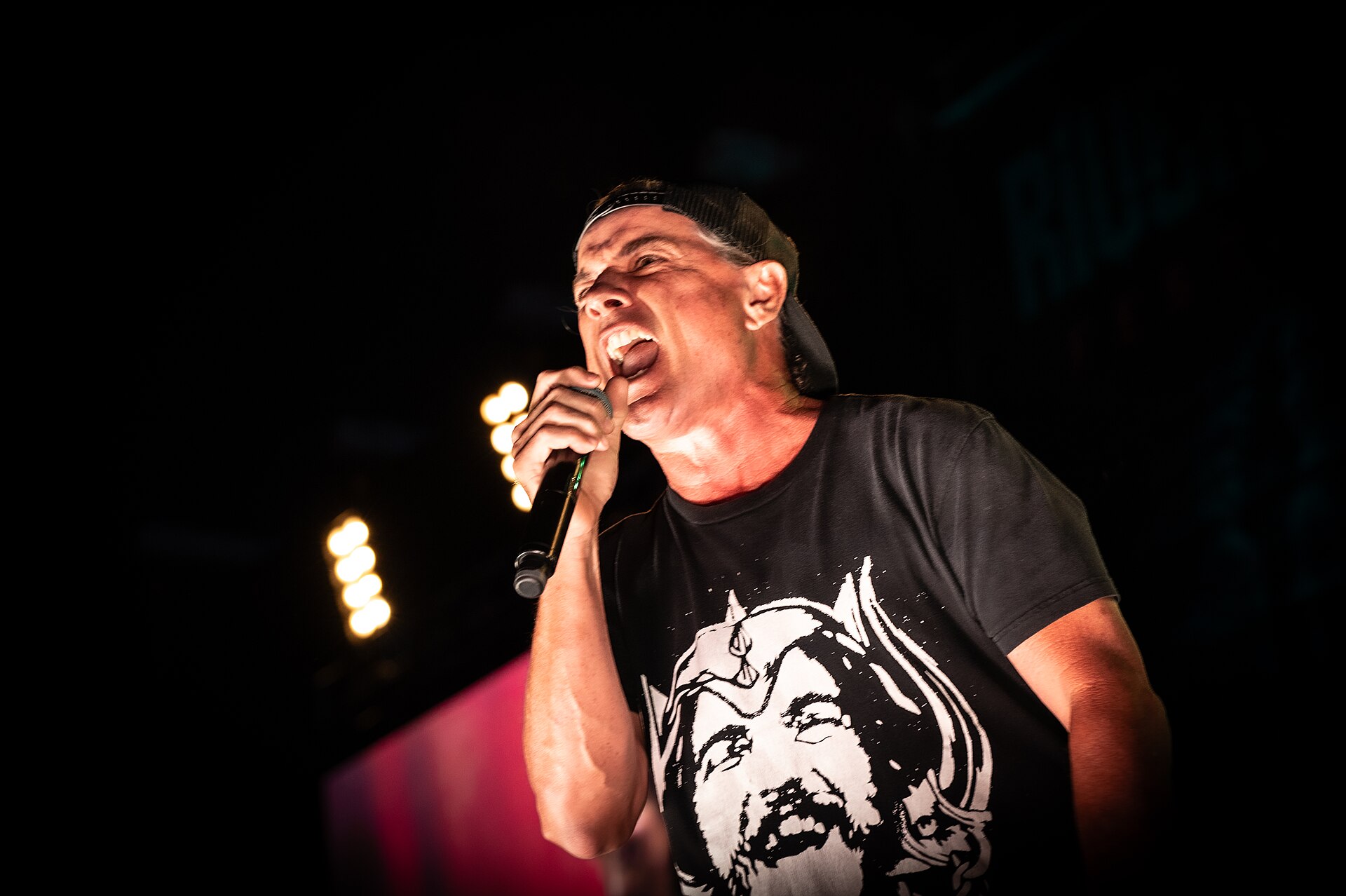
Photo: Dario De Marco — Wikimedia Commons, public domain (Whitfield Crane, Ugly Kid Joe, Riverside Festival, Aarburg 2024)
How 'Cat's in the Cradle' Got Handed Down: Chapin, Cash, Ugly Kid Joe and DMC
A song about a father who never passes anything on has been passed on flawlessly for fifty years: folk to country to metal to hip-hop to sitcom shorthand. The lyric describes a broken relay. The song is a working one.
The words weren’t his
Start with the credit line, because everything else hangs off it.
The lyric to “Cat’s in the Cradle” began as a poem by Sandy Chapin, Harry Chapin’s wife. Two things set it off, and she laid both out in the Chapin family’s own newsletter, Circle (Behind the Song). The first was another family’s silence: her first husband, James Cashmore, and his father John Cashmore, Brooklyn Borough President for 21 years (Wikipedia), barely spoke. Sandy: “During dinner, my father-in-law would speak to his son through me… I just thought it was the most incredible thing I’d ever seen.” The second was a country song she heard on the radio about how fast childhood goes: “That song put me in the mood for writing a lyric.”
Which country song? Nobody knows. It isn’t identified in the Circle piece, in the Wikipedia article, or anywhere else I could find. Fifty years of Chapin scholarship and the ignition source is still anonymous. If you know it, come find me.
Harry’s first reaction was a shrug. Sandy again: “He came home and I showed him the poem, and he sort of brushed it aside.” About a year after their son Josh was born, he changed his mind: “Hey, this is great; I’m going to put some music to it.” When Elektra picked it as the lead single, Sandy called the ceiling: “That song will only appeal to 45-year-old men, and they don’t buy records.”
It went to #1 on the Billboard Hot 100 in December 1974, the only #1 of his career (Wikipedia). It landed on Verities & Balderdash (Elektra, August 1974) and went out as a single that October 1. Grammy nomination for Best Male Pop Vocal in 1975, Grammy Hall of Fame in 2011, 2× Platinum from the RIAA.
And Sandy is on the tracklist. She’s credited as co-writer on the original 1974 Elektra release, and the song’s credit reads “Harry Chapin and Sandra Chapin” (Verities & Balderdash, Wikipedia). The words were hers on paper from day one. The story just never travelled with the credit. For decades the song was filed under “man sings about his own failures as a father,” when the man was singing his wife’s poem about a different family’s dinner table.
The prophecy that closed
Harry knew what he was holding. On Soundstage in 1975 he told the audience the song was about his son Josh: “and frankly, this song scares me to death” (ReMIND Magazine).
He was working about 200 concerts a year, roughly half of them benefits (Colgate Magazine), the hunger work that became WhyHunger and, later, the Harry Chapin Foundation. On July 16, 1981 he died in a crash on the Long Island Expressway, on his way to another show. He was 38. July 2026 marked 45 years.
His kids have talked about it with more grace than the song allows. Jen Chapin, on CBS Sunday Morning: “That was time we didn’t have.” Jason Chapin points to the reading most people miss in the last verse: the grown son isn’t cold, he’s busy with his own kids, being a good dad. The chain in the lyric is a scheduling problem inherited whole, replication rather than cruelty, which is why the line everyone quotes back is “just like me.”
Cash first, then the metal kids
Most retellings skip a leg: Johnny Cash got there before the alt-rock guys. “Cat’s in the Cradle” is track 2 on Boom Chicka Boom (Mercury, January 22, 1990), out as a single that June (Wikipedia), two years ahead of the version most people mean when they say “the cover.”
That one is Ugly Kid Joe’s, and the band has always been blunt about how it got there. Whitfield Crane, quoted in Survival of the Fittest: Heavy Metal in the 1990s (via Songfacts): “We didn’t have enough songs to fill the record… Just as a filler, really.” It went on America’s Least Wanted (Stardog/Mercury, 1992), a Texas station started spinning it unprompted, and per Crane “it went #1 immediately” on that station. The single followed on February 21, 1993: #6 Hot 100, #1 in Australia, Gold in the US. It was the biggest hit of their career, from the track that was there to pad the runtime. They also dropped the apostrophe, which is either a typo or a statement.
The “filler” framing has been complicating itself lately. In the 2025 documentary, Crane talks about his own alcoholic father (BraveWords). Set that next to what he told Songfacts about why the cover landed: “that song really affected people the same way Harry Chapin’s original version affected me.” That is a different answer from “we needed a track.” The filler was personal; the band just didn’t lead with it in 1992.
Small footnote for the connection-hunters: Cash’s Boom Chicka Boom was Mercury, and America’s Least Wanted came out on Stardog/Mercury two years later. Same label family, same song, back to back. Nobody has documented anyone at Mercury noticing, but it’s a hell of a coincidence.
Third genre, third generation
In 2006, Darryl “DMC” McDaniels of Run-DMC built “Just Like Me” on it, with Sarah McLachlan singing the Chapin part (Songfacts, WhoSampled).
The backstory is the reason it works. McDaniels learned around age 35 that he was adopted; McLachlan’s “Angel” is what he credits with pulling him out of a suicidal stretch (Billboard). During the sessions the two discovered they were both adopted. Chapin’s family site has him on record about finding the song, “Thank you universe, that’s the one”, and about Chapin the humanitarian after Jam Master Jay was killed: “I thought, ‘I need to do what Harry Chapin did’” (Circle).
He’d remembered it from childhood. He took the refrain about a boy growing up just like his father and turned it into an adoption record thirty-two years later, with the same phrase now meaning the opposite.
When one bar is the whole argument
By 2010 the song had stopped needing to be played in full. In The Office S6E19, “St. Patrick’s Day,” Dwight cues up “Cat’s in the Cradle” loudly at Jim, a new father just back from paternity leave, after a speech about how he and Mose never saw their own fathers (Wikipedia). The petty part is that it works: Jim wishes he were home. (Which version Dwight queues isn’t named in any source I could find, so I won’t tell you.) The Middle and BoJack Horseman have both reached for it; a 1993 Northern Ireland anti-violence PSA used it to frame family neglect.
That afterlife is now a film of its own: Harry Chapin, Cat’s in the Cradle: The Song That Changed Our Lives, directed by Rick Korn, premiered in New York on October 30, 2025 and out on DVD and digital November 4, 2025 (Shore Fire, amNewYork). Crane and McDaniels are both in it, alongside Billy Joel, Pat Benatar, Judy Collins and Dee Snider; Rolling Stone’s review confirms the film runs the Cash, Ugly Kid Joe and McDaniels versions (via Yahoo). Jason Chapin co-produced. Proceeds go to WhyHunger, Long Island Cares and the Harry Chapin Foundation, which in February 2026 took in a $250,000 estate gift, the largest in its 45 years (Foundation news). The song still funds the work.
Korn’s line about it: “What makes this song so amazing is the multi-generational and multi-cultural effect it has on people around the world even to this day.”
The chain letter
Halestorm’s “Dear Daughter”, the last piece in this little series, is an open letter, written to be handed to someone. “Cat’s in the Cradle” hands itself down, which is the joke and the horror of it. Folk 1974, country 1990, metal 1993, hip-hop 2006, sitcom shorthand 2010, documentary 2025. Every carrier picked it up because it had already happened to them, which makes inherited a better word for it than covered.
And both songs in this series were ghostwritten by the family. Lzzy Hale wrote “Dear Daughter” out of a question a journalist asked her; Harry Chapin sang his wife’s poem about another man’s father and told a room in 1975 that it was about himself.
Ugly Kid Joe, for the record, are back out on the road on August 20, 2026 in Bensalem, PA, through Rocklahoma and into mid-September, with a new album in progress that reportedly features K.K. Downing and that Klaus Eichstadt says is heavier than Rad Wings of Destiny (Blabbermouth). The band that got famous off a folk ballad about a dad is making its most metal record.
Which leaves the third letter in the chain, and it’s the reply: Ozzy and Kelly Osbourne’s 2003 “Changes,” a father-daughter rewrite of a song about a man losing everyone. That’s the trilogy: open letter, chain letter, answered letter. If you’ve got a better candidate for the reply, tell me on X or Threads at @realrocklab.
In this web: Ugly Kid Joe · Run Dmc · Halestorm · Harry Chapin · Johnny Cash · Sarah Mclachlan · Lzzy Hale