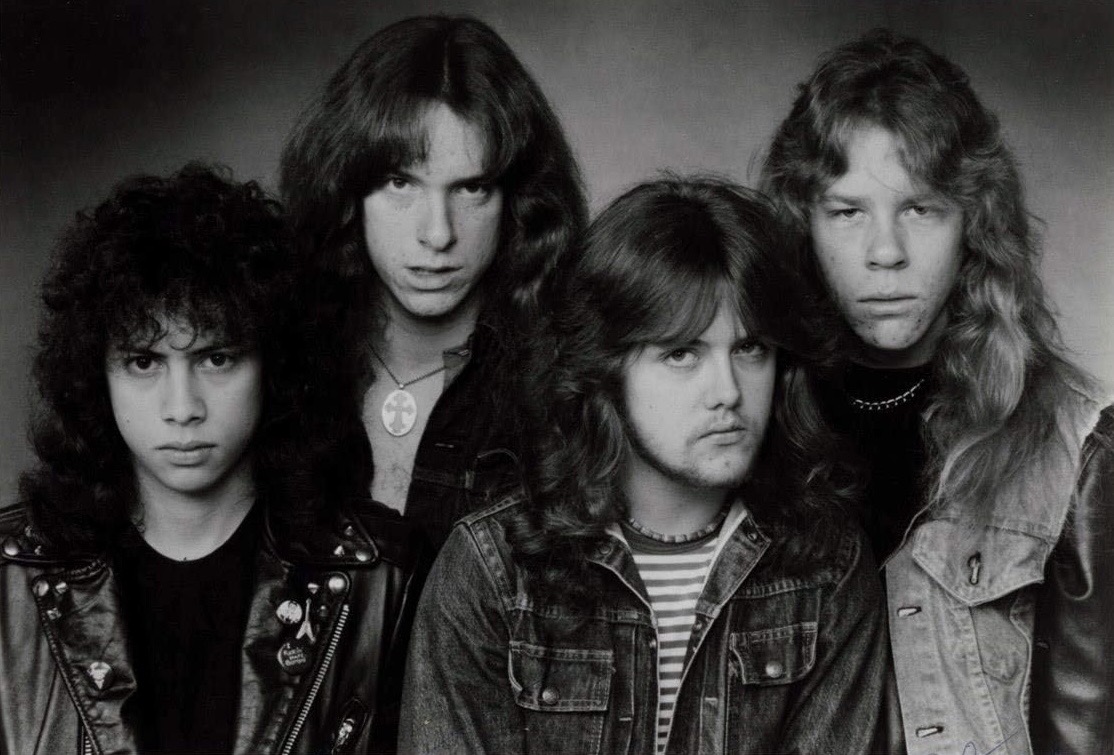
Foto: Distributed by Megaforce Records — Public domain, via Wikimedia Commons
Forty years without Cliff Burton: the card draw in Sweden, and the two bass players who came after
On 27 September 1986 a bus went off the road near Dörarp, Sweden, and Metallica lost its bass player at 24. Four decades later the fan argument is still Jason Newsted versus Robert Trujillo, which has never been the actual question.
The night before
The band was on the European leg of the Damage, Inc. tour, out behind Master of Puppets, riding a bus between Stockholm and Copenhagen. On the night of 26 September, Cliff Burton and Kirk Hammett drew cards to decide who picked a bunk first. Burton pulled the ace of spades and took the one Hammett had been sleeping in.
“I said fine, take my bunk. I’ll sleep up front; it’s probably better anyway,” Hammett told VH1’s Behind the Music, via Ultimate Classic Rock.
Shortly before seven in the morning the bus swerved, left the road and went over on its side. Burton was thrown through a window and the bus landed on him. He was 24.
The driver told the authorities he had lost control on a patch of black ice. That is the driver’s account, and it is the one that got repeated for forty years. Members of Metallica have publicly disputed it, saying there was no ice on the road. Nobody reading this needs the cause settled to understand the rest, and the honest version is that it is not settled.
Six weeks
Jason Newsted joined in October 1986. His first show with Metallica was on 8 November 1986 at the Country Club in Reseda, California, per Ultimate Classic Rock. That was six weeks after the crash, in a band that had just buried its friend and had a tour to finish.
He had seen what he was replacing. Talking to Heavy Consequence on 27 September 2026, forty years to the day, Newsted described watching Burton play live in 1985: “Maybe if I try really hard, I could be a tenth of as good as that… intimidating as fuck.” And on the ease of it: “Just wake up 10 minutes out of bed and play as good as I could after working for five hours.”
That is the man who took the job. Then the band spent years making him pay for it.
The paper trail
From here it stops being about grief and starts being documented, which is the part that interests us. You do not have to take anyone’s word for how Newsted was treated. It is printed.
On The $5.98 E.P.: Garage Days Re-Revisited, the 1987 covers record that was his first release with the band, the sleeve credits him as “Master J. Newkid”. Metal Injection has him walking through the hazing years later. He was already talking about it at the time: a 1986 video interview surfaced by Louder has a baby-faced Newsted, weeks into the gig, describing the “sense of abuse” that came with being the new guy.
Then came …And Justice for All in 1988, his first full album, where his bass is effectively inaudible in the mix. The fan mythology says sabotage. Newsted’s own explanation is colder than that: “There was nobody there to work parts out with… It was just ‘record your bass’ and that’s that.” He was isolated in the process, and the record sounds like it.
James Hetfield gave the reason years afterward, in Louder: “All our grief and sadness got directed at him.”
A sleeve credit, a mix, and a frontman saying out loud that a band aimed its mourning at the wrong person. Newsted left in January 2001, after fourteen years and three months.
The clock nobody watched
Robert Trujillo joined in 2003. He is now past twenty-three years in the band.
Run the arithmetic: Burton had roughly four years, from late 1982 to September 1986. Newsted had fourteen years and three months. Together, a bit over eighteen years. Trujillo passed their combined total somewhere around the middle of 2021, and as far as I can tell nobody marked the date.
That nobody marked it tells you the argument was never about tenure. Loudwire ran a head-to-head poll (Newsted or Trujillo, pick one) back in November 2024, and the same fight restarts in comment sections every anniversary. Time served is not the variable, and neither is technique. The two of them are being measured against a 24-year-old who has been dead for forty years and who gets more flawless in memory every year, which is a contest structured so that the living cannot win it. Newsted knew the terms going in; that is what “a tenth of as good as that” means.
Castro Valley, before any of it
The connection that makes this more than an obituary runs backwards from the crash.
Before Trauma, before Metallica, Burton was in a high school band in Castro Valley called EZ-Street, playing UFO and Aerosmith covers. The guitarist was Jim Martin. The drummer was Mike Bordin. Both of them ended up in Faith No More: Bordin behind the kit for the whole run, Martin on guitar through The Real Thing and Angel Dust.
So the Bay Area thrash record collection and the Bay Area funk-metal record collection start, partly, in the same garage. Bordin left EZ-Street around 1981 after friction with Martin; Burton and Martin kept going as Agents of Misfortune while at Chabot College in Hayward, entering a Battle of the Bands there in 1981. There is tape of that band somewhere, and Burton on it is already recognisably Burton.
And the name sticks around. In February 2026, Castro Valley held Cliff Burton Day at the Chabot Theater, with Bordin on the bill alongside members of the Damage, Inc. road crew. KSHE 95 has the details. Forty years on, the drummer from the high school band is the one who shows up to tell the stories, in a theatre carrying the same name as the college where Burton’s next band played a Battle of the Bands.
What I want next
The bass seat is the most-argued chair in Metallica and the best-documented one, and the part of the record that stays thin is the beginning. EZ-Street exists mostly in recollection: what I would like to see are photographs and setlists. Somebody in Castro Valley has a flyer from a school gig in 1979 or 1980 with three names on it, two of which ended up in Faith No More and one of which ended up on Master of Puppets.
If you have that flyer, or a tape, or you were at the Chabot College Battle of the Bands in 1981, come find us at @realrocklab on Threads or @realrocklab on X. I keep coming up empty on the EZ-Street photos.
The thread to pull next is Jim Martin, who is the quieter half of this connection: he was at Burton’s funeral, he carried that friendship into a band that sounded nothing like Metallica, and Angel Dust came out three years before Faith No More let him go. What happens to a guitar player who is the last link to a story everyone else tells about somebody else?
In this web: Metallica · Faith No More · Cliff Burton · Kirk Hammett · Mike Bordin