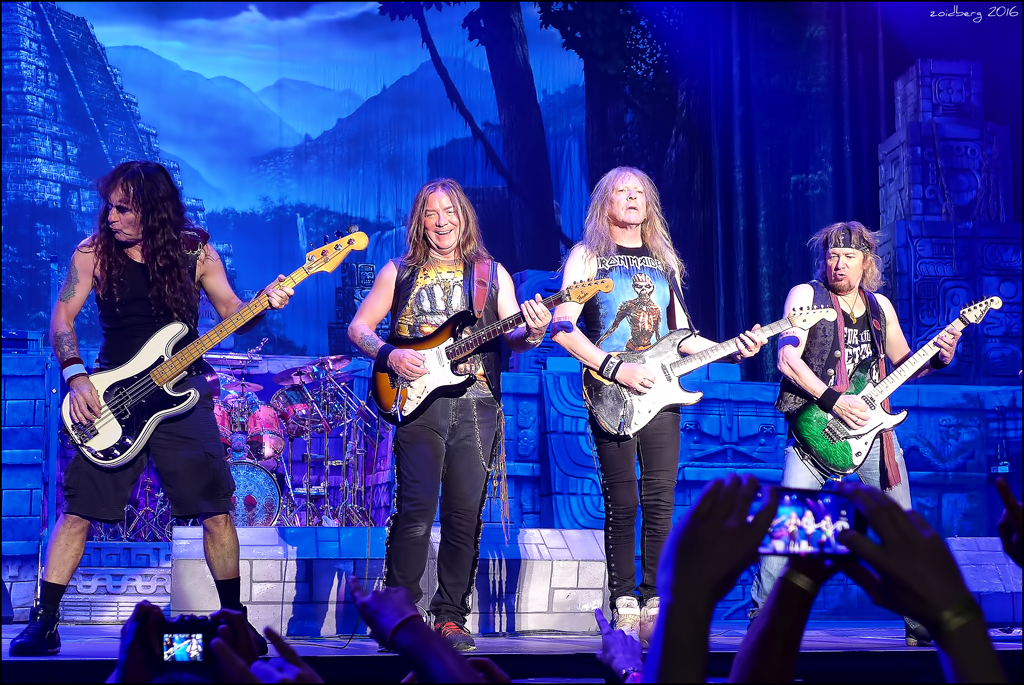
Photo: dr_zoidberg — Wikimedia Commons, CC BY-SA 2.0 (Iron Maiden, Madrid, 13 Jul 2016)
Fear of the Dark: How Iron Maiden's Audience Rewrote the Song
The most famous vocal hook in “Fear of the Dark” isn’t on the album. A crowd wrote it, and one crowd in particular, 250,000 strong in Rio, made it permanent.
Play the studio version. Something’s missing.
Put on the studio cut of “Fear of the Dark”, title track and closer of Iron Maiden’s ninth album, released May 11, 1992. Great song: moody intro, a gallop in the middle, that circling guitar melody. But if you’ve only ever heard it live, or watched any concert footage from the last three decades, you’ll notice a hole where something should be.
The “ooooh” is missing. The wordless crowd vocal that shadows the guitar melody, the part everyone in the building sings and the part that is the song for most fans, doesn’t exist on the record. Steve Harris wrote the track alone (credits here), and he didn’t write that part. Nobody in the band did; the audience did. That’s the story: a song whose definitive arrangement was composed, collectively and uncredited, by the people in front of the stage.
The rewrite happened fast
The popular version of this story says the Rock in Rio 2001 crowd invented the singalong. They didn’t invent it. They canonized it, and the invention had happened years earlier.
The crowd vocal shows up almost immediately after the album came out. Iron Maiden released a live version as a single on March 1, 1993, pulled from A Real Live One, recordings from the 1992 tour, months after the studio album. It went to #8 on the UK singles chart, within a year of release. The live version got further as a single than the song ever did as a studio artifact, because audiences had already added something the band couldn’t put there themselves.
So by 1993 the rewrite was underway. What it didn’t have yet was a definitive recording.
Rio, January 19, 2001
Last night of the Brave New World Tour. Rock in Rio 3, around 250,000 people, the second-largest crowd Iron Maiden ever played to. When “Fear of the Dark” hits, the Brazilian audience sings the melody loud enough to work as a lead instrument, in tune and in time: a quarter-million voices carrying a part that appears on no official studio recording.
The band released it on the Rock in Rio live album in 2002, and that performance, rather than the 1992 studio take or the 1993 single, became the reference version, the one where the crowd is essentially a band member. YouTube reaction videos to that footage still orbit the same sentence: this crowd is legendary.
So the timeline runs like this: the audience rewrote the song between 1992 and 1993, and a Brazilian audience made the rewrite official in 2001.
The origin story the band can’t agree on
There’s a second layer, the kind of thing we love at the Lab: the song’s own origin has two competing versions, held by two members of the same band.
The version you’ve probably heard, the one Bruce Dickinson told from stages for years, is that Steve Harris genuinely fears the dark and the song is that fear set to music. It’s tidy: the bass player who wrote “The Number of the Beast” is scared of the lights going out.
Harris’s own account is better. In an interview, he pushed back on the fear story: the inspiration was his house, a medieval property in Essex dating to around the 1400s, the kind of place with six centuries of creaks, which genuinely spooked his kids. His punchline, roughly: the scariest thing in that house was him.
So the singer tells the mythic version and the writer tells the domestic one: a dad in a very old house, watching his children get scared of hallways. The song became an arena ritual about collective darkness, and it started as creaky floorboards in Essex.
The song outlived its own era
One more connection, because 1992 was a strange moment to write a future setlist immortal. Fear of the Dark was the last Iron Maiden album before Bruce Dickinson left. He announced his exit in 1993 and played his final show on August 28, 1993 at Pinewood Studios for the BBC, later released as Raising Hell (Loudwire has the full timeline). He wouldn’t return until 1999.
The album that closed the classic Bruce era produced the song that refused to stay in it. Blaze Bayley sang it through the mid-90s, and Bruce reclaimed it after the reunion. The crowd part survived every lineup because it never belonged to a singer, so it can’t leave the band.
Where the song is right now
The song is on stage this year. The Run For Your Lives tour, built for Maiden’s 50th anniversary, draws only from the first nine albums, which means the catalog cuts off exactly at Fear of the Dark. And the title track is sitting in the encore on the 2026 European dates (setlist.fm receipts).
Bruce, meanwhile, spent late July doing the least Iron Maiden thing possible: on July 23 he jumped on stage at a Comic-Con party in San Diego to sing “All the Young Dudes” with The Coverups, Billie Joe Armstrong’s covers band (Stereogum’s writeup). He was in town for his Mandrake Project comic. His own review of the cameo, via Blabbermouth: “preserved on YouTube in all its awful, awful splendor.”
Someone that relaxed about an unrehearsed bar-band moment understands that some of music’s best material is unscripted, and he fronts the biggest example in metal every night.
In October the tour lands in Brazil: São Paulo October 25 (sold out), an extra São Paulo date October 27, Curitiba October 28, with Alter Bridge opening (dates). The country whose crowd turned a singalong into the song’s official arrangement gets to perform its own composition again, 25 years later.
The thread to pull
“Fear of the Dark” is the cleanest case of an audience rewriting a song into a new canonical form, and it isn’t the only one. Live arrangements harden into “the real version” more often than studio purists admit: chants migrate from terrace culture into setlists, call-and-response sections get grandfathered into official live albums. That’s the Lab question we’ll dig into next: when a crowd adds a part and the band keeps it, who’s actually doing the arranging?
Got a candidate, a song where the live version overwrote the record? Bring it to @realrocklab on X or Threads.
In this web: Iron Maiden · Steve Harris · Bruce Dickinson