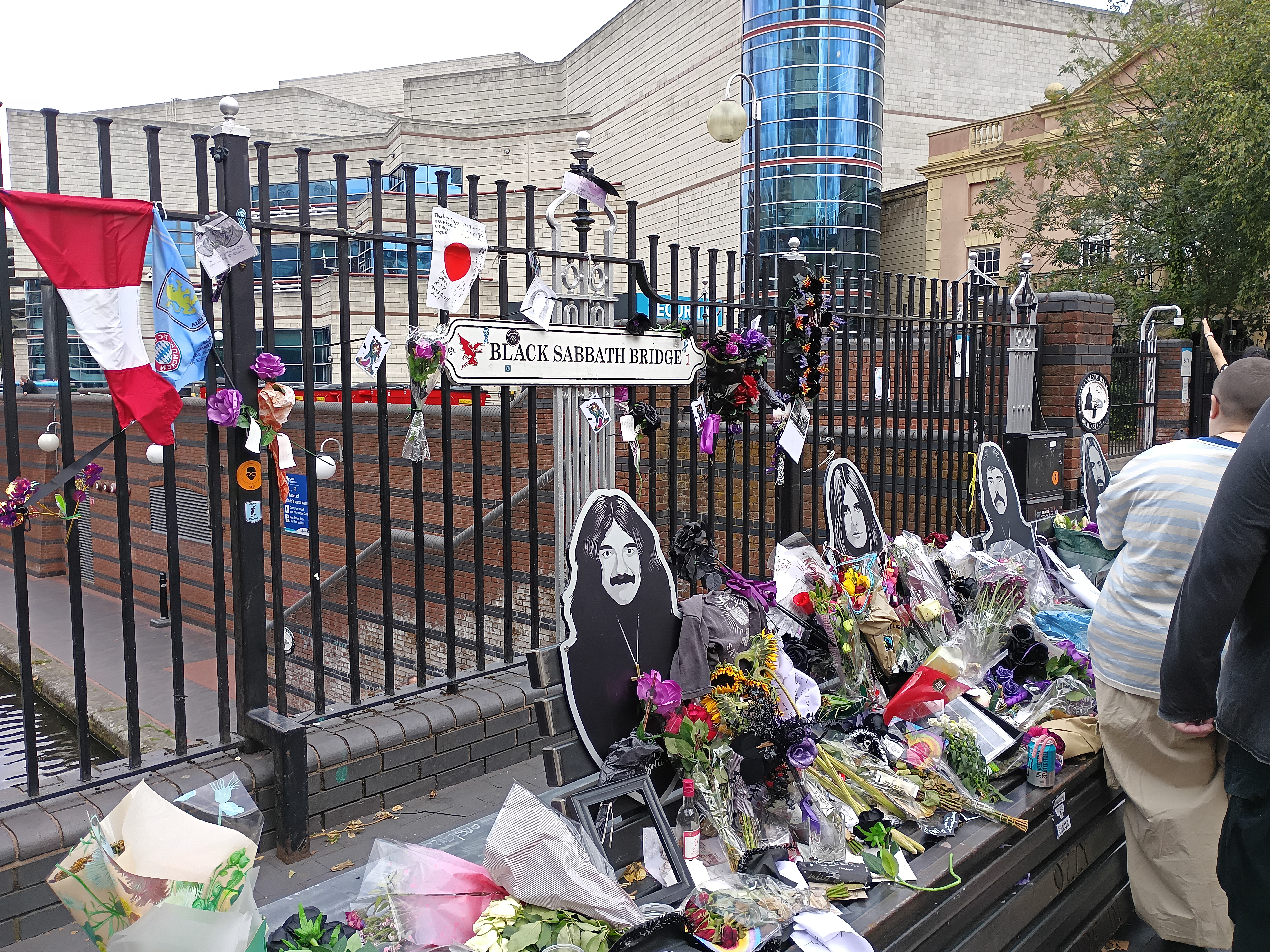
Foto: Fatih Renkligil — CC BY-SA 4.0, via Wikimedia Commons
Deep Purple split in 1973 — and grew back as four bands
Ian Gillan says “outside influences” broke Mark II. Ritchie Blackmore says two alpha males who couldn’t share a room. Neither version explains the stranger part: what the wreckage built.
Five guys in a van in 1968. By 1980, if you had a rock station on, you were hearing Rainbow, Whitesnake, Black Sabbath and Deep Purple in the same hour — and the people in those four bands had mostly stopped speaking to each other. One argument, four discographies.
Ian Gillan gave his version of the argument this June, sitting down with drummer Ian Paice on the Rockonteurs podcast. It’s the version of a man who has answered this question for fifty years.
Gillan’s account: the van got crowded
“You start off and there’s like five guys in a van, and with your gear in the back, and then you expand a bit,” Gillan told host Gary Kemp. Then, he says, it changes shape: “all of a sudden, your party’s expanded by personal relationships, and then the outside influences don’t gel quite as well.”
Outside influences. Managers, partners, the entourage that arrives when a band stops being five people and becomes a business. He also names the musical fork: “Ritchie, I think, was going towards what became Rainbow in terms of song construction.”
Then the line that makes the whole interview worth playing: he calls himself “as much to blame as anyone, probably more than anyone.” He’s told this story enough times to have worn the edges off it.
Blackmore’s account: two alphas, one room
Ritchie Blackmore has never framed it as logistics. Guitar Player revisited his account from The Ritchie Blackmore Story in August, and it is blunter:
“He was, as they say, an alpha guy. So was I. He wanted to control, I wanted to control. So we butted heads because of that.”
And: “We still respected each other, but we never got on. We just couldn’t be in the same room.”
Here’s the thing — neither man contradicts the other. Gillan describes the pressure system; Blackmore describes what the pressure did to two specific people inside it. Same story, two skulls. And the interesting part isn’t who was right. It’s what the debris did next.
The mechanics of the break, in order
Gillan handed in his resignation in June 1973, on a US tour, with a leaving date of 30 June. The last Mark II show was in Japan — Osaka, Kōsei Nenkin Kaikan, 29 June 1973, according to the purple.de tour archive (some sources claim a Cardiff date in July; the tour archive and setlist.fm list nothing after Osaka). Bassist Roger Glover was pushed out shortly after, at Blackmore’s insistence.
The replacements arrived fast and from nowhere. David Coverdale was 21, working a boutique in Redcar, when he read in Melody Maker that Deep Purple wanted a singer. He mailed in a tape and a photo of himself as a boy scout, with a note: “dear Deep Purple, as you can see, I’m always prepared!” Ian Paice pulled it off the pile. Glenn Hughes came in the other door — Blackmore, Jon Lord and Paice caught him playing the Whisky a Go Go with Trapeze in April 1973 and hired him to play bass and sing.
Mark III’s Burn went to No. 3 in the UK and No. 9 in the US in February 1974. It worked. And then the guitarist did something worth reading slowly.
Blackmore recorded the next band before he left this one
Ritchie Blackmore’s Rainbow was cut at Musicland in Munich between 20 February and 14 March 1975. Blackmore announced he was leaving Deep Purple on 26 March 1975, in Munich. His last show with the band was 7 April, at the Palais des Sports in Paris.
Read the order of those dates again. The Rainbow album existed on tape while Deep Purple still thought it had a guitarist. Four of the five musicians on it came from Elf, including a singer named Ronnie James Dio.
Deep Purple made one more record with Tommy Bolin on guitar, Come Taste the Band, and folded on 15 March 1976 at the Liverpool Empire. Bolin was dead of an overdose by December, aged 25. The band was over. The tree was just starting.
The tree
Blackmore’s branch. Rainbow with Dio, 1975. Dio leaves in 1979 when Blackmore wants something more commercial than swords and rainbows — and lands in Black Sabbath, where Heaven and Hell arrives on 18 April 1980. Graham Bonnet, then Joe Lynn Turner, follow him at the Rainbow microphone.
Coverdale’s branch. After Deep Purple folded in March 1976, Coverdale made two solo records and then formed Whitesnake, first show 3 March 1978 at Lincoln Technical College. Jon Lord joined during the Trouble sessions that same year. Ian Paice joined before Lovehunter in 1979. Which means that by 1979 Whitesnake contained three-fifths of Deep Purple Mark III — and nobody called it Deep Purple. In 1987 the self-titled album sold over eight million copies in the US alone and put “Here I Go Again” at No. 1 on the Hot 100, with “Is This Love” right behind it at No. 2.
Gillan’s branch. The Ian Gillan Band (jazz-rock, commercially a wall), then Gillan (Mr. Universe, Glory Road), then — on 6 April 1983 — an announcement that Ian Gillan was the new singer of Black Sabbath, for Born Again. He was replacing Dio. Who had come from Rainbow. Which was Blackmore’s.
Hughes’ branch. Black Sabbath’s Seventh Star, released January 1986, was built as a Tony Iommi solo record and got a Black Sabbath logo stamped on it by the label. Hughes sang it. Later: Hughes/Thrall, the Tony Iommi Band, Black Country Communion.
Add it up: three of Black Sabbath’s post-Ozzy singers — Dio, Gillan, Hughes — came out of this one argument.
The knots nobody points at
Two details close loops that most retellings leave hanging.
Roger Glover, fired in 1973 because Blackmore wanted him gone, became Rainbow’s bassist, producer and lyricist from 1979 — working for the man who had him sacked. And Joe Lynn Turner, Rainbow’s singer, became Deep Purple’s singer on Slaves and Masters in 1990, after Gillan was fired. Gillan came back in 1992; Turner was out.
Meanwhile the original knot got tied again. Mark II reconvened in Vermont in April 1984 and made Perfect Strangers — No. 5 in the UK, No. 17 on the Billboard 200. Gillan’s memory of those rehearsals: “It was just like being at Hanwell in 1969. It was fantastic.” It held for nine years. Blackmore played his last show with them in Helsinki on 17 November 1993, and left. Steve Morse held the guitar chair from 1994 to July 2022; Simon McBride has it now. Jon Lord died in July 2012.
And then, in August, the whole thing came back around
On 12 August 2026, at the Jones Beach Theater in Wantagh, New York, Ritchie Blackmore walked onstage with Deep Purple for the first time in 33 years and played “Smoke on the Water” to close the set. He is 81. Gillan, Glover and Paice were standing there — the other three men from Mark II.
Gillan introduced him by reading out how it happened: “I got a letter from this man saying, ‘I only live around the corner. Do you mind if I come and jam with you?’”
Blackmore told Guitar Player he woke up the day before the show with the idea. He asked; Gillan’s answer, relayed by Blackmore, was three words: “It made me smile.”
Then: “I wasn’t there to be playing correct notes. I was there to see old friends.” And: “I was there to heal any wounds — but there weren’t any wounds.” And, quieter: “I think we realized it could be the last time we see each other, maybe.”
The thread to pull next
Fifty-three years and roughly forty albums separate the argument from the encore, and the thing that fascinates me isn’t the reconciliation — it’s the productivity of the fight. Deep Purple didn’t dissolve in 1973. It reproduced.
Which raises a question I don’t have a clean answer to yet: does this happen anywhere else at this scale? The obvious rival is the Yardbirds, who gave up Eric Clapton, Jeff Beck and Jimmy Page and, through Page, Led Zeppelin — but that’s a band splitting into careers, not a band that kept regenerating for two decades while its own offspring competed with it on the same radio. Whitesnake outsold Deep Purple. Rainbow outsold Deep Purple for a while. Black Sabbath hired two of its singers.
If you can name a family tree with more branches from one 1973 argument, tell us — @realrocklab on Threads or X. I’ll take the bait.
Sources: Ian Gillan and Ian Paice on the Rockonteurs podcast (20 June 2026), via Ultimate Classic Rock · Guitar Player — Blackmore on why Deep Purple couldn’t survive · Guitar Player — exclusive on the Jones Beach reunion (Gary Graff, 15 Aug 2026) · Blabbermouth · Rolling Stone · purple.de Mark II tour archive
In this web: Black Sabbath · Whitesnake · Deep Purple · Led Zeppelin · Ian Gillan · Ritchie Blackmore · David Coverdale · Glenn Hughes · Ronnie James Dio