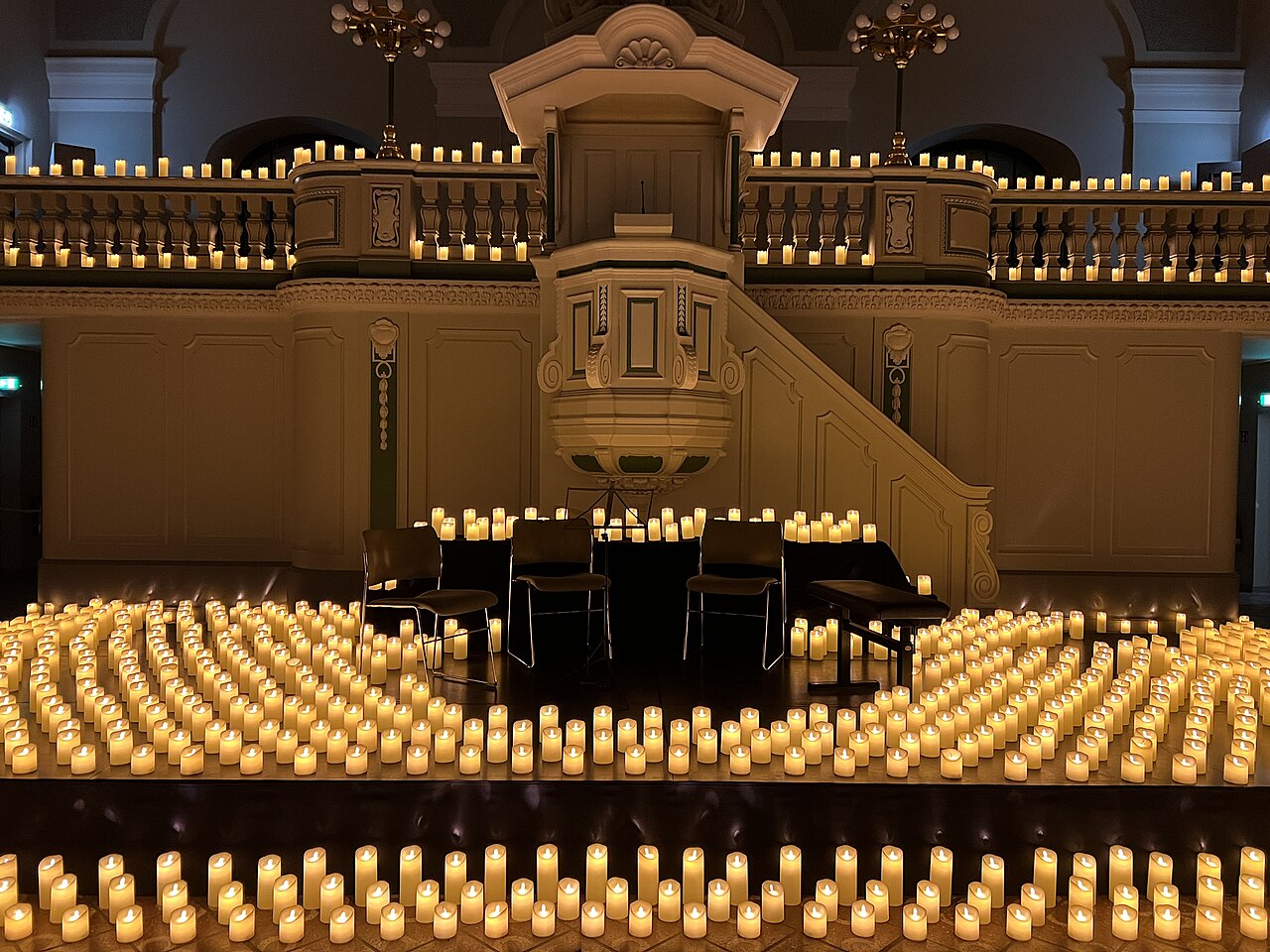
Candlelight concert at the Französische Friedrichstadtkirche, Berlin, 2026 — photo: Lukas Beck, CC BY 4.0, via Wikimedia Commons
System of a Down, by Candlelight: How Brazil's Museums Became Metal Venues
Fever’s Candlelight series is running an unprecedented rock and metal program across São Paulo, Rio, and Belo Horizonte in late 2026: System of a Down by string quartet, under the concrete span of MASP. The interesting question is why it works so well.
Picture the room for a second
A string ensemble, hundreds of flickering (LED, but still) candles, an audience sitting in respectful concert silence inside one of Brazil’s great cultural landmarks. Then the cellist digs into the opening riff of “Chop Suey!”
That’s not a hypothetical. Candlelight, Fever’s global series of candlelit tribute concerts, usually staged in museums, theaters, and churches, has assembled the heaviest program it has ever run in Brazil. Across the second half of 2026, its three Brazilian cities are hosting tributes to System of a Down, Metallica, Rush, Linkin Park, Pink Floyd, and Queen, plus recurring rock-anthem nights. System of a Down alone gets dates in all three cities, a coordinated national run for one of the heaviest catalogs Candlelight touches anywhere.
Metal has fully arrived at the candlelit chapel. And there’s a real music argument hiding under the candles.
What survives when you strip the distortion
These concerts answer a lab question: take away the wall of amps, the drums, the scream, and what’s left?
Composition is what’s left. And the catalogs Fever picked for Brazil are, almost suspiciously, the ones where the composition was doing the heavy lifting all along.
System of a Down is the clearest case. Daron Malakian has talked about growing up on Armenian, Arabic, and Greek music, and so much of the band’s melodic material leans on that folk tradition: ornamented, keening lines that lived for centuries on instruments like the duduk (the Armenian double-reed that sounds like a voice grieving) before they ever touched a drop-C guitar. Strip “Aerials” or “Toxicity” down to strings and you’re translating the music back. Those melodies sit more naturally on a bowed instrument than almost anything else in the nu-metal era.
Rush is the other giveaway. A trio writing through-composed, multi-movement pieces (music that keeps developing instead of cycling a verse-chorus loop) in shifting odd meters, beats that refuse to count in fours, where every part is load-bearing and nobody is just strumming: that’s a description of a chamber ensemble. Rush was chamber music with amps for forty years. A string arrangement of “YYZ” or “La Villa Strangiato” is the genre label finally catching up to the writing.
Metallica ran this experiment on themselves. S&M, recorded in April 1999 with the San Francisco Symphony under arranger-conductor Michael Kamen, is the record that legitimized the orchestra-metal crossover for a mainstream audience. Before that, Apocalyptica had already proven in 1996 that four cellos could carry Plays Metallica by Four Cellos as a serious record, not a gag. The classical-metal bridge is old and well-trafficked; Candlelight just put candles on it.
The gateway runs in both directions
The usual framing for these concerts is one-directional: classical music “elevating” rock, or rock “dumbed down” for a wine-and-cheese crowd. Both framings miss what happens in the room.
Candlelight’s core audience is people who buy tickets to experiences, the museum-night crowd, many of whom would never walk into a metal show. For them, this is the trojan horse: they come for the candlelit aesthetic and leave having genuinely absorbed forty minutes of System of a Down’s songwriting. Some fraction of them will go look up the originals. That’s new rock listeners, manufactured at scale.
But flip it around. These shows also put metalheads, people who own the shirt and have seen the band live, into a seated, silent, acoustic listening context, often for the first time in their lives. Sitting in front of a string quartet with nothing to do but listen is its own gateway drug. Some fraction of that crowd walks out curious about what else strings can do.
That’s an audience-crossover machine running in both directions at once. It’s rarer than it sounds, and it’s why this series keeps expanding into heavier catalogs: the mechanism works on both sides of the aisle.
The venues are half the story
It matters that these aren’t club shows. In São Paulo, the rock program runs at MASP, the Museu de Arte de São Paulo, Lina Bo Bardi’s brutalist landmark suspended over Avenida Paulista. In Rio, dates split between the Solar de Botafogo, a restored early-1900s manor turned cultural center, and the Museu do Amanhã, Santiago Calatrava’s sci-fi museum on the waterfront (which, for a Pink Floyd tribute, is almost too on-the-nose). Belo Horizonte gets the Teatro SESIMINAS.
Playing “Master of Puppets” in rooms like these does something a festival can’t: it reframes the material as repertoire, canon, the kind of music that belongs in a museum, in the good sense.
The dates, if you’re in Brazil
The essentials, in one place. Shows run about 60 minutes; tickets start around R$35 to R$89 depending on city and seating.
- System of a Down tribute: São Paulo (MASP), Jul 23, Aug 27, Oct 11 · Rio (Solar de Botafogo), Aug 8, Aug 21, Oct 31 · Belo Horizonte (Teatro SESIMINAS), Sep 6
- Tribute to Metallica: Rio (Solar de Botafogo), Nov 28
- Tribute to Rush: São Paulo (MASP), Aug 20 and Nov 6
- Linkin Park tribute: dates in all three cities across H2
- Tribute to Queen: São Paulo (Theatro São Pedro), Jul 24
- Tribute to Pink Floyd: Rio (Museu do Amanhã), Aug 8 and Oct 10
- Rock Classics: São Paulo (MASP), from Jul 9, recurring monthly · 80s Rock Anthems nights also in rotation
Dates shift and sell out; check the city hubs below before planning around any of these.
Lab question: which catalog shouldn’t survive this?
The candlelight treatment flatters catalogs built on melody, harmony, and structure; System of a Down, Rush, Queen, and Pink Floyd all pass easily. But some of the greatest rock ever made lives entirely in texture: the specific sound of a specific amp in a specific room. What does a string quartet do with early Stooges, where the composition is three chords and the entire artwork is the violence of the performance? With Motörhead, where the writing is deliberately simple and the meaning is the roar?
If the acoustic-translation test separates composition-bands from texture-bands, that’s a taxonomy, not a ranking. And it cuts straight through the middle of the metal canon in ways that might surprise you. That’s a future piece. Meanwhile: if a string quartet plays “Ace of Spades” in a museum, is it still “Ace of Spades”?
Sources
In this web: System of a Down · Metallica · Rush