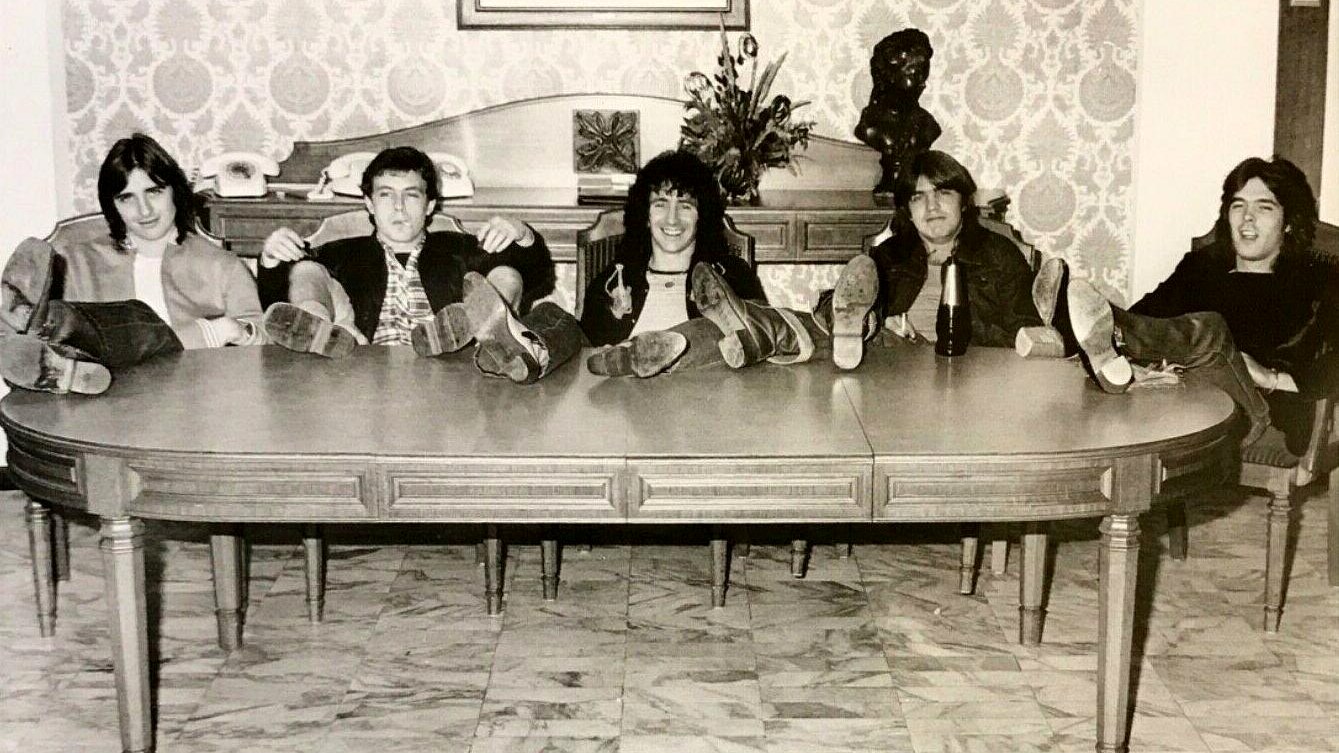
AC/DC, 1977 — Atco Records publicity photo for Let There Be Rock (public domain, via Wikimedia Commons)
Bon Scott at 80: The 1973 Geordie Gig That Secretly Connected AC/DC's Two Eras
Bon Scott would have turned 80 on July 9. The best way to honor him skips the highlight reel and goes back to the night in 1973 when he watched Brian Johnson scream himself off a stage, filed it away, and accidentally wrote the ending of his own band’s story seven years early.
The myth we’re here to break
There’s a version of AC/DC history everyone carries around: two bands, cleanly split. The Bon Scott era, sweaty, sly and dangerous, and the Brian Johnson era, the stadium machine that made Back in Black. Before and after, original and replacement.
It’s a tidy story. It’s also wrong, and Bon himself is the proof.
Years before AC/DC needed a new singer, before AC/DC even existed in the form we know, Bon Scott stood in a crowd in England, watched a singer from Newcastle collapse mid-song, and thought it was the greatest thing he’d ever seen. That singer was Brian Johnson. Bon told the story to the Young brothers for years afterward, and when the worst happened in February 1980, that story is what they reached for.
The two eras of AC/DC are one system, and Bon wired the connection himself. This one is a proper web.
Stop one: Fraternity, the band before the band
Rewind to the early seventies. Bon Scott, born Ronald Belford Scott in Forfar, Scotland, on July 9, 1946, and raised in Australia from age six, is not yet the shirtless bagpipe-toting menace of rock legend. He’s a working singer grinding through the Australian circuit: drummer in The Spektors, pop frontman in The Valentines, and by 1970, vocalist in Fraternity, an Adelaide-based band chasing a heavier, proggier, more “serious” sound.
The part nobody dwells on is that Fraternity were good enough to win things. They took out Hoadley’s Battle of the Sounds, Australia’s big national band competition, in 1971, beating Sherbet no less, and the prize (a trip to London, plus prize money) bankrolled a relocation to the UK. So off they went, chasing the same dream every Australian band chased: crack England, crack the world.
England, famously, did not crack. Fraternity, who by then had rebranded as Fang, which tells you how the strategy meetings were going, spent their UK stint broke and cold, playing support slots on other people’s bills for bands with actual hits.
One of those bands was Geordie.
Stop two: the night Brian Johnson’s appendix changed rock history
Geordie were Newcastle’s shot at the glam-stomp moment: big riffs, bigger choruses, and a hit on their hands with “All Because of You,” which hit #6 in the UK in 1973. Out front was a flat-capped bruiser named Brian Johnson with a voice like a firework in a phone box.
In April 1973, at Torquay Town Hall, Fraternity/Fang landed on a bill supporting Geordie. Bon Scott, 26 years old, stood in the wings or out in the crowd, watching the headliner.
And the headliner was having a night. As the story goes, and Angus Young has told it many times over the years, Johnson ended the set on the floor of the stage, screaming, kicking, writhing, giving what looked like the most unhinged, committed rock performance Bon had ever witnessed. Bon was floored. This was how you fronted a band. Total abandon.
Johnson himself confirmed in later interviews that he wasn’t performing. He was having an appendicitis attack, and he got through the set flat on his back because he physically couldn’t stand. As Angus Young tells it, “they came in and wheeled the guy off” at the end.
Bon didn’t know that. He just saw a man apparently willing to die for a song, and he never forgot it.
Stop three: Bon joins AC/DC carrying the story with him
Fast-forward to late 1974. Fraternity has fizzled, Bon is back in Adelaide recovering from a serious motorcycle crash, and he gets introduced to a young Sydney band called AC/DC, initially hanging around as a driver and helper before it became obvious to everyone that the guy chauffeuring the band could sing the doors off their current frontman. By October 1974 he’d replaced Dave Evans, and the classic run begins: High Voltage, T.N.T., Dirty Deeds Done Dirt Cheap, Let There Be Blood on the Tracks (no, sorry, Let There Be Rock), Powerage, and in 1979 the breakthrough, Highway to Hell.
And through all of it, Bon kept telling the Geordie story. Angus and Malcolm Young have both recalled Bon raving about this singer he’d seen in England, the guy who screamed on the floor, the best frontman he’d ever watched. Bon Scott, one of the most singular vocalists in rock history, spent years telling his own band about another singer, and he told it as a fan. That’s the DJ instinct: when you hear something great, you point at it. He was, without knowing it, leaving his band a forwarding address.
Stop four: February 1980, and the memory does its job
Bon Scott died in London on February 19, 1980, at 33. The band nearly ended right there. By most accounts it was Bon’s own father, Chick Scott, who told the Youngs at the funeral to keep going.
So they started auditioning singers, and somewhere in that grim process someone remembered the story of the screamer from Geordie, Bon’s guy.
By this point Brian Johnson had left the music-industry fast lane entirely and was back in Newcastle running a vinyl car-roof and windscreen business. He came down to audition and sang Ike & Tina Turner’s “Nutbush City Limits” and then, in a detail almost too on-the-nose, “Whole Lotta Rosie.” A Bon song. He got the job within days.
Five months later, recorded at Compass Point in the Bahamas with producer Mutt Lange, the same man who’d produced Highway to Hell, AC/DC released Back in Black on July 25, 1980. The cover is black for mourning, bells toll on track one, and it became one of the best-selling albums ever made, every note of it a tribute.
Why this is one system, not two eras
Look at what actually connects across the supposed dividing line:
- The singer. Brian Johnson was Bon’s recommendation, delivered years in advance and activated by grief.
- The producer. Mutt Lange bridges Highway to Hell and Back in Black. The sonic blueprint carries over into 1980 and sharpens.
- The material. Back in Black is an album-length answer to Bon, made by people processing his death in the only language they had.
The “two AC/DCs” framing treats Bon’s death as a wall. The band followed Bon’s taste more than it replaced him. The last A&R decision of Bon Scott’s career was made in a crowd in 1973, watching a man scream through a burst appendix. Happy 80th, Bon. You called it.
The thread to pull next
That name in the middle of the bridge, Mutt Lange, deserves his own episode. The producer who carried AC/DC across their darkest moment also connects them to a genuinely absurd web: Highway to Hell to Back in Black to Foreigner’s 4 to Def Leppard’s Pyromania and Hysteria, and eventually all the way to Shania Twain’s Come On Over, which means the loudest album about mourning in rock history and “Man! I Feel Like a Woman!” share DNA. Same ears and the same obsessive perfectionism in wildly different rooms.
How does one producer’s fingerprint survive that much genre travel? That’s the next experiment in the lab.
In this web: AC/DC · Geordie · Bon Scott · Brian Johnson