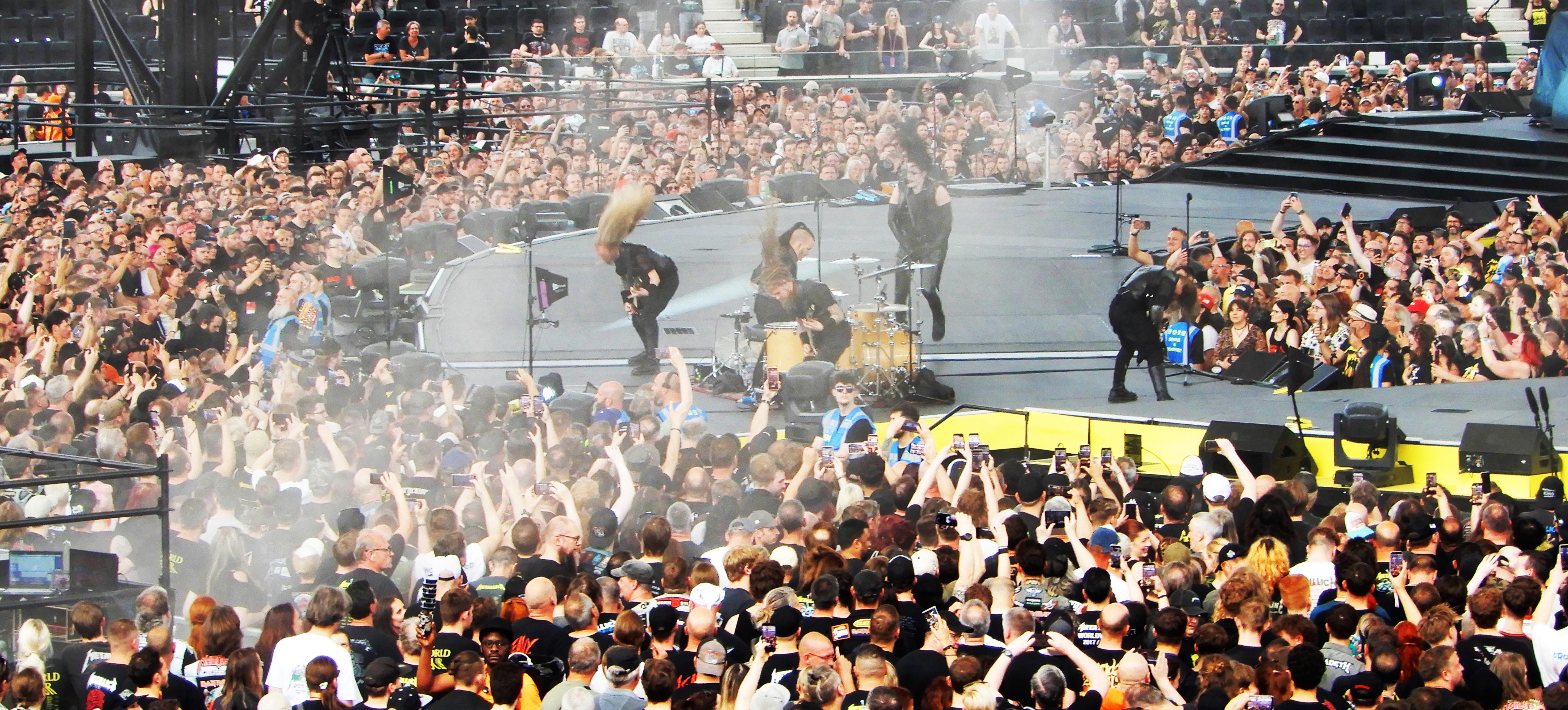
Foto: Antoine TILLY — CC BY-SA 4.0, via Wikimedia Commons
Andy Wallace mixed Nevermind because he had made Slayer records: the producer chain behind six weeks of 1991
Between 12 August and 24 September 1991, five albums arrived that rearranged what rock radio sounded like. The thread nobody pulls runs through the people at the mixing desk, and it starts on a thrash record from 1986.
The six weeks, in order
Start with the calendar, because the calendar is the part people misremember.
Metallica released the self-titled album everyone calls the Black Album on 12 August 1991. Pearl Jam released Ten on 27 August. Guns N’ Roses put out Use Your Illusion I and II on the same day, 17 September. And on 24 September, a Tuesday, Nirvana’s Nevermind and Red Hot Chili Peppers’ Blood Sugar Sex Magik both landed (1991 in music).
Six weeks, start to finish. Whether that reshuffled rock or just happened to be a busy autumn is an argument about interpretation. The sequence itself is on the record.
One correction to the story as it usually gets told: 24 September 1991 was not a two-album day. A Tribe Called Quest released The Low End Theory the same date, and Pixies released Trompe le Monde in the US on 24 September, a day after the UK release (1991 in music; Trompe le Monde). That makes four records on the date, not two. The shared Tuesday is still remarkable. It just has more people in it than the anniversary posts admit.
The name on the back cover
Nevermind was produced by Butch Vig, who also engineered it, recorded at Sound City between May and June 1991 (Nevermind). That much is in every 35th-anniversary retrospective. Vig himself has been talking about it: “It was a zeitgeist moment for me, making that album… It changed my life,” he told rock107.
What the retrospectives skip: the band did not like the first mixes. Neither did Vig. DGC handed them a list of names to mix the record instead, and Kurt Cobain picked Andy Wallace off that list (Nevermind).
Wallace’s credential, the one that made Nirvana say yes, was Slayer. Krist Novoselic put it plainly: “We said, ‘Right on,’ because those Slayer records were so heavy” (Nevermind).
So the record that dragged the American underground onto daytime radio was signed off by a man hired on thrash credentials. The link is who was in the room, and it says nothing about the two records sounding alike.
Which Slayer record, exactly
This is where I have to be careful, because the tidy version of this story is a step further than the sources go.
Wallace engineered Reign in Blood, released 20 October 1986, produced by Rick Rubin (Reign in Blood). That is solid. It is also the Slayer record everybody reaches for when they want to make this point.
But the documented reason Nirvana wanted Wallace is “those Slayer records,” plural, and the album most often named in that context is Seasons in the Abyss from 1990, not Reign in Blood (Nevermind). What DGC handed Cobain was a name attached to a body of work that sounded heavy, and Reign in Blood is inside that body of work.
Wallace came out of Slayer sessions, including the most consequential one, and that is why Nirvana wanted him. Saying Reign in Blood specifically got him the gig is inventing a nice sentence the paper trail does not support.
What Rubin and Wallace actually did in 1986
Reign in Blood is worth describing, because the thing people remember about it is exactly what Wallace brought forward.
Rubin stripped the reverb off on purpose. Kerry King said the result was “way more threatening,” and Rubin explained the intent this way: “I didn’t want it to be a blur of bass; I wanted it to be a pulse” (Reign in Blood).
That is the whole trick, in plain words: no echo, nothing washed out, everything sitting in the front of the speaker with sharp edges, loud but dry. It is the record MTV later called “directly responsible for the rise of death metal” (Reign in Blood).
Now go put on Nevermind. It is a different band in a different decade, with different songs, and it is also nothing like a mud puddle. Everything is in front of you and legible at high volume.
Cobain eventually turned on it. He described the finished mix as “closer to a Mötley Crüe record than it is a punk rock record” (Nevermind). Which is a complaint, and also a fairly precise description of what a loud, clean, radio-proof mix does to a punk band.
It did not explode on day one
One more thing the anniversary coverage flattens.
Nevermind entered the Billboard 200 at number 144. It did not reach number one until 11 January 1992, when it knocked Michael Jackson’s Dangerous off the top, selling roughly 300,000 copies a week by then (Nevermind).
So the famous Tuesday was a release date. The moment came almost four months later, after radio and MTV had chewed on “Smells Like Teen Spirit” through the autumn, and the gap between the two is where the interesting work happened.
Worth noting, since the question comes up at every anniversary: no 35th-anniversary reissue has been announced. The most recent official expansion is still the 30th-anniversary Super Deluxe from 2021. What is happening is independent, like the free anniversary event at Technique Records in Miami on 23 September 2026 (Miami New Times).
The thread to pull next
The Wallace story is one strand of a bigger pattern that runs straight through those six weeks: the people who made the loudest records of 1991 mostly learned their craft somewhere the audience for those records was not looking.
Rubin was making rap records at Def Jam before he made a thrash landmark (mixdown: Rick Rubin). Wallace was cutting metal before he was handed the album that defined a scene built partly in opposition to metal. The boundaries that fans police so carefully turn out to be almost invisible from the other side of the glass.
So pull the sleeve of a favourite record from that stretch and read the small print on the back. If the mix or production credit is a name you did not expect, we want it: @realrocklab on Threads or X.
Sources: 1991 in music · Nevermind · Reign in Blood · Trompe le Monde · rock107: Butch Vig on 35 years · mixdown: Rick Rubin · Miami New Times
In this web: Metallica · Pearl Jam · Guns N Roses · Nirvana · Red Hot Chili Peppers · Pixies · Slayer · Kurt Cobain · Rick Rubin