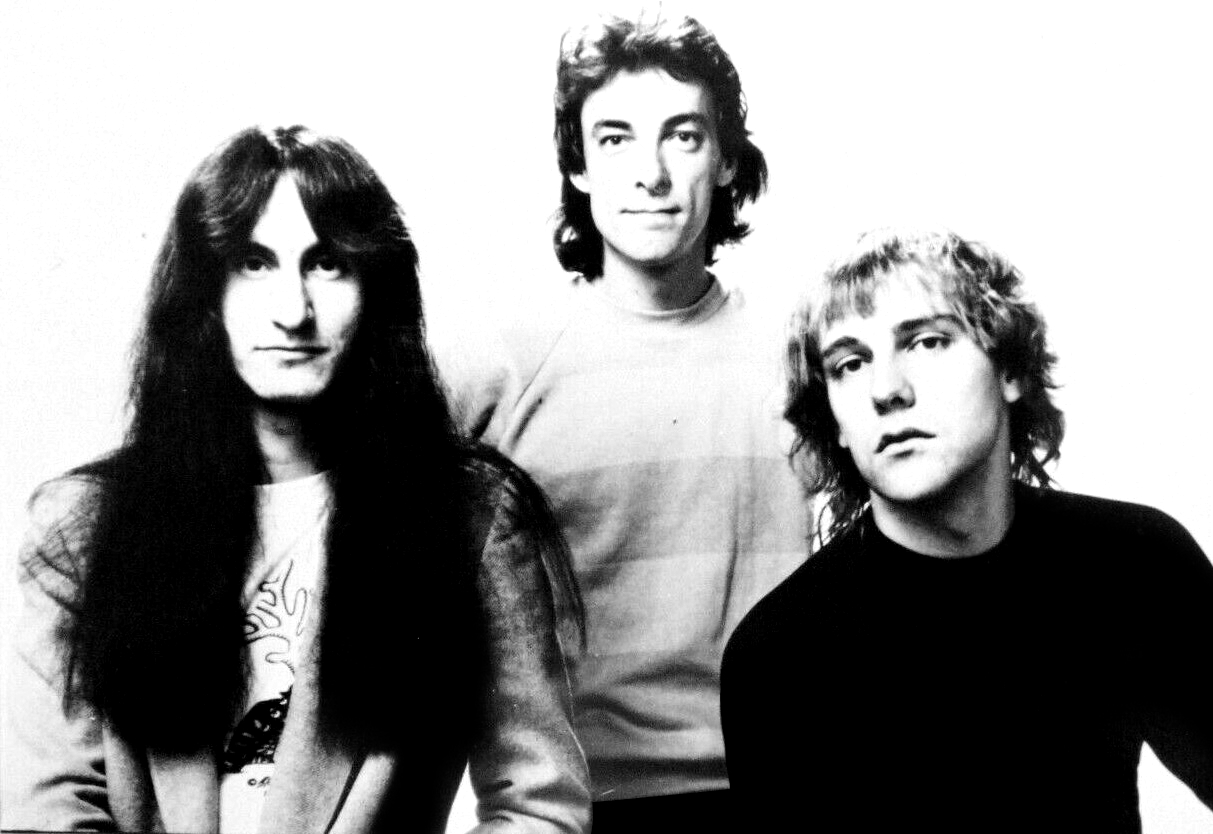
Foto: PolyGram, promotional press photo of Rush, 1970s — Public domain, via Wikimedia Commons
2112 at 50: How Rush Answered Mercury's Demand for a Hit Single With a 20-Minute Suite
In 1976, one album away from being dropped, Rush handed their label the least commercial thing they’d ever made, and side one of 2112 bought them the next four decades of doing whatever they wanted.
It’s late 1975, and Rush are playing smaller rooms than they were a year earlier. Their third album, Caress of Steel, has stiffed: two side-long suites, hostile reviews, shrinking crowds. The band’s own name for the supporting run tells you everything: the “Down the Tubes Tour.” Geddy Lee later told MOJO they joked about Neil Peart going back to selling farm equipment, and him and Alex Lifeson going back to painting movie theatres.
Mercury Records was seriously considering cutting them loose. Manager Ray Danniels talked the Chicago head office into one more album, and the label made it clear what it wanted: something shorter and more commercial, with a single on it.
So Rush went into Toronto Sound Studios in January 1976 with producer Terry Brown and, in about four weeks, cut a seven-part, 20-minute-and-34-second science-fiction suite about a future where priests control all music. It filled the entire first side.
Geddy’s version of the band’s thinking, from that same MOJO interview: “If we’re going to go out, we’ll go out doing our crazy shit, not failing at what you want us to be.”
That one sentence is the whole story of 2112, and everything after it is consequences.
The suite is about the band that made it
Read the plot of “2112” next to the situation Rush were in and it stops being sci-fi. The Priests of the Temples of Syrinx decide what music is permitted. A man finds a guitar, brings them something new, and gets told it doesn’t fit the plan. That’s a band with a label breathing down its neck, writing an allegory of the exact meeting they’d just walked out of, then putting it on the record the label demanded be commercial.
They weren’t subtle about the resentment, either. “Our record company Mercury had told us in no uncertain terms that we were a huge disappointment to them,” Geddy told MOJO. The album is the reply.
And the reply worked. 2112, released in spring 1976 (the exact date is contested: Mercury-era documentation says March, AllMusic says April 1), became the first Rush album to crack the Billboard 200’s top 100, reaching #61 in the US and #5 in Canada, per Wikipedia’s sourced chart data. It went gold by November 1977. From that point on, Mercury stopped telling Rush what kind of records to make. Without 2112 there is no Hemispheres, no Permanent Waves, no Moving Pictures. The insubordination was the purchase price of the entire catalogue that followed.
The wrinkle: the Ayn Rand credit
Fan histories tend to skip this part. Peart credited “the genius of Ayn Rand” in the liner notes (the suite’s plot loosely tracks her novella Anthem), and in 1978 it blew up on them. Barry Miles wrote an infamous NME piece painting the band as crypto-fascists. Geddy, whose parents survived the Holocaust, read the story as anti-totalitarian and took the accusation personally. “I wanted to punch the guy who wrote that,” he told MOJO. Peart spent the following decades distancing himself from Rand, eventually describing himself to Rolling Stone as a “bleeding-heart libertarian.”
Fifty years on, the honest reading is that a 23-year-old drummer grabbed the individual-versus-the-system framing from the book he’d just read, because he was living it. The credit aged badly. The story he told with it, that no institution gets to decide what music is allowed, aged perfectly.
The guy in the room who took notes
This connection doesn’t show up in the anniversary coverage.
The Mercury A&R man who signed Rush to their American deal was Cliff Burnstein. He was at the label while all of this played out: the flop, the ultimatum, the band betting on themselves and winning. His exact role in the one-more-album reprieve isn’t documented (the negotiation is credited to Danniels), so put it this way: the guy who signed them had a front-row seat to the most profitable act of label-defiance of the decade.
Burnstein then left Mercury, co-founded Q Prime with Peter Mensch, and managed Def Leppard and Metallica on a philosophy that, per Billboard’s history of the company, amounts to trusting the band’s instincts over the label’s. Metallica’s Master of Puppets went platinum with no single and no video. The line from 2112 to Master of Puppets runs through one person’s Rolodex.
One more name from the room: Hugh Syme, the art director who put the Starman (the naked man against the red star, Peart’s individual against the masses) on 2112’s back cover. Syme also played the Mellotron on “Tears,” which made him the first outside musician ever to appear on a Rush album, per Louder’s history of the covers and the “Tears” credits. The band that wrote a suite about creative self-sufficiency had its visual identity and a piece of its sound made by the same pair of hands, which seems fitting.
Fifty years on, the album is still climbing
This is the part that makes 2026 the right year to tell the story, because the anniversary is not a museum piece.
On August 7, the RIAA certified 2112 4× platinum. The previous certification was 3× platinum in November 1995, per Theprp. The record moved another million units across thirty-one years in which the band stopped touring, lost Neil Peart, and watched the album format itself nearly die. The suite the label said nobody would buy is still selling.
On October 2 comes the official 50th-anniversary reissue: black “liquid vinyl” in a die-cut sleeve, alongside the first-ever vinyl pressing of The Spirit of Radio: Greatest Hits 1974–1987, per Blabbermouth and uDiscoverMusic.
And Geddy and Alex are on the road again. The Fifty Something tour, the first Rush tour in eleven years, with German drummer Anika Nilles behind the kit, opened in June at the Kia Forum in Los Angeles, the same stage where the band played their final show with Peart in 2015, and has grown to 58 shows across 24 cities with over 500,000 tickets sold, per Blabbermouth and Metal Insider. The four sold-out Toronto homecoming nights at Scotiabank Arena in August were filmed in full for a possible concert film, directed by Geddy’s brother Allan Weinrib, per Exclaim!. That’s possible, not announced, so hold the confetti.
The thread to pull
The 2112 lesson gets quoted as “bet on yourself,” but that flattens it. The mechanism is narrower: the bet paid off because the thing they refused to compromise was specific, a sound only they could make, and because one label guy in the room turned the lesson into a management philosophy that shaped the next two decades of metal. Insubordination alone doesn’t build a career. Insubordination that someone powerful learns from does.
Which raises the question we want to chase next: Q Prime ran the trust-the-band playbook with Metallica on Master of Puppets, another breakthrough with no hit single. How much of that campaign was Burnstein consciously re-running 1976? We’re digging into it. If you’ve got sources (interviews where Burnstein connects the two), bring them to @realrocklab on X or Threads.
In this web: Rush · Def Leppard · Metallica · Geddy Lee · Neil Peart · Alex Lifeson · Cliff Burnstein